Introduction
Grasim Industries’ bold entry into the paints industry with Birla Opus in February 2024 shook up a market long dominated by Asian Paints. With a ₹10,000 crore investment and a 10% revenue market share by Q4 FY25, Grasim is no longer just a challenger—it’s a serious contender aiming for the #2 spot behind Asian Paints. Using Porter’s Five Forces Model, let’s revisit Grasim’s strategic move, analyze its impact 18 months later, and assess whether the paint sector remains a hot investment in 2025. I’ve dug into the financials and market dynamics to unpack this corporate showdown.
Grasim’s Progress and Market Positioning
Grasim’s Birla Opus has scaled rapidly, achieving ₹3,500 crore in revenue in Q4 FY25, securing a 10% revenue share in the organized decorative paints market. With five of six greenfield plants operational (1,096 million liters per annum capacity), Grasim’s aggressive push—backed by UltraTech Cement’s dealer network—has disrupted giants like Asian Paints (down 42.4% in Q2 FY25 net profit) and smaller players like Indigo Paints. The Indian paint industry, growing at a 10% CAGR (2x India’s 7% GDP growth), remains a battleground. But has Grasim’s gamble paid off, or are margin pressures and price wars dimming its shine?
Let’s break it down with Porter’s Five Forces.Porter’s Five Forces Analysis
Threat of New Entrants: High and Rising
Grasim’s entry, with 1.2M kiloliters capacity (30% of industry total), has lowered barriers for others. JSW Paints, a five-year player, is also chipping away at unorganized players (12-15% market share). New entrants face high capital costs (Grasim spent ₹9,352 crore by March 2025), but strong brands and dealer networks make disruption possible. Update: Grasim’s 2025 complaint against Asian Paints for anti-competitive practices signals a fierce fight to secure market footing.
Bargaining Power of Buyers: Moderate to High
Consumers benefit from price competition and more choices (Birla Opus offers 129 products, 900+ SKUs). However, Asian Paints’ 59% market share and brand loyalty keep buyers anchored, though Grasim’s premium offerings and lower prices are swaying contractors and retailers. Update: Rural demand, boosted by India’s 7% GDP growth, gives buyers more leverage as brands compete on price and quality.
Bargaining Power of Suppliers: Moderate
Rising raw material costs (e.g., titanium dioxide, crude oil-linked inputs) pressure suppliers, but Grasim’s scale and backward integration (like Asian Paints) reduce dependency. Smaller players like Akzo Nobel struggle more. Update: 2025’s crude oil volatility (post-Trump tariffs) has squeezed supplier margins, forcing competitive pricing.
Intensity of Competitive Rivalry: Very High
Grasim’s entry has sparked a price war, with Asian Paints’ Q2 FY25 profit dropping 42.4% due to weak demand and Grasim’s aggressive pricing. Berger Paints and Kansai Nerolac are fighting to hold their 20% and 15% shares, while Grasim eyes Berger’s #2 spot. Update: Grasim’s 50,000+ dealer network and marketing blitz (e.g., painter rewards) have intensified rivalry, with EBITDA margins shrinking across the board.
Threat of Substitutes: Low to Moderate
Substitutes like wallpapers or textured coatings remain niche due to cost and durability concerns. However, price-sensitive consumers in tier-2/3 markets may explore unorganized brands as Grasim and JSW erode their share. Update: Birla Opus’s eco-friendly paints align with 2025’s sustainability trend, reducing substitute appeal.
Margin Risks and Competitive Strategies
Grasim’s ₹9,352 crore capex (94% of planned) has fueled growth but hurt margins, with Q1 FY25 reporting a standalone loss of ₹521.2 million due to paint business costs. Asian Paints’ 1.67M touchpoints and Berger’s loyalty programs counter Grasim’s dealer incentives and e-commerce pilot. Price wars, reminiscent of HUL-Colgate battles, could persist into 2026, especially with crude oil price spikes impacting costs. Update: Grasim’s Q4 FY25 paints revenue shows promise, but profitability lags as it prioritizes market share over margins.
Current Market Share (Estimated, June 2025)
Based on Q4 FY25 data and industry trends:
| Company | Current Market Share | Previous Market Share |
|---|---|---|
| Asian Paints | 55% | 59% |
| Grasim (Birla Opus) | 10% | New Entrant |
| Berger Paints | 18% | 20% |
| Kansai Nerolac | 14% | 15% |
| Akzo Nobel India | 5% | 6% |
Graphical representation of the above table:
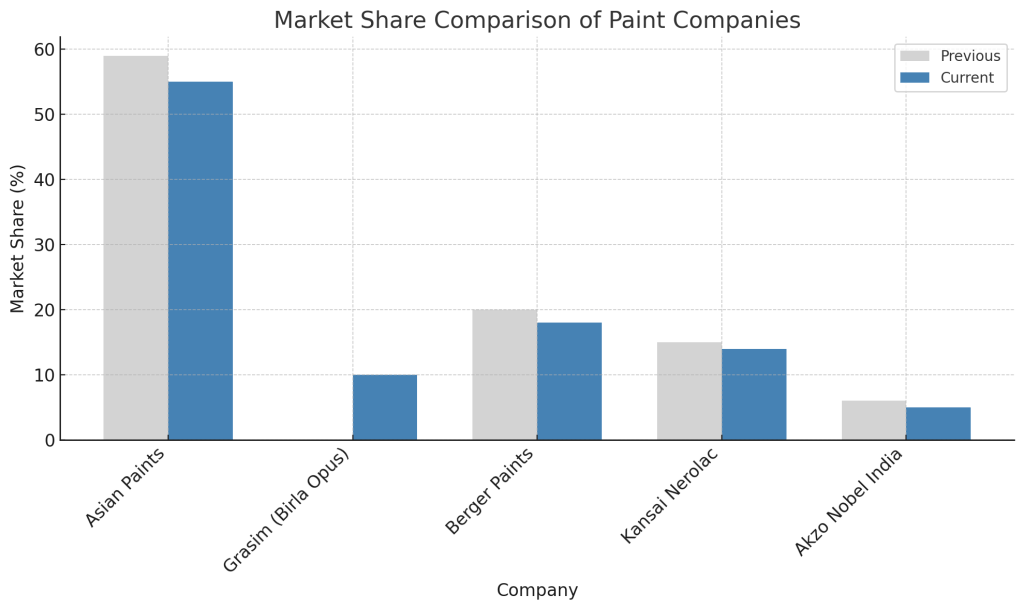
Source: Adapted from Q4 FY25 reports and industry estimates. Grasim’s 10% share, gained in under 18 months, signals its threat to Berger and Kansai. Asian Paints’ dominance is slipping but remains formidable.
Fundamentals of Top Players (June 2025)
| Company | Mkt Cap (₹ Cr) | CMP (₹) | PE | ROCE % | ROE % | DY % | EPS (₹) |
|---|---|---|---|---|---|---|---|
| Asian Paints | 2,33,000 | 2,437.95 | 45.0 | 32.5 | 25.0 | 0.95 | 54.00 |
| Berger Paints | 60,000 | 515.00 | 50.0 | 22.0 | 19.0 | 0.50 | 10.30 |
| Kansai Nerolac | 22,000 | 272.00 | 34.0 | 13.5 | 10.0 | 0.65 | 8.00 |
| Akzo Nobel India | 11,000 | 2,400.00 | 27.0 | 33.0 | 25.0 | 2.50 | 88.90 |
| Indigo Paints | 6,000 | 1,260.00 | 45.0 | 20.0 | 17.0 | 0.30 | 28.00 |
| Grasim (Paints)* | 1,81,274 (total) | 2,708.40 | 15.0 | 10.0 | 3.8 | 0.37 | 55.57 |
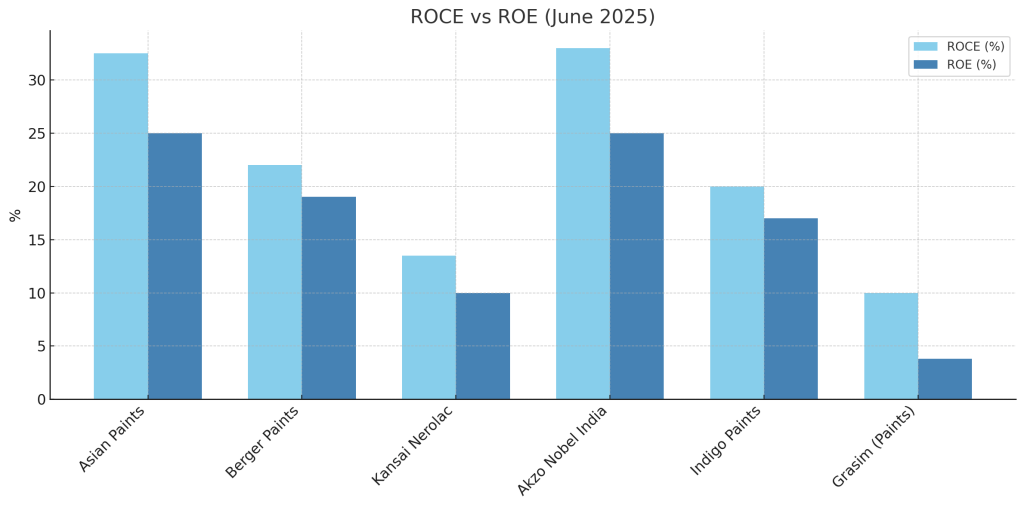
Note: Grasim’s market cap includes its diversified businesses, not just paints; paints segment PE estimated. Data updated from Q4 FY25 reports and market sources. Grasim’s paints segment, with a low PE of 15x, remains undervalued compared to Asian Paints’ 45x, signaling growth potential despite lower ROE due to heavy capex.
Here’s a visual comparison of ROCE vs ROE for the top paint companies as of June 2025. It highlights how well each company utilizes capital and equity.
Analytical Conclusion
Grasim’s Birla Opus has disrupted the paint industry, grabbing 10% market share and challenging Berger for #2. However, margin pressures (Q1 FY25 loss of ₹521.2M) and price wars (Asian Paints’ 42.4% profit drop) highlight risks. The industry’s 10% CAGR, driven by urbanization and sustainability trends, offers long-term upside. Investors should watch Grasim’s Q1 FY26 results for profitability signals and Asian Paints Wes and Berger for defensive moves. With my CA Final lens, I’d focus on Grasim’s cash flow resilience (debt-to-equity 1.88) and Birla Opus’s premium positioning as buying opportunities for long-term investors.
What’s your take? Is Grasim’s paint gamble a game-changer, or will Asian Paints hold its throne? Comment below!


Leave a Reply