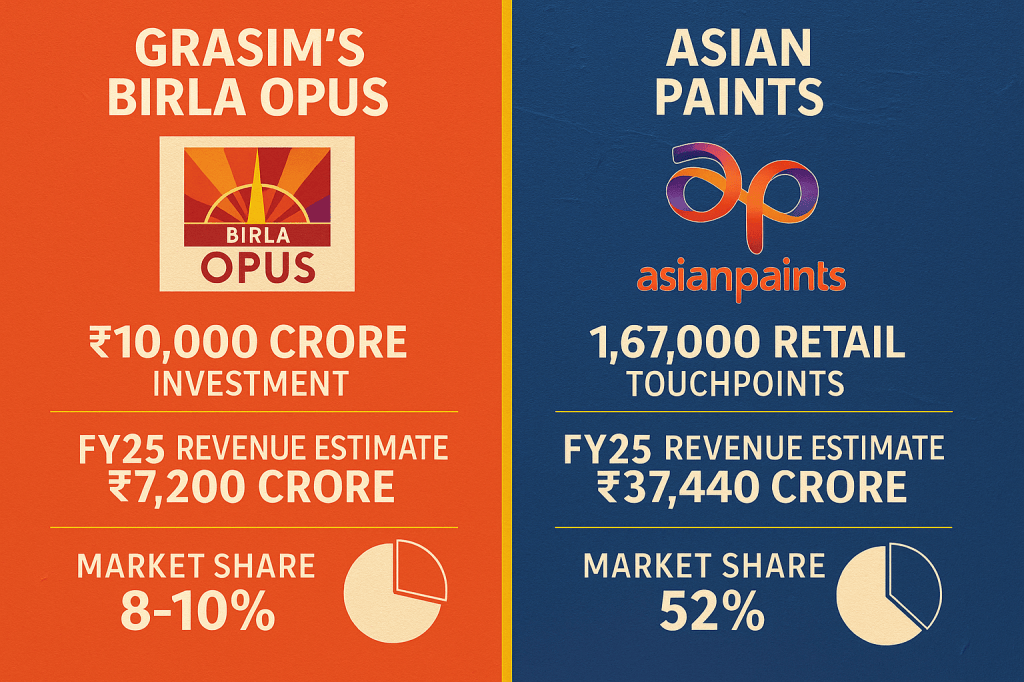
India’s ₹80,000 crore paint industry, projected (estimate) to grow at a 9-10% CAGR through 2030, is undergoing a seismic shift as Grasim Industries’ Birla Opus challenges the market leader, Asian Paints (42-54% decorative paints share), and incumbents like Berger Paints, Kansai Nerolac, and AkzoNobel. Grasim’s ₹10,000 crore investment, aggressive pricing, and rapid distribution expansion have intensified competition, forcing rivals to respond strategically. This article explores Grasim’s and Asian Paints’ strategies, financial projections (estimates) for FY25 and FY28, competitor responses, and market impacts.
Competitive Strategies
Grasim’s Birla Opus: Disruptive Ambition
Birla Opus, launched in February 2024, uses scale, pricing, and distribution to disrupt the market. Offering 176 products across 1,250 SKUs at 5-6% lower prices than Asian Paints, it targets cost-conscious consumers and contractors. Grasim leverages UltraTech Cement’s 54,000-dealer network to reach 50,000 outlets, aiming for 6,000 towns by FY25. Providing 55,000 free tinting machines and 2-3% higher dealer margins lures retailers from competitors. Its ₹10,000 crore investment supports 1,332 MLPA capacity across six plants, increasing industry supply by 40%. Heavy advertising and a complaint against Asian Paints for alleged anti-competitive practices underscore Grasim’s aggressive stance.
Asian Paints: Fortifying Dominance
Asian Paints leverages its 80-year legacy, 1,67,000 retail touchpoints, and 70,000+ tinting machines for color customization. Diversifying into home décor (Beautiful Homes Stores, White Teak acquisition) broadens revenue streams. Facing Grasim’s pricing, it’s increasing advertising and trade schemes to retain dealer loyalty, despite low reliance on top distributors (0.9% of revenue from top 10). Q2 FY25 saw a 42.4% profit drop to ₹694.64 crore due to weak demand and competition, prompting urban-focused strategies.
Financial Projections (Estimates)
Grasim Industries (Birla Opus)
- FY25 (Estimate): Grasim targets an 8-10% market share in the ₹72,000 crore decorative paints market, equating to ~₹7,200 crore in revenue (estimate), including Birla White Putty. Q1 FY25 reported a ₹52 crore loss due to paints costs, with ₹9,000 crore invested. Q4 FY25 showed 17.33% revenue growth to ₹44,267 crore, but annual net profit fell 21.85% to ₹7,756.33 crore. Operating losses are expected (estimate) to continue.
- FY28 (Estimate): Grasim aims for ₹10,000 crore in revenue (estimate), implying a ~10% share in a projected (estimate) ₹100,000 crore market. Profitability is expected (estimate) by FY28, with single-digit EBITDA margins as costs stabilize.
Asian Paints
- FY25 (Estimate): Market share fell to 52% from 59% by Q4 FY25, with decorative revenue at ~₹37,440 crore (estimate). Q4 FY25 decorative growth was 1.6%, with an 8% EPS cut (estimate) due to higher costs. EBITDA margins may drop to 15-17% (estimate). Total revenue could near ₹40,000 crore (estimate).
- FY28 (Estimate): With a 10% industry CAGR and 12%+ revenue growth (estimate), revenue could reach ₹48,000-50,000 crore (estimate) with a 50%+ share. Margins may stabilize at 15-16% (estimate), yielding net profit of ₹7,500-8,000 crore (estimate).
Competitor Responses
Berger Paints (18-19% Share)
Berger counters with ₹170 crore in H1 FY25 capex to expand capacity and its 64,000-dealer network. It launched eco-friendly paints and targets rural markets, but margins fell to 16% in H1 FY25 due to Grasim’s pricing pressure.
Kansai Nerolac (15-17% Share)
Nerolac invests ₹186 crore in H1 FY25 for capacity, focusing on automotive coatings for EVs. Its decorative segment faces pricing pressure, with margins at 16%. It strengthens its 3,784-employee retail network.
AkzoNobel India (7% Share)
AkzoNobel is exploring a $2.1-2.5 billion exit, with Indigo Paints, JSW Paints, and Pidilite in talks to acquire assets. Asian Paints may evaluate its portfolio, signaling M&A opportunities.
JSW Paints
JSW, with ₹2,200 crore FY24 revenue, targets ₹5,000 crore by FY26, expanding its 1.7 lakh KL capacity and water-based paint portfolio to capture unorganized market share.
Indigo Paints
Indigo expands facilities and launches unique products like metallic emulsions, but margins are strained as industry A&P costs rise.
Market Impacts
Grasim’s capacity expansion triggers a price war, benefiting consumers. Unorganized players (12-15% share) and smaller firms face consolidation risks. Industry revenue growth slowed to 4% in FY24, but a FY26-27 recovery (8-10%, estimate) could drive the market to ₹100,000 crore by 2030. Asian Paints’ stock fell 5.6%, with Berger and Nerolac facing similar pressures.
Conclusion
Grasim’s Birla Opus disrupts with scale and pricing, forcing competitors to innovate and expand. Asian Paints holds strong, but Berger, Nerolac, and others adapt to survive. AkzoNobel’s potential exit and JSW’s rise signal a dynamic market. By FY28, intensified competition will reshape India’s paint industry, benefiting consumers with choice and value.
Disclaimer: The information provided in this article, including financial projections and market estimates, is based on publicly available data, industry reports, and analyst insights as of June 29, 2025. These projections are estimates and subject to change due to market dynamics, economic conditions, and company performance. The author and publisher are not responsible for any inaccuracies or losses incurred from decisions based on this content. Readers are encouraged to verify data with official sources before making financial or investment decisions.


Leave a Reply