Introduction
With former U.S. President Donald Trump once again advocating for fresh tariffs on Russia and China, global attention has shifted back to the broader legislative and economic tools used by the United States to assert pressure on its geopolitical rivals. One such instrument is the Sanctioning Russia Act, a significant policy tool aimed at curbing Russia’s economic, military, and technological ambitions.
Since its enactment, the Act has not only affected Russia’s domestic economy but also carried strategic implications for countries like China, which maintains close ties with Moscow, and India, which has traditionally balanced its relations with both Russia and the West.
In this article, we’ll explore the origins of the Sanctioning Russia Act, its key provisions, and the evolving consequences it has created for Russia, China, India, and the wider global economy.
What is the Sanctioning Russia Act?
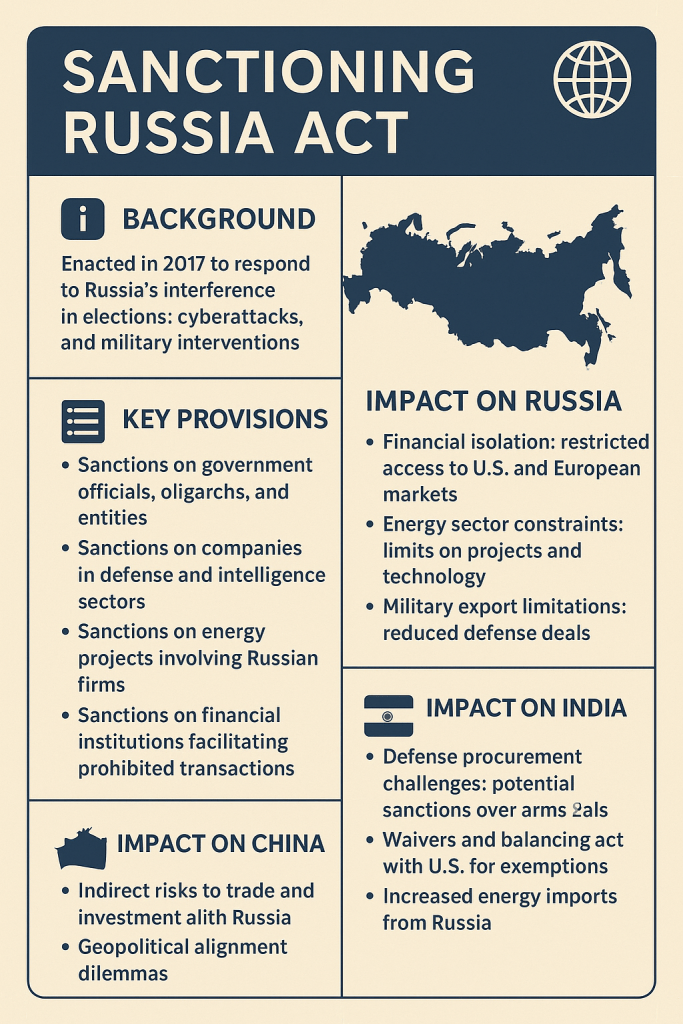
The Sanctioning Russia Act refers to a series of U.S. legislative measures, prominently including the Countering America’s Adversaries Through Sanctions Act (CAATSA), passed in 2017, alongside subsequent amendments and executive actions aimed at penalizing Russia for a range of activities considered harmful to U.S. and allied interests.
These activities include:
- Interference in foreign elections
- Cyberattacks on critical infrastructure and institutions
- Military interventions, notably in Ukraine and Syria
- Violations of international law and human rights abuses
While initially focused on Russia, the Act also covers sanctions against Iran and North Korea, but its Russia-specific provisions have had the widest and most sustained geopolitical impact.
Impact on Russia
The sanctions have had a pronounced impact on Russia’s economy and global standing:
- Financial isolation: Russian banks and financial institutions faced severe restrictions, limiting their access to U.S. and European capital markets.
- Energy sector constraints: Sanctions on oil and gas projects hampered technological upgrades and foreign investments.
- Military and defense export limitations: Russian defense contractors faced growing difficulties securing international deals, particularly with countries wary of secondary U.S. sanctions.
Following the 2022 invasion of Ukraine and subsequent escalation in sanctions, Russia pivoted further towards economic self-reliance and deepened ties with China, India, and other non-Western economies. However, the long-term isolation from Western financial systems and technology has posed structural challenges.
Ripple Effects on China
While not directly targeted by the Sanctioning Russia Act, China’s strategic partnership with Russia has exposed it to indirect risks:
- Trade and investment caution: Chinese firms involved in Russia’s energy and infrastructure sectors face growing scrutiny and potential U.S. secondary sanctions.
- Technology transfer limitations: Collaboration in sensitive sectors like semiconductors, AI, and defense technology faces increased obstacles due to U.S. export controls and sanction enforcement.
- Geopolitical alignment dilemmas: China continues to balance its economic ties with the U.S. and Europe while strengthening its strategic coordination with Moscow, especially within platforms like BRICS and the Shanghai Cooperation Organisation (SCO).
Trump’s recent tariff rhetoric adds another layer of economic pressure, potentially forcing China to further recalibrate its trade and investment strategies in a volatile global environment.
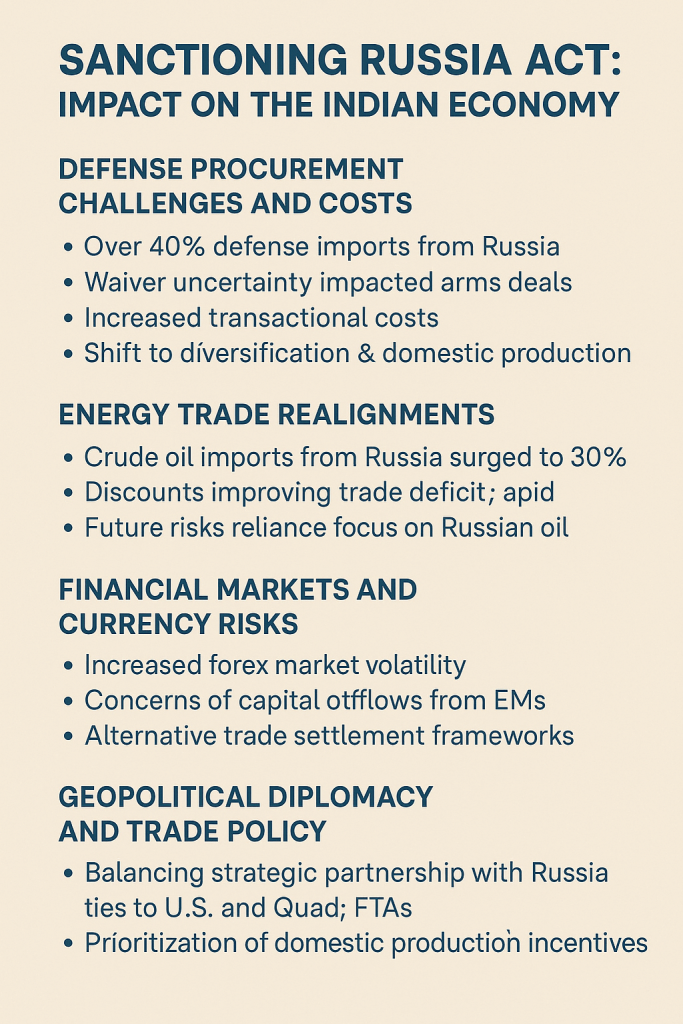
Impact on the Indian Economy
While much of the global attention around the Sanctioning Russia Act has centered on its effects on Russia, the Indian economy has felt significant indirect consequences due to the country’s longstanding defense, energy, and trade relationships with Moscow. As India has carefully navigated this complex geopolitical environment, the sanctions have influenced multiple sectors of its economy, strategic policy decisions, and global trade posture.
1️⃣ Defense Procurement Challenges and Costs
India remains one of the world’s largest importers of military hardware, with Russia historically accounting for over 40% of India’s defense imports. Key projects like the S-400 Triumf missile defense system, nuclear-powered submarines, and advanced fighter jets have been central to India’s national security strategy.
Under Section 231 of CAATSA, any country engaging in significant transactions with Russia’s defense or intelligence sectors faces the risk of secondary U.S. sanctions. While the U.S. government has so far extended waivers to India, this uncertainty has impacted:
- Procurement timelines, as contracts undergo additional scrutiny.
- Increased transactional costs, with payment routing and currency settlement becoming complicated due to restrictions on Russian banks.
- Shift in sourcing strategies, encouraging India to diversify its defense partnerships with countries like France, Israel, and the U.S., while also accelerating domestic defense production under the ‘Make in India’ initiative.
2️⃣ Energy Trade Realignments
Post-2022, Western sanctions severely curtailed Russia’s ability to sell oil and gas to Europe, pushing Moscow to offer deep discounts to Asian economies, notably India and China.
For India:
- Crude oil imports from Russia surged to over 30% of total imports by 2024, up from just 1% before 2022.
- This provided a crucial buffer against high global oil prices, improving India’s trade deficit position and easing domestic inflationary pressures.
- However, payment mechanisms became complicated, with India resorting to rupee-ruble trade settlements and third-country financial intermediaries to bypass sanctioned Russian banks.
While beneficial in the short term, this growing reliance poses future risks:
- Exposure to volatility in U.S. sanctions enforcement.
- Potential diplomatic strain if future U.S. administrations tighten secondary sanction clauses affecting Indian oil refiners and traders.
- Complicating India’s climate commitments as cheaper Russian oil slows the transition to renewable energy.
3️⃣ Financial Markets and Currency Risks
The Indian financial markets have also been indirectly influenced:
- Increased volatility in foreign exchange markets, particularly during major sanction announcements or geopolitical escalations.
- Concerns over capital outflows from emerging markets like India, as investors seek safer assets amid global risk-off sentiment triggered by U.S. sanctions on Russia.
- Efforts by the Reserve Bank of India (RBI) to maintain rupee stability, while facilitating alternative trade settlement frameworks with Russia to safeguard energy and defense transactions.
Geopolitical Diplomacy and Trade Policy
The Act has forced India to walk a tightrope in global diplomacy:
- Maintaining its strategic partnership with Russia, a legacy supplier of military hardware and a vital energy source.
- Strengthening ties with the U.S. and Quad partners (Japan, Australia) as part of its Indo-Pacific strategy.
- Advocating for a multipolar world order in multilateral forums like BRICS and G20, resisting Western pressure to isolate Russia diplomatically.
This balancing act has shaped India’s trade and investment policies:
- Prioritizing trade diversification towards Southeast Asia, Africa, and Latin America.
- Expediting bilateral free trade agreements (FTAs) with countries like the UAE and Australia.
Bolstering domestic production incentives through schemes like PLI (Production Linked Incentives) to reduce dependence on geopolitically sensitive imports.
5️⃣ India’s Leverage in Global Energy Markets
With discounted Russian oil improving its import bill, India has gained:
- Greater bargaining power with Middle Eastern crude suppliers, often negotiating better terms.
- A role as a refining hub for re-exporting Russian crude derivatives, particularly to Europe and Asia, indirectly benefiting from arbitrage opportunities created by Western sanctions.
This has positively impacted India’s current account deficit, foreign exchange reserves, and industrial capacity utilization rates, though it remains susceptible to future geopolitical disruptions.
Current Relevance in 2025
As of mid-2025, the Sanctioning Russia Act continues to influence international trade and diplomacy:
- Russia’s economic isolation persists, though it has fostered new economic corridors with China, India, Iran, and African nations.
- The U.S. and EU remain committed to sanction regimes, though enforcement levels and focus areas have evolved.
- India continues to secure exemptions while diversifying its defense sourcing and expanding indigenous defense production.
- Trump’s renewed tariff threats have revived concerns over escalating economic nationalism and the potential for further sanctions-related complications, especially affecting countries engaged with both Russia and China.
Conclusion: A Complex Economic Balancing Act
The Sanctioning Russia Act, though not targeted at India, has exerted a profound influence on its economy by disrupting traditional trade patterns, defense procurements, and financial operations. India has so far managed these challenges pragmatically — leveraging discounted energy deals, negotiating waivers, and diversifying its strategic alliances.
However, the long-term sustainability of this strategy will depend on:
- Evolving U.S.-Russia-China dynamics.
- India’s ability to expand indigenous production capabilities.
- Maintaining diplomatic agility in an increasingly polarized global order.
As of 2025, India’s handling of the Sanctioning Russia Act’s ripple effects stands as a notable example of strategic economic diplomacy in a complex, sanctions-driven world.


Leave a Reply