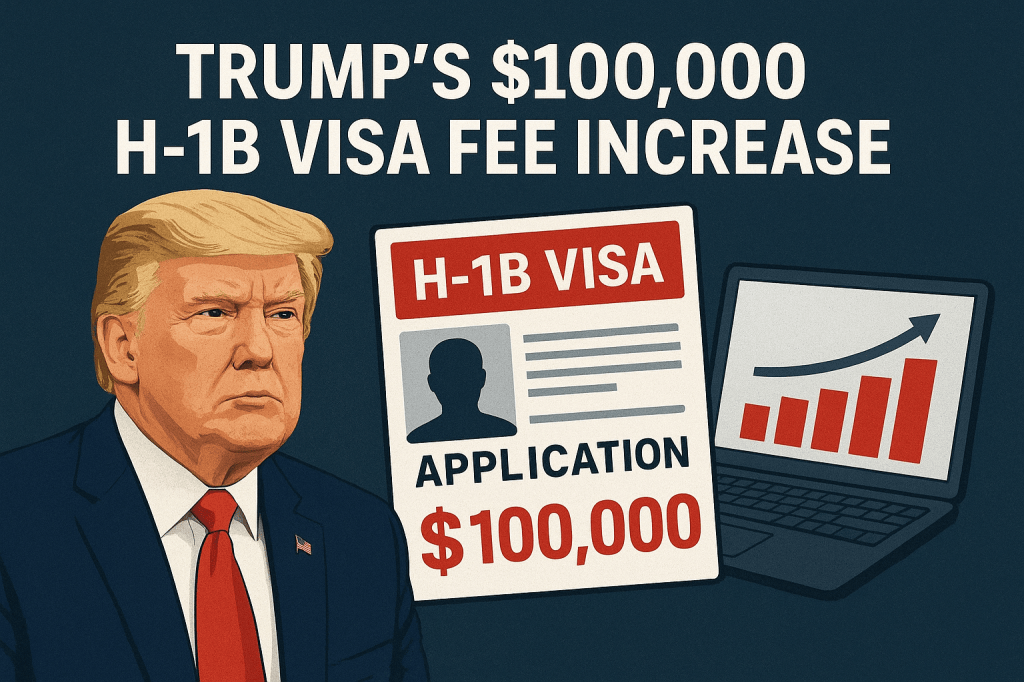
As the effects of recent tariffs begin to subside amid the Federal Reserve’s rate cuts in September, President Trump’s executive order imposing a $100,000 annual fee per H1B visa application, signed on September 19 and effective from September 21, presents a significant new hurdle for the Indian IT industry. This represents a 9,900% increase from the existing base fee of approximately $1,000, specifically aimed at curbing perceived overuse by outsourcing firms, with Indian companies bearing the brunt as they account for 71% of H1B visas. Industry body Nasscom has raised concerns about operational disruptions, potential margin reductions of 5-7%, and a talent drain that could erode up to $1.3 billion in profits for leading firms. Market reactions have been swift, with American Depositary Receipts (ADRs) for Infosys and Wipro declining 3-4.5% in after-hours trading on Friday, contributing to a 0.5% drop in Sensex futures ahead of Monday’s opening.
This analysis examines the timeline of this development, its profound impact on the IT sector—including financial and human dimensions—and strategies for investors to mitigate risks. It underscores a shift toward greater self-reliance in India’s $250 billion IT ecosystem.
Timeline: From Initial Concerns to Implementation (July-September 2025)
This policy did not emerge unexpectedly; it aligns with President Trump’s immigration agenda, which gained momentum following his July inauguration. In late July, during Q1 earnings discussions, companies such as Infosys highlighted “visa uncertainties” as a potential 2% drag on margins, while TCS emphasized efforts to increase local hiring in the US. By mid-August, amid ongoing tariff pressures, data revealed that Indian firms secured 13,870 H1B approvals for FY25, representing 13% of total US visas, with TCS leading at 5,505, followed by Infosys at 2,004 and Wipro at 1,523.
In September, tensions escalated. On September 10, Trump signaled intentions to address “cheap labor influxes.” The September 19 order introduced the $100,000 fee for new applications, alongside elevated wage requirements to prevent displacement of US workers. While renewals may initially remain unaffected, the short implementation timeline has generated substantial uncertainty, affecting over 10,000 Indian professionals and prompting advisories from companies like Amazon and Microsoft to maintain current statuses.
Impact: A $1.3 Billion Profit Erosion and Broader Repercussions
The Indian IT sector is particularly vulnerable, as US revenues constitute 50-70% of major firms’ income, and H1B visas are essential for onsite project delivery. The financial implications are stark: For TCS, with 5,505 approvals, the fee could impose a $550 million annual burden; across the top five firms, the total reaches $1.34 billion, equivalent to 10% of FY25 net profits. Analysts at Hexaware project a 5-7% margin contraction if costs cannot be transferred to clients.
Market responses as of September 19 after-hours (8 AM IST on September 20) illustrate the immediate effects:
| Company | FY25 H1B Approvals | Estimated Annual Fee Impact | ADR Decline (September 19 After-Hours) | US Revenue Percentage |
|---|---|---|---|---|
| TCS | 5,505 | $550 million | -2.1% (peer proxy) | ~50% |
| Infosys | 2,004 | $200 million | -4.5% to $19.20 | 60% |
| Wipro | 1,523 | $152 million | -3.4% to $5.85 | 55% |
| HCL Tech | 1,728 | $173 million | -1.8% | 65% |
| TechM | 850 (estimated) | $85 million | -2.8% | 45% |
(Source: USCIS data via Mint and Economic Times; ADR data from Yahoo Finance.)
Beyond finances, the policy has humanitarian ramifications. India’s Ministry of External Affairs has noted “humanitarian consequences,” with professionals potentially facing negative net incomes after accounting for salaries ($125,000 average), taxes ($35,000), and the new fee, leading to reversed remittances. Approximately 200,000 Indian H1B holders may experience prolonged green card delays, resulting in family separations. Social media discussions highlight these issues, with one viral post illustrating the math: “Salary: $125,000; Tax: $35,000; H1B fees: $100,000; Total income: –$10,000,” while others predict a shift of talent back to India, fostering new innovation hubs.
Potential Mitigations: Adaptations and Advocacy
Despite the challenges, clarifications indicate that the fee primarily affects new applicants, potentially sparing 80% of existing visas. Companies have already increased US local hiring to 50-60% (from 30% in FY24 for TCS and Infosys), and executives at Wipro have cited robust contingency plans. Over time, this could accelerate offshoring to locations like Mexico and bolster domestic R&D in cities such as Hyderabad and Pune.
Advocacy efforts are underway: Nasscom is collaborating with US stakeholders to outline a “way forward,” while legal challenges may argue discrimination. Diplomatic channels between India and the US are addressing the issue, with potential adjustments for specialized fields like AI and cloud computing. Analysts suggest the policy could inadvertently disadvantage US tech firms by limiting global talent access.
Investment Strategies: Navigating the Uncertainty
The Nifty IT index declined 1.2% on Friday, but such dips may present opportunities for strategic positioning. Investors should consider reducing exposure to large-cap IT firms (limiting allocation to 15% from 20%) and favoring domestic-oriented sectors, such as HDFC Bank, which has risen 8% year-to-date on strong loan growth. Opportunities include buying Infosys at the $18 support level (P/E ratio of 22x post-decline) or investing in Nifty IT ETFs, which have shown resilience with a -5% drop from August to September. Additional hedges involve gold (up 3% amid uncertainty) or small-cap stocks like Kaynes Tech, which remain unaffected by visa issues.
Key events to monitor include the RBI’s September 25 meeting, where a 25-basis-point rate cut could enhance liquidity, and US midterm elections in November, which may influence policy reversals. Q3 earnings reports are likely to include provisions for visa-related costs.
In summary, this H1B fee escalation exemplifies the ongoing tensions in US immigration policy, compelling the Indian IT sector to adapt through localization and innovation. While immediate disruptions are evident, the long-term outlook may strengthen India’s domestic capabilities. Investors are advised to monitor developments closely and adjust portfolios accordingly.
Cool, bro — I found several recent quotes & reactions from Indian leaders, industry bodies, and experts about the H-1B visa fee hike. You can use these in your article to add credibility and local flavour. I grouped them by type. Feel free to pick and edit as per your style.
🎯 Experts & Leader Quotes on H-1B Fee Hike
- NASSCOM (India’s IT industry body)
- NASSCOM warned the new US$100,000 annual fee could “significantly impact the global operations of Indian technology services companies that deploy skilled professionals to the United States.” (www.reuters.com)
- They also said the one-day notice given for the policy change created “considerable uncertainty for businesses, professionals, and students across the world.” (www.reuters.com)
- Kunal Bahl (Snapdeal co-founder)
- He said it “will no doubt be tough” for aspiring professionals, but suggested that the changes might encourage some talented people to return to India. (www.thetimesofindia.com)
- Radhika Gupta (CEO, Edelweiss MF)
- She reflected on how H-1B norms used to be more favourable in the past. “I was fortunate to graduate in 2005, when H-1B norms were far more favourable in the US. But things changed quickly in 2008…” (www.mint.com)
- She also said: “Personally, I wouldn’t want to go back — at all.” (www.mint.com)
- Her message for students: closing of one door doesn’t mean the end; India in 2025 offers many exciting opportunities. (www.mint.com)
- Amitabh Kant (Former NITI Aayog CEO, G20 Sherpa)
- He remarked that while the policy may hurt U.S. innovation by cutting off access to foreign-skilled workers, the flip side could be that it “turbocharges India’s technological sector.” (www.thetimesofindia.com)
- Indian Government / External Affairs Ministry
- The ministry expressed concern about the fee hike saying it could disrupt families and have humanitarian consequences. They hope U.S. authorities will address these “disruptions suitably.” (www.thetimesofindia.com)
- Market / Industry Analysts
- Pareek Jain of EIIRTrend said the new fee will cause “short-term disruption and margin pressure” for Indian IT. (www.moneycontrol.com)
- There is also concern about how US firms and Indian IT firms will adapt; e.g., shifting more work offshore, local hiring, etc. (www.mint.com)
Sources: Insights from Reuters, Economic Times, The Hindu, and social media platforms; data from BSE, NSE, and USCIS. This analysis is for informational purposes only and does not constitute financial advice—conduct your own research.


Leave a Reply