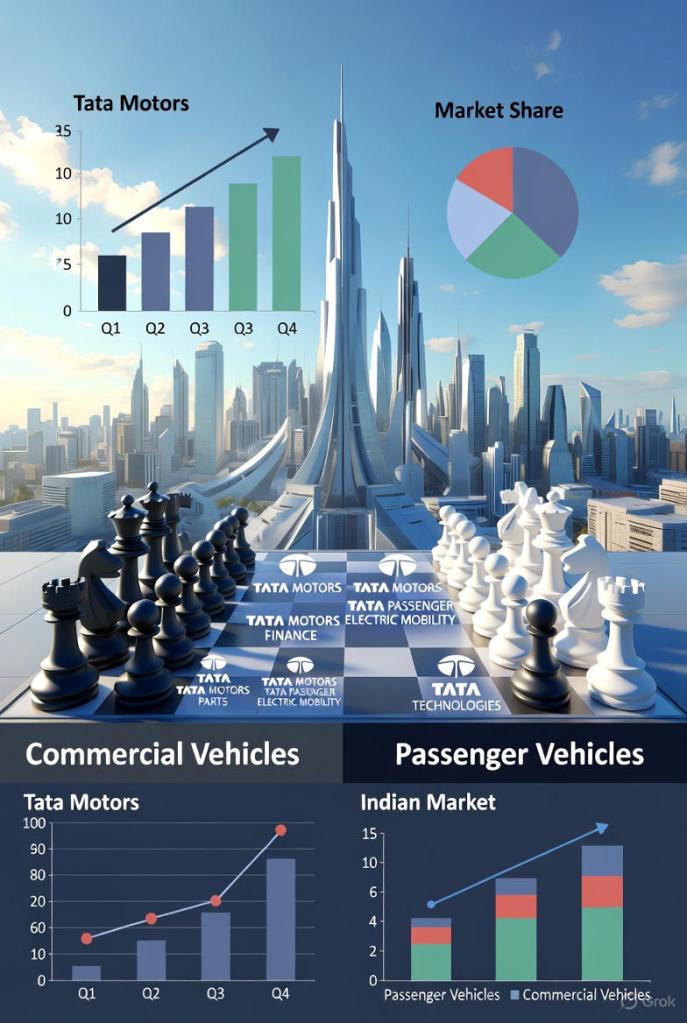
In the high-stakes game of corporate chess, few moves are as bold—and potentially rewarding—as a demerger. It’s the business equivalent of breaking up a sprawling empire to let its kingdoms thrive independently, shedding the weight of a “conglomerate discount” that often drags down valuations. Enter Tata Motors, the Indian auto giant whose 2025 split into commercial vehicles (CV) and passenger vehicles (PV) arms has become a textbook case. As the dust settles on its debut trading day today, November 12, 2025, the results are already whispering lessons for other behemoths like Reliance Industries and ITC. With India’s markets buzzing from a wave of restructurings, 2025 feels like the tipping point. Why now? And who’s next? Let’s unpack the drama, the numbers, and the domino effect.
Tata Motors’ Split: A Clean Break and Early Wins
Tata Motors’ demerger saga kicked off in earnest last year, but it crystallized in 2025. The company, long saddled with disparate businesses—from rugged trucks to sleek EVs—announced the carve-out in a bid to sharpen focus and unlock value. The scheme took effect on October 1, 2025, with October 14 as the record date. Shareholders received a 1:1 entitlement: one share in the new Tata Motors Passenger Vehicles Ltd. (TMPV) for every Tata Motors share held, plus an equal allotment in the soon-to-list TML Commercial Vehicles Ltd. (TMLCV).
The PV arm wasted no time hitting the exchanges. It debuted at ₹400 per share, implying a valuation of around ₹260–₹270 for the CV business based on pre-split pricing. Fast-forward to yesterday, November 11, and TMPV closed at ₹407.60—a modest 1.9% pop from its opening but still nursing a 51.63% dip from its 52-week high amid broader auto sector volatility. Year-to-date in 2025, TMPV has clocked a -9.24% return, reflecting headwinds like softening EV demand and supply chain snarls. Yet, analysts remain bullish, citing TMPV’s edge in the premium passenger segment, where JLR (Jaguar Land Rover) contributes over 60% of revenues. Earnings are due November 14, with whispers of a surprise EV push potentially juicing the stock.
Enter TMLCV, the workhorse of the duo, listing today on BSE and NSE in the T Group. Pre-market buzz pegged its debut at ₹300–₹350, well above the implied ₹260–₹270, with optimists like those at ET Now eyeing ₹320–₹470. As of midday trading, it’s hovering around ₹325—a solid 25% premium to expectations—fueled by India’s booming infrastructure spend and a CV upcycle projected to hit 8–10% CAGR through 2027. In contrast to TMPV’s consumer whims, TMLCV’s steady cash flows from fleet sales and exports have made it the early darling, trading at a forward P/E of 12x versus TMPV’s 15x.
The split’s math tells a compelling story. Pre-demerger, Tata Motors traded at a conglomerate discount, its ₹3.2 lakh crore market cap (as of September 2025) undervaluing the sum-of-the-parts (SOTP) by 15–20%. Post-split, TMPV’s ₹1.8 lakh crore cap plus TMLCV’s nascent ₹1.1 lakh crore (at ₹325/share) already erodes that gap, delivering shareholders an implicit 10–12% value unlock on day one. It’s classic arithmetic: SOTP Value = Σ (Business Unit EBITDA × Sector Multiple) + Net Debt Adjustments. For Tata, CV’s ₹15,000 crore FY25 EBITDA at 10x yields ₹1.5 lakh crore, while PV’s ₹12,000 crore at 14x adds ₹1.68 lakh crore—totaling ₹3.18 lakh crore pre-discount. Demerger zaps the 18% overhang from cross-subsidization fears, letting each arm borrow and invest autonomously.
Lessons in Valuation: The Conglomerate Curse and Its Cure
Tata’s tale underscores a timeless truth: diversified giants often trade at a “conglomerate discount”—10–30% below their intrinsic parts, per studies like Kroll’s 2025 India Industry Multiples report. Why? Investors distrust sprawling managements juggling oil rigs and soaps, slapping on a complexity penalty. In India, holding companies like Maharashtra Scooters have languished at 60% discounts to their Bajaj stakes. Demergers flip the script, enabling focused strategies and attracting sector-specific capital.
Take the formula: Post-Demerger Value = Pre-Split Cap + (Discount Relief × SOTP Premium). For Tata, that relief alone added ₹40,000–₹50,000 crore in perceived value. Globally, spin-offs like GE’s 2024 healthcare carve-out delivered 20%+ pops; in India, Raymond’s 2025 textile-lifestyle split juiced shares 15%. The key? Tax-neutral schemes under the Companies Act, plus NCLT fast-tracks slashing approval times to six months. Shareholders win tax-deferred allotments, while firms shed underperformers—Tata’s PV arm, for instance, can now double down on EVs without CV’s capex drag.
Scanning the Horizon: Reliance and ITC in the Crosshairs
If Tata lit the fuse, Reliance and ITC are stacking the powder keg. Mukesh Ambani’s ₹20 lakh crore empire spans refineries, retail, and telecom—a SOTP dream begging for dissection. 2025 saw the FMCG arm spun into New Reliance Consumer Products Ltd., a ₹75,000 crore entity blending Campa Cola with Soch apparel. But the real fireworks? Jio’s H1 2026 IPO, targeting a $200 billion valuation, followed by Retail’s 2027 debut. Analysts peg Reliance’s conglomerate discount at 12–15%, with SOTP implying ₹22–₹23 lakh crore versus its current ₹19.5 lakh crore cap. A full split could unlock ₹2.5 lakh crore, per Motilal Oswal models: O2C at 8x EBITDA (₹4 lakh crore) + Jio at 25x (₹10 lakh crore) + Retail at 40x (₹6 lakh crore). With green energy bets faltering, demerger chatter peaked at the August AGM, where dividend hikes hinted at value redistribution.
ITC, the tobacco-to-FMCG pivot master, isn’t far behind. Its January 1, 2025, hotels demerger—effective date locked, record on January 6—carves out ITC Hotels Ltd. (ITCHL), with ITC retaining 40% and shareholders snagging 60% in a 1:10 ratio. At ₹500 billion, ITCHL trades at a 20x EV/EBITDA premium to ITC’s 25x core, potentially lifting the parent’s ₹6 lakh crore cap by 8–10%. Post-split, ITC’s cigarettes and staples get laser focus, shedding hospitality’s cyclical drag. Brokerages like ET Now eye ₹1,000/share for ITC by mid-2026, a 25% upside from today’s ₹800. SOTP here? FMCG at 35x (₹2.5 lakh crore) + Tobacco at 20x (₹2 lakh crore) + Hotels at 18x (₹0.5 lakh crore)—total ₹5 lakh crore pre-discount, versus ITC’s blended 22x.
Why 2025? The Perfect Storm for Shake-Ups
This isn’t coincidence; it’s convergence. India’s GDP hums at 6.5% (IMF 2025 forecast), but conglomerates face activist heat—think British American Tobacco’s nudge on ITC. The 2025 Budget streamlined mergers via CAA Rules, axing timelines and easing cross-border nods. Add tax perks (no capital gains on demergers) and a bull market craving pure-plays, and voila: a demerger deluge. From Vedanta’s metals split to Aditya Birla’s fashion carve-out, 2025 logs 15+ major restructurings, per Economic Times tallies—double 2024’s pace. Low valuations (Nifty at 20x forward) amplify unlocks, while global spin-off fever (e.g., 3M’s 2025 health IPO) spills over.
The Final Lap: Dominoes Falling, Value Rising
Tata Motors’ split isn’t just a win—it’s a blueprint. CV’s debut pop versus PV’s steady grind shows focused bets pay off, with valuation math proving demergers aren’t zero-sum. As Reliance eyes Jio’s trillions and ITC polishes its hotels gem, expect more empires to fracture. For investors, it’s harvest time: buy the discount, ride the split. In 2025’s restructure renaissance, the message is clear—sometimes, to conquer, you must divide. What’s your next demerger bet? The board’s yours.
Image Source: Grok (xAI). Images used for illustrative purposes only.


Leave a Reply