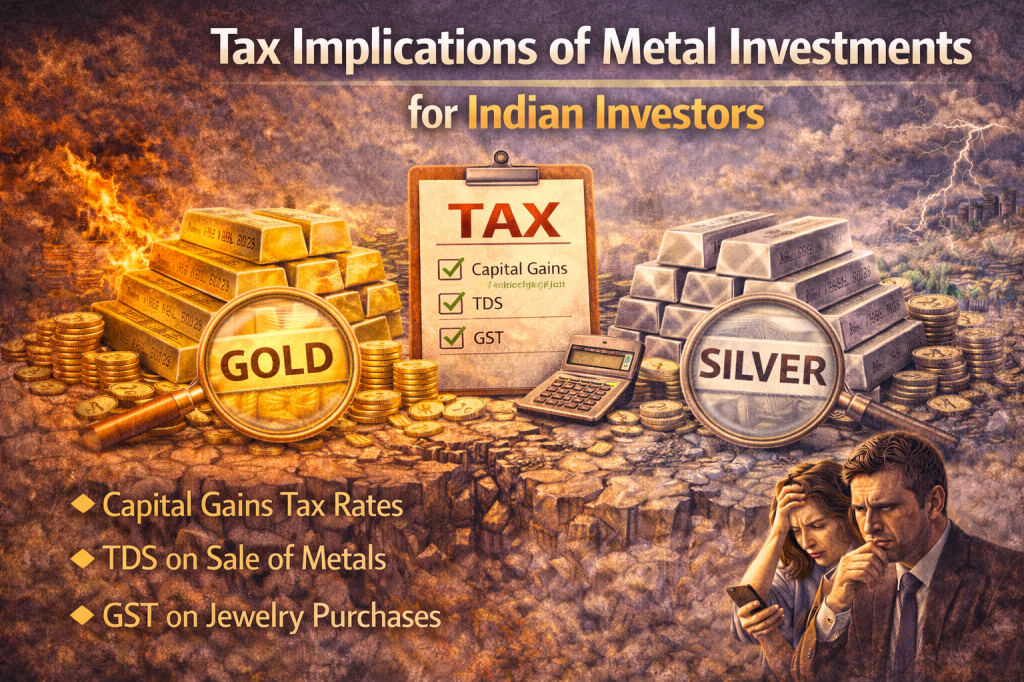
Investing in metals, particularly precious ones like gold and silver, has long been a favored strategy for Indian investors seeking to hedge against inflation, diversify portfolios, and preserve wealth. These assets can be held in various forms, including physical bars or jewelry, exchange-traded funds (ETFs), mutual funds, sovereign gold bonds (SGBs), or digital gold. However, understanding the tax implications is crucial, as they can significantly impact your net returns. In this post, we’ll explore the key tax aspects for Indian investors, with a focus on income tax on gains, GST considerations, and the recent proposals from Budget 2026.
Types of Metal Investments and Their Taxation
Before diving into the details, let’s outline the common forms of metal investments:
- Physical Metals: Gold or silver in the form of coins, bars, or jewelry.
- Gold/Silver ETFs and Mutual Funds: Paper-based investments traded on stock exchanges.
- Sovereign Gold Bonds (SGBs): Government-issued bonds linked to gold prices, offering fixed interest.
- Digital Gold: Online platforms allowing fractional ownership of physical gold stored in vaults.
Taxes apply at two main stages: purchase (via GST) and sale/redemption (via capital gains tax). Additionally, any interest income (e.g., from SGBs) is taxable.
GST on Purchase
When buying physical gold or silver, a 3% Goods and Services Tax (GST) is levied on the making charges for jewelry or the full value for bars/coins. This remains unchanged in Budget 2026. For digital gold, ETFs, and mutual funds, no GST applies on purchase, but underlying costs may include it indirectly. SGBs are exempt from GST as they are securities.
Capital Gains Tax on Sale or Redemption
Profits from selling metal investments are treated as capital gains and taxed based on the holding period:
- Short-Term Capital Gains (STCG): Taxed at your applicable income tax slab rate (ranging from 0% to 30%, plus cess and surcharge).
- Long-Term Capital Gains (LTCG): Taxed at a flat 12.5% rate without indexation benefits (a change introduced in Budget 2024 and retained in 2026).
The holding period to qualify for LTCG varies by asset type:
- Physical and digital gold/silver: More than 24 months.
- ETFs and mutual funds: More than 12 months.
- SGBs: More than 12 months (if sold before maturity).
For SGBs, the annual interest of 2.5% is taxed at slab rates as “income from other sources.”
Key Changes from Budget 2026
Presented on February 1, 2026, by Finance Minister Nirmala Sitharaman, Budget 2026 largely maintains the existing tax framework for metal investments, with no alterations to capital gains rates or GST. However, it introduces a significant tweak for Sovereign Gold Bonds: The capital gains exemption at maturity (after 8 years) is now restricted to original subscribers only. Secondary market buyers will no longer qualify for this exemption, effective from April 1, 2026. This aims to encourage direct subscriptions from the RBI and curb speculative trading.
This change could make SGBs less attractive for secondary investors, as they will now face LTCG tax of 12.5% on redemption gains, even at maturity.
Comparison of Tax Rates: Pre- and Post-Budget 2026
To highlight the implications, here’s a table comparing the tax treatment before and after Budget 2026 proposals. Note that capital gains rates remain unchanged; the primary shift is in SGB exemptions.
| Asset Type | Holding Period for LTCG | Tax on STCG | Tax on LTCG (Pre-2026) | Tax on LTCG (Post-2026) | Other Notes (Post-2026) |
|---|---|---|---|---|---|
| Physical Gold/Silver | >24 months | Slab rates | 12.5% (no indexation) | 12.5% (no indexation) | Unchanged; GST 3% on purchase. |
| Digital Gold | >24 months | Slab rates | 12.5% (no indexation) | 12.5% (no indexation) | Treated same as physical; no GST on purchase. |
| Gold/Silver ETFs/MFs | >12 months | Slab rates | 12.5% (no indexation) | 12.5% (no indexation) | Unchanged; STT may apply on ETFs. |
| Sovereign Gold Bonds | >12 months (if sold) | Slab rates | 12.5% (no indexation); Exemption at maturity for all holders | 12.5% (no indexation); Exemption at maturity only for original subscribers | Interest taxed at slab; secondary buyers lose exemption from April 1, 2026. |
Strategies to Minimize Tax Impact
- Hold for LTCG: Aim for the longer holding period to benefit from the lower 12.5% rate.
- Tax Harvesting: Sell and repurchase to book losses offsetting gains, but watch for wash-sale rules.
- Diversify Forms: SGBs remain appealing for original buyers due to interest and exemption, while ETFs offer liquidity with shorter LTCG periods.
- Track Costs: Maintain records of purchase prices to accurately calculate gains.
Remember, losses from metal investments can be set off against other capital gains (STCL against STCG/LTCG, LTCL only against LTCG) and carried forward for up to 8 years.
Disclaimer
This blog post is for informational purposes only and does not constitute financial, tax, or investment advice. Tax laws are subject to change, and the information here is based on Budget 2026 proposals, which may be amended. Always consult a qualified tax professional or financial advisor to assess your specific situation before making investment decisions. The author and publisher are not liable for any losses incurred based on this content.


Leave a Reply