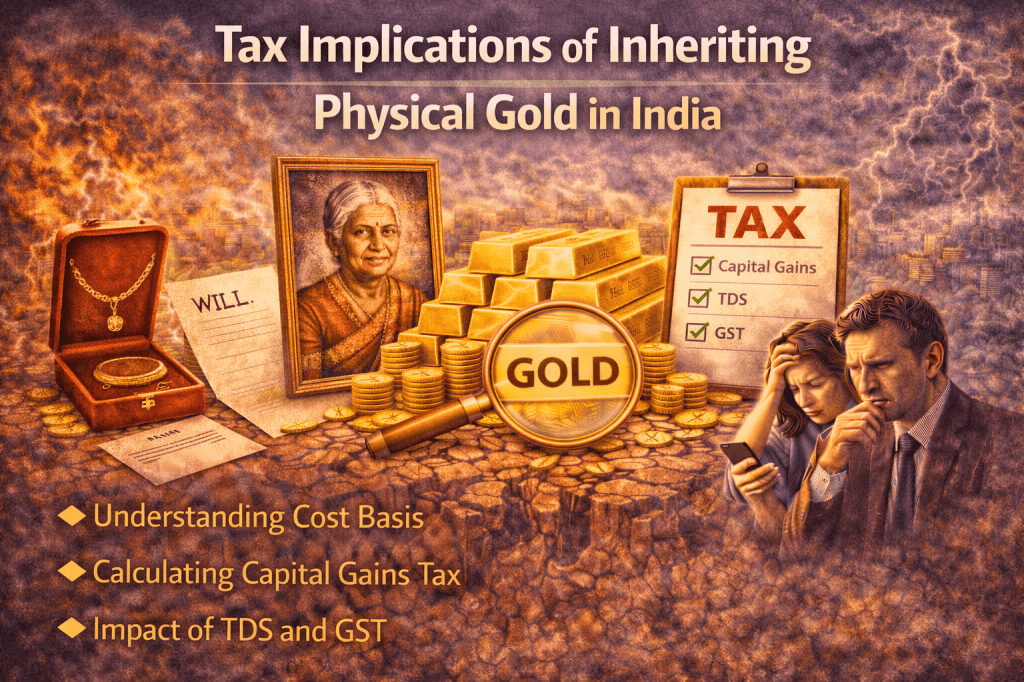
Gold holds a special place in Indian culture, often symbolizing prosperity, tradition, and family legacy. It’s common for physical gold—whether in the form of jewelry, coins, or bars—to be passed down through generations via inheritance. However, while inheriting gold might feel like a heartfelt gift from the past, it’s essential to understand the tax rules surrounding it to avoid any surprises down the line. In this post, we’ll break down the key tax implications in the Indian context, focusing on physical gold received through inheritance.
No Tax Liability at the Time of Inheritance
One of the most reassuring aspects of inheriting physical gold in India is that there’s no immediate tax burden. India does not levy an inheritance tax or estate duty on assets like gold passed down through succession or a will. This means when you receive the gold from a deceased relative, it’s not considered taxable income under the Income Tax Act. Whether it’s from your parents, grandparents, or other family members, the transfer itself is exempt.
This exemption extends to gold jewelry or bullion acquired from explained sources, such as inheritance, without attracting scrutiny from tax authorities. There’s also no Goods and Services Tax (GST) applicable on inherited gold, as it’s not a purchase or sale transaction. However, keep records like the will, death certificate, or family partition documents to prove the source, as unexplained gold could lead to penalties if investigated.
Capital Gains Tax: When You Decide to Sell
The real tax implications kick in only if and when you sell the inherited gold. At that point, it’s treated as a capital asset, and any profit from the sale is subject to capital gains tax. Here’s how it works:
Holding Period and Classification
- The holding period is calculated from the date the original owner (the deceased) acquired the gold, not from when you inherited it. This is a crucial benefit, as it often qualifies the asset as long-term.
- Following changes in the Union Budget 2026, physical gold is now considered a long-term capital asset if held for more than 24 months. If the total holding (original owner + you) is less than 24 months, it’s short-term.
If the gold was acquired before April 1, 2001, you can use the fair market value (FMV) as of that date as the cost of acquisition, which can help reduce taxable gains.
Tax Rates
- Long-Term Capital Gains (LTCG): Taxed at 12.5% (plus applicable surcharge and cess) without the benefit of indexation, as per post-2026 rules. Indexation, which adjusted for inflation, was removed for non-financial assets like gold in recent budgets.
- Short-Term Capital Gains (STCG): Added to your total income and taxed at your applicable income tax slab rates, which can go up to 30% or more for higher earners.
Calculation Example
Suppose your grandmother bought gold in 2010 for ₹10 lakh, and you inherit it in 2025. If you sell it in 2027 for ₹30 lakh:
- Holding period: From 2010 (over 24 months) → LTCG.
- Gain: ₹30 lakh – ₹10 lakh = ₹20 lakh.
- Tax: 12.5% on ₹20 lakh = ₹2.5 lakh (plus cess/surcharge).
Deductions for selling expenses (like brokerage or assaying fees) can be subtracted from the sale price.
Exemptions and Reinvestment Options
To save on LTCG tax, you can reinvest the proceeds under Section 54F by purchasing a residential house in India (conditions apply, such as reinvesting the entire sale amount). Alternatively, invest in specified bonds under Section 54EC for partial exemption. Always check current limits and timelines.
Other Considerations
- Gifts vs. Inheritance: While inheritance is tax-free, gold received as a gift from non-relatives exceeding ₹50,000 in a year is taxable as income from other sources. Gifts from close relatives remain exempt, similar to inheritance.
- Holding Limits: There’s no legal cap on how much gold you can hold if it’s from a legitimate source like inheritance. But if authorities deem it unexplained, it could be taxed at up to 78% (including penalties).
- Wealth Tax: Abolished in 2015, so no ongoing tax on holding gold.
- GST on Future Transactions: If you melt or remake inherited gold into new jewelry, making charges attract 5% GST, and the value attracts 3% GST if considered a supply.
Inheriting gold can be a valuable asset, but strategic planning around sales can minimize tax outflows. If you’re in a position to hold onto it long-term, it might even appreciate further, preserving your family’s legacy.
Disclaimer
This article is for informational purposes only and is based on general interpretations of Indian tax laws as of 2026. Tax regulations can change, and individual circumstances vary. It is not a substitute for professional advice. Please consult a qualified tax advisor or chartered accountant for personalized guidance before making any decisions related to inheritance or sale of gold. The author and blog assume no liability for actions taken based on this content.


Leave a Reply