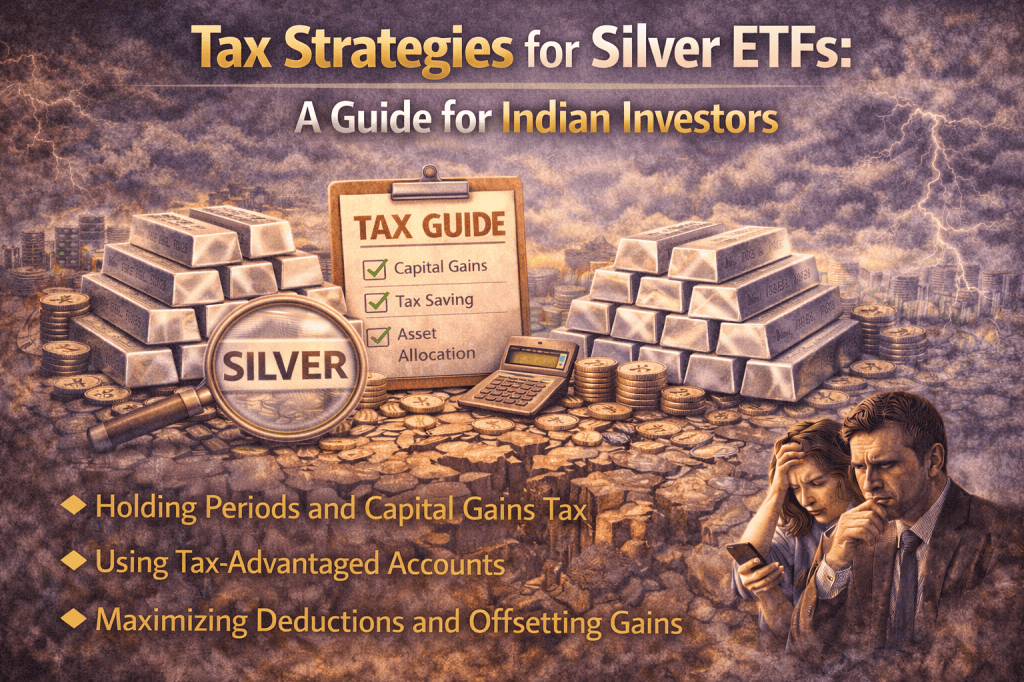
Silver Exchange-Traded Funds (ETFs) have become a popular way for Indian investors to gain exposure to silver prices without the hassles of physical storage, theft risks, or making charges. These funds track the price of silver and trade on stock exchanges like NSE or BSE, offering liquidity and transparency. However, taxation plays a crucial role in your net returns. Below, I’ll outline key tax strategies to optimize your investments in silver ETFs, based on the current Indian tax framework.
Understanding Taxation on Silver ETFs
Silver ETFs are classified as non-equity oriented funds and treated as listed securities for tax purposes. Gains from selling units are considered capital gains:
- Short-Term Capital Gains (STCG): If held for less than 12 months, taxed at your applicable income tax slab rates (which can go up to 30% plus surcharge and cess for higher incomes).
- Long-Term Capital Gains (LTCG): If held for more than 12 months, taxed at a flat 12.5% without indexation benefits.
Additionally:
- No Securities Transaction Tax (STT) is levied on the purchase of ETF units, but a small STT (0.001%) applies on the sale if done on the exchange.
- No GST on ETF transactions, unlike physical silver (which attracts 3% GST).
- Losses from silver ETFs can be set off against other capital gains (STCL against STCG/LTCG, LTCL only against LTCG).
The Union Budget 2026, presented on February 1, 2026, did not propose any specific changes to the tax rates for silver ETFs or commodity-based investments like these. It maintained the existing structure from previous budgets (notably the rationalization in Budget 2024). However, it introduced a new Income Tax Act 2025 with simplified provisions and stricter compliance rules, which could indirectly affect reporting for investors. For context, here’s a comparison table of tax treatment across common silver investment options in India post-Budget 2026:
| Investment Type | Holding Period for LTCG | STCG Tax Rate | LTCG Tax Rate | Other Taxes/Notes |
|---|---|---|---|---|
| Silver ETFs | >12 months | Income tax slab rates | 12.5% (no indexation) | Treated as listed securities; STT on sale (0.001%); no GST; easy liquidity. |
| Physical Silver | >24 months | Income tax slab rates | 12.5% (no indexation) | 3% GST on purchase; storage costs; no STT; gains on jewelry include making charges. |
| Silver Futures/Options | N/A (treated as business income) | Income tax slab rates (as business income) | N/A | Commodities Transaction Tax (CTT) at 0.01% on non-agri futures; speculative losses set-off restricted. |
| Silver Mutual Funds (non-ETF) | >24 months (if unlisted) | Income tax slab rates | 12.5% (no indexation) | Similar to debt funds; no STT; potential exit loads. |
This table highlights why silver ETFs often have a tax edge over physical silver due to the shorter holding period for LTCG qualification.
Effective Tax Strategies for Silver ETFs
To minimize your tax liability and maximize returns, consider these strategies tailored for Indian investors:
- Optimize Holding Period: Aim to hold silver ETF units for at least 12 months to qualify for the lower 12.5% LTCG rate instead of slab rates. This is especially beneficial if you’re in a higher tax bracket (e.g., 30%). For short-term trades, factor in slab taxes and transaction costs.
- Tax-Loss Harvesting: If silver prices dip, sell units at a loss to offset gains from other investments. You can immediately repurchase similar ETFs (avoiding the same fund to prevent wash-sale-like issues, though India doesn’t have strict wash-sale rules). Do this before March 31 to utilize losses in the current financial year.
- Systematic Investment Plans (SIPs): Use SIPs in silver ETFs to average out costs over time. Each installment is treated separately for holding period calculation, so plan redemptions to prioritize long-term units. This reduces overall tax impact through rupee-cost averaging.
- Set-Off and Carry Forward Losses: Short-term losses from silver ETFs can offset any capital gains, while long-term losses offset only LTCG. Unused losses can be carried forward for up to 8 years. Pair this with gains from equities or other assets for tax efficiency.
- Portfolio Diversification: Combine silver ETFs with equity ETFs or stocks to balance your portfolio. Silver acts as a hedge against inflation and rupee depreciation, but its volatility means it shouldn’t exceed 5-10% of your portfolio. Monitor global silver prices influenced by industrial demand (e.g., in solar panels, electronics).
- Exit Timing: Redeem during low-income years to minimize slab-rate taxes on STCG. Also, watch for budget announcements or global events that could affect silver prices—Budget 2026 focused on infrastructure and renewables, which might boost silver demand long-term.
- Compliance and Reporting: Under the proposed Income Tax Act 2025 (effective from April 1, 2026), ensure timely filing of returns. Use Form ITR-2 or ITR-3 for reporting capital gains from ETFs. Keep records of purchase/sale dates and amounts for accurate calculations.
By focusing on long-term holding and smart loss management, silver ETFs can be a tax-efficient way to invest in this precious metal, especially compared to physical forms.
Disclaimer: This post is for informational purposes only and does not constitute financial, tax, or investment advice. Tax laws can change, and individual circumstances vary. Please consult a qualified tax advisor or financial planner before making any investment decisions. The information is based on publicly available data as of February 2026 and may not reflect future updates. Investments in ETFs carry market risks, and past performance is not indicative of future results.


Leave a Reply