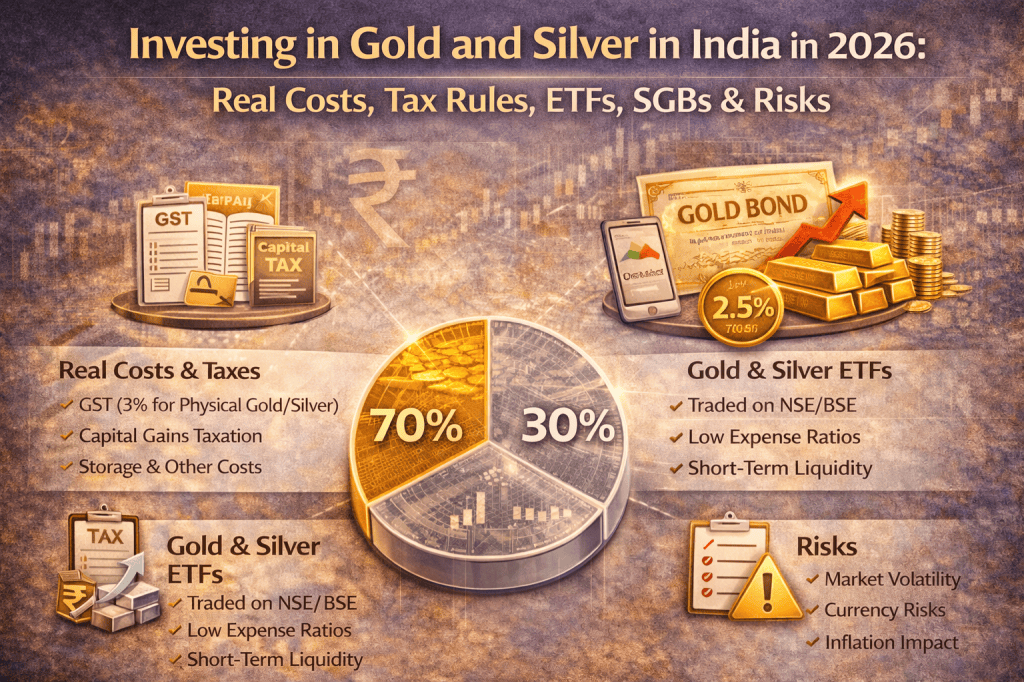
Gold and silver are deeply embedded in Indian culture and investment portfolios. But beneath tradition lies a nuanced financial landscape with costs, tracking errors, liquidity issues, and tax implications that many investors overlook.
This comprehensive guide will help Indian investors understand how to navigate that landscape across Gold & Silver ETFs, Sovereign Gold Bonds (SGBs), and physical metals.
1. Precious Metal ETFs in India: Examples, Costs & Tracking Errors
Popular Gold & Silver ETFs in India
India has seen a massive rise in ETF interest, with gold and silver funds attracting significant investor money. (Angel One)
Gold ETFs (examples):
- Gold BeES (Nippon India ETF) – India’s first gold ETF and a benchmark product for tracking gold prices. (Reddit)
- ICICI Prudential Gold ETF – One of the most liquid gold ETFs on NSE/BSE. (India TV)
- HDFC Gold ETF – Another popular option with wide trading volume. (AajTak)
- SBI Gold ETF, Kotak Gold ETF, Mirae Asset Gold ETF, 360 One Gold ETF – Other actively traded funds. (NDTV)
Silver ETFs (examples):
- Tata Silver ETF – One of the larger silver ETFs by AUM. (Financial Express – Hindi)
- HDFC Silver ETF, SBI Silver ETF, Nippon India Silver ETF – Silver tracking funds with reasonable liquidity. (AajTak)
- Kotak Silver ETF, Groww Silver ETF, ICICI Prudential Silver ETF, UTI Silver ETF – Other silver options for diversification. (NDTV)
Expense Ratios & Tracking Error
Gold and silver ETFs in India carry expense ratios (annual management fees) that vary by fund and typically range from ~0.25% to ~0.9%. Silver ETFs generally cost more due to higher storage and insurance expenses.
Tracking error—the difference between what the ETF returns and what actual spot metal prices do—comes from operating costs, cash holdings, and market dynamics. Silver ETFs often show wider tracking deviations due to higher volatility and lower overall trading depth. (AajTak)
Liquidity in Stress Periods
Liquidity can dry up quickly. For example, in recent market downturns, many silver ETFs traded at discounts to their net asset values (NAVs) of up to 10–25%, illustrating how ETF market prices can diverge from underlying metal values in volatile conditions. (Navbharat Times)
2. Sovereign Gold Bonds (SGBs): Government-Backed Options
Sovereign Gold Bonds have historically been a favourite India-specific instrument for gold exposure because they offer:
- Interest @ 2.5% annually
- No storage or purity risk
- Capital gains tax exemption if held to maturity
However, post-Budget 2026 changes mean the tax exemption on capital gains applies only if you subscribe directly at issue and hold until maturity—a significant rule shift that affects many buyers. (The Economic Times)
Some common SGB series available on the secondary market (with varying maturities) include:
- SGB June 2030 Series
- SGB August 2030 Series
- SGB December 2031 Series
These are tradable on exchanges like NSE/BSE, though liquidity can be low and bid-ask spreads wide. (Smart Investing India)
Long-term holders of earlier SGB issues have seen very strong returns on redemption—some exceeding 300% over the full holding period—partly due to gold price appreciation plus interest. (The Times of India)
3. Physical Gold & Silver: Traditions Come with Frictions
Purity & Buy-Sell Costs
- BIS hallmarking improves purity standards but doesn’t eliminate all adulteration risk.
- Making charges on jewellery (often 5–25%) are not recoverable at sale.
- Buy/sell spreads for coins and bars can be wide.
Storage & Insurance Costs
Unlike ETFs or SGBs, owning bullion means:
- Bank locker rent
- Insurance premiums
- Theft risk
These recurring costs accumulate over time.
4. Taxation Rules for Indian Investors
ETFs & Physical Metals:
- Short-term gains: Traded metals held less than 24 months are taxed as per income slab.
- Long-term gains (LTCG): After 24 months, taxed at 12.5% without indexation.
SGBs:
- Interest income taxed at your slab rate.
- Capital gains tax-free if held to maturity (with direct subscription as per 2026 Budget). (The Economic Times)
These rules can significantly impact after-tax returns and therefore investment decisions.
5. Strategic Takeaways for Indian Investors
Choose based on your objective:
✔ SGBs – For long-term, buy-to-hold wealth preservation (tax efficiency if rules met).
✔ Gold ETFs – Highly liquid and tradable, good for flexible exposure.
✔ Silver ETFs – For tactical diversification but expect higher volatility and liquidity swings.
✔ Physical metals – Cultural and sentimental value, but costly and less liquid.
Be cautious of digital gold products offered via apps—they’re often unregulated, may not provide legal ownership of actual metal, and lack SEBI protection, making them riskier than ETFs or SGBs. (Reddit)
The table below summarizes how different gold and silver investment options in India compare across costs, liquidity, taxes, and risks:
Gold & Silver Investment Options in India: Comparison Table
| Parameter | Gold ETFs | Silver ETFs | Sovereign Gold Bonds (SGBs) | Physical Gold | Physical Silver |
|---|---|---|---|---|---|
| Underlying Asset | Physical gold (domestic prices) | Physical silver | Gold (not silver) | Gold jewellery/coins/bars | Silver coins/bars |
| Examples (India) | Gold BeES, HDFC Gold ETF, SBI Gold ETF | Tata Silver ETF, HDFC Silver ETF, Nippon Silver ETF | SGB 2030, SGB 2031, SGB 2032 series | Jewellery, coins, bars | Coins, bars |
| Expense Ratio / Cost | ~0.25%–0.60% p.a. | ~0.40%–0.90% p.a. | Nil (but opportunity cost) | Making charges 5%–25% | Dealer margins + GST |
| Tracking Error Risk | Low–Moderate | Moderate–High | None (linked to gold price) | None | None |
| Liquidity (Normal Markets) | High | Moderate | Low–Moderate | Low | Low |
| Liquidity (Market Crashes) | Moderate | Low | Very low | Very low | Very low |
| Bid-Ask Spread | Narrow | Wider than gold ETFs | Often wide | Wide | Very wide |
| Taxation – Capital Gains | 12.5% LTCG (after 24 months) | 12.5% LTCG (after 24 months) | Tax-free at maturity | 12.5% LTCG (after 24 months) | 12.5% LTCG (after 24 months) |
| Taxation – Income | None | None | 2.5% interest taxed at slab | None | None |
| Storage & Insurance | Not required | Not required | Not required | Required | Required (bulky) |
| Purity Risk | None | None | None | Moderate | Moderate |
| Suitability | Portfolio hedge, liquidity | Tactical diversification | Long-term gold holding | Wealth preservation / consumption | Niche holding |
| Best For | Investors needing flexibility | High-risk tolerance investors | Buy-and-hold investors | Cultural + long-term holders | Small allocations only |
| Key Risks | Tracking error, expense drag | Liquidity, volatility | Illiquidity before maturity | Making charges, theft | Storage, liquidity |
Disclaimer
This article is for educational and informational purposes only and does not constitute financial, investment, or tax advice. Precious metal investments involve market risk, tracking error, liquidity challenges, and regulatory changes. Tax laws may change. Consult a qualified financial advisor or tax professional before making investment decisions.


Leave a Reply