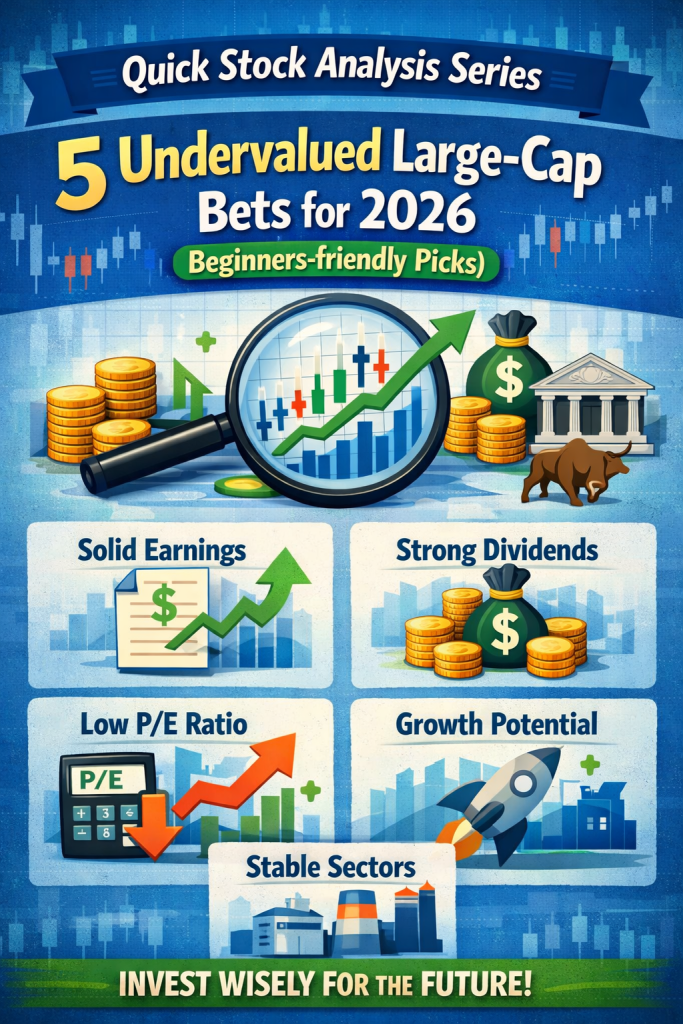
As 2026 unfolds, market volatility, sector rotation, and global uncertainties have created pockets of value in large-cap stocks. While mid and small caps saw sharp corrections recently, several fundamentally strong large-cap companies are trading at reasonable valuations compared to their historical averages.
In this edition of the Quick Stock Analysis Series, let’s look at five potentially undervalued large-cap stocks from banking, IT, and consumer sectors — explained in simple terms for beginner to intermediate investors.
1️⃣ HDFC Bank (Banking)
Why It Looks Attractive:
- Market leader in private banking
- Strong retail loan franchise
- Improving deposit growth after merger integration
- Historically trades at premium valuations
After the merger with HDFC Ltd, the stock went through a consolidation phase due to margin pressure and integration costs. However, long-term fundamentals remain intact. As loan growth stabilizes and margins improve, valuation rerating could follow.
Simple takeaway: A dominant bank temporarily facing integration challenges, not structural weakness.
2️⃣ Infosys (IT Services)
Why It Looks Attractive:
- Global IT outsourcing giant
- Strong cash reserves and dividend history
- AI and cloud capability expansion
- Valuations corrected after weak guidance cycles
IT stocks corrected globally due to recession fears and slower tech spending. However, digital transformation and AI adoption are long-term themes. Infosys remains one of the cleanest balance sheet plays in Indian IT.
Simple takeaway: Temporary slowdown, but long-term demand for tech services remains intact.
3️⃣ ITC Limited (Consumer + FMCG)
Why It Looks Attractive:
- Strong cash-generating cigarette business
- Fast-growing FMCG segment
- Attractive dividend yield
- Defensive during volatility
After a strong rally in previous years, ITC saw consolidation. However, steady earnings, pricing power, and diversification into FMCG, hotels, and agri-business make it relatively stable in uncertain markets.
Simple takeaway: A defensive large-cap with consistent cash flow and dividends.
4️⃣ State Bank of India (Banking – PSU Leader)
Why It Looks Attractive:
- Largest public sector bank in India
- Improved asset quality
- Strong credit growth
- Trading at reasonable price-to-book compared to private peers
PSU banks were re-rated significantly in 2023–2024. However, recent corrections have made valuations more reasonable. SBI benefits directly from India’s credit growth cycle.
Simple takeaway: A cyclical recovery story that has already cleaned up its balance sheet.
5️⃣ Hindustan Unilever Limited (Consumer Staples)
Why It Looks Attractive:
- Market leader in multiple FMCG categories
- Strong brand portfolio
- Rural demand recovery potential
- Historically premium valuation now slightly moderated
Consumer stocks underperformed due to rural slowdown and inflationary pressure. If rural demand improves in 2026, HUL could see earnings momentum return.
Simple takeaway: A quality compounder trading below its peak valuations.
Let’s now compare these stocks from a valuation and risk–reward perspective to simplify decision-making.
Here are two simple, beginner-friendly tables you can directly insert into your blog post under a new section titled:
📊 Valuation & Risk–Reward Snapshot (2026)
1️⃣ Simple Valuation Comparison Table (Illustrative)
| Company | Sector | P/E (Approx) | P/B (Approx) | Dividend Yield | Valuation View |
|---|---|---|---|---|---|
| HDFC Bank | Private Bank | Moderate vs history | ~2.5–3x | Low–Moderate | Slightly below historical premium |
| Infosys | IT Services | ~18–22x | High ROE justified | ~2%+ | Near lower end of cycle valuations |
| ITC Limited | FMCG + Tobacco | ~22–25x | Strong cash flows | ~3–4% | Reasonable for defensive play |
| State Bank of India | PSU Bank | Lower vs private peers | ~1.5–2x | Moderate | Attractive vs growth potential |
| Hindustan Unilever Limited | FMCG | ~40x (moderated) | Premium | ~1–1.5% | Below peak premium multiples |
How to Explain This to Beginners:
- P/E (Price-to-Earnings): How much investors are paying for ₹1 of earnings
- P/B (Price-to-Book): Commonly used for banks
- Dividend Yield: Annual cash return to shareholders
- Lower vs historical averages may signal better entry points
(Note: Multiples are rounded for simplicity and may vary with market movements.)
2️⃣ Risk–Reward Summary Table (Beginner-Friendly)
| Company | Growth Potential | Stability | Key Risk | Risk Level | Overall Risk–Reward View |
|---|---|---|---|---|---|
| HDFC Bank | Moderate–High | Very High | Margin pressure | Low–Moderate | Stable compounder with recovery upside |
| Infosys | Moderate | High | Global slowdown | Moderate | Cyclical recovery candidate |
| ITC Limited | Moderate | Very High | Regulatory/tax risk | Low | Defensive with steady returns |
| State Bank of India | High (credit cycle) | Moderate | Economic slowdown | Moderate | Higher beta but strong cycle tailwind |
| Hindustan Unilever Limited | Moderate | Very High | Rural demand weakness | Low | Premium quality at slightly better price |
Why Large Caps May Outperform in 2026
- Valuation gap between large caps and mid/small caps narrowed
- Institutional preference during volatility
- Better earnings visibility
- Stronger balance sheets
For beginner investors, large caps offer lower volatility, higher liquidity, and more predictable performance compared to smaller companies.
Key Risks to Watch
- Global recession impacting IT
- Interest rate volatility affecting banks
- Weak rural demand hurting FMCG
- Global commodity price fluctuations
No stock is risk-free — even large caps can underperform in the short term.
Final Thoughts
The goal isn’t to chase momentum — it’s to identify quality businesses temporarily trading at reasonable valuations.
If 2025 was about correction and consolidation, 2026 could reward patience in large-cap names with strong fundamentals.
Long-term wealth creation often comes from buying strong companies during phases of pessimism — not euphoria.
Disclaimer
This article is for educational and informational purposes only and should not be considered financial or investment advice. Stock market investments are subject to market risks. Please consult your financial advisor before making any investment decisions. The stocks mentioned are illustrative examples and not recommendations to buy or sell.


Leave a Reply