
Introduction
Recent market volatility has left many investors confused.
Sharp swings, sudden corrections, and uncertainty have made one thing clear — timing the market is difficult, but understanding businesses is essential.
With several stocks now trading below their recent highs, it might be tempting to jump in.
But smart investors know this isn’t the time for impulsive decisions —
it’s the time for careful analysis and clarity.
Instead of asking “What should I buy?”, the better question is:
👉 “How do I evaluate a stock properly?”
That’s where financial ratios come in.
They help you cut through the noise and focus on what truly matters — the fundamentals of a company.
In this post, let’s break down 6 essential financial ratios every investor should understand before making any investment decision.
📊 6 Financial Ratios Every Investor Must Know Before Buying Stocks
In a market filled with noise, news, and opinions, one thing remains constant — numbers don’t lie.
If you want to invest wisely and avoid costly mistakes, understanding financial ratios is not optional — it’s essential.
Here are 6 powerful financial ratios every investor should know before investing in any stock.
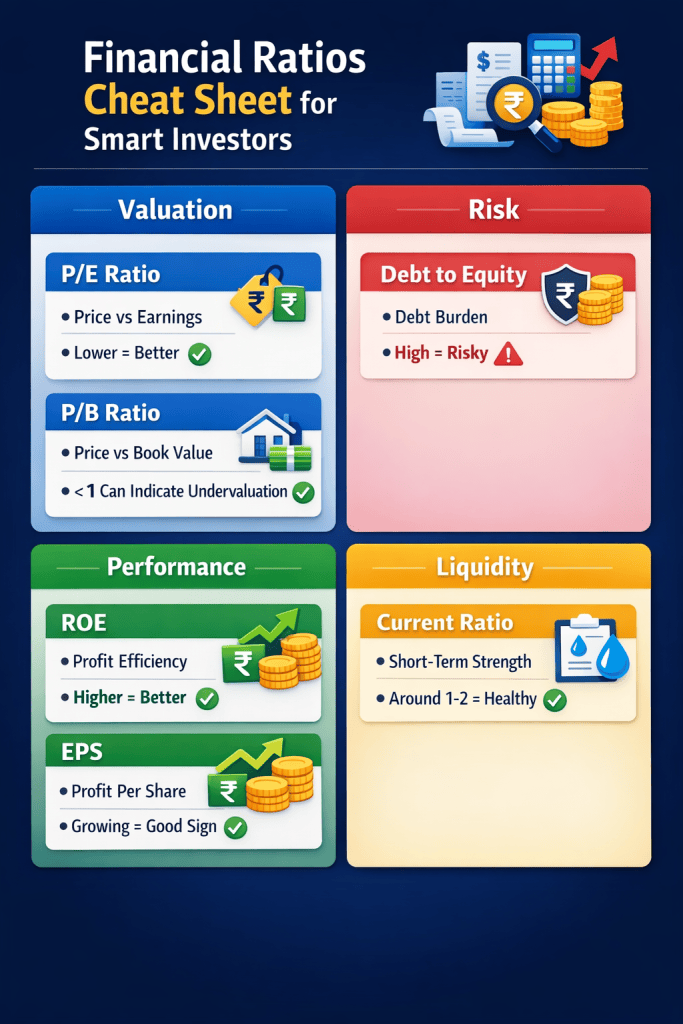
1️⃣ Price to Earnings Ratio (P/E)
What it tells you:
How much you are paying for ₹1 of a company’s earnings.
Formula:
P/E ={Price per Share}/{Earnings per Share}
How to use it:
- High P/E → Growth expectations
- Low P/E → Undervalued (or risky)
👉 Don’t judge it alone — compare within the same sector.
2️⃣ Price to Book Ratio (P/B)
What it tells you:
Whether a stock is trading above or below its actual value.
Formula:
P/B = {Market Price}/{Book Value per Share}
How to use it:
- P/B < 1 → Potential undervaluation
- High P/B → Strong market confidence
3️⃣ Debt to Equity Ratio (D/E)
What it tells you:
How much debt a company uses compared to its equity.
Formula:
D/E = {Total Debt}/{Shareholders’ Equity}
How to use it:
- High D/E → Risky (especially in downturns)
- Low D/E → Safer balance sheet
4️⃣ Return on Equity (ROE)
What it tells you:
How efficiently a company generates profit from shareholders’ money.
Formula:
ROE ={Net Income}/{Shareholders’ Equity}
How to use it:
- Higher ROE → Better efficiency
- Look for consistency over years
5️⃣ Current Ratio
What it tells you:
Whether the company can meet its short-term obligations.
Formula:
Current Ratio = {Current Assets}/{Current Liabilities}
How to use it:
- 1 → Healthy
- Too high → Inefficient use of assets
6️⃣ Earnings Per Share (EPS)
What it tells you:
Profit earned per share of the company.
Formula:
EPS = {Net Profit}/{Total Shares Outstanding}
How to use it:
- Rising EPS → Growth signal
- Declining EPS → Warning sign
⚠️ Final Thoughts
No single ratio can give you the full picture.
Smart investors always:
- ✅ Use multiple ratios together
- ✅ Compare with industry peers
- ✅ Track trends over time
Because in investing, clarity beats hype.
Disclaimer: This article is for educational and informational purposes only and should not be considered as financial advice. Please consult a financial advisor before making any investment decisions.


Leave a Reply