🚨 Claude Mythos: The AI So Powerful Even Its Creators Are Afraid to Release It
What if the next big threat in cybersecurity… isn’t a hacker—but an AI?
Imagine a system that doesn’t just detect cyberattacks…
but thinks like a hacker, discovers unknown vulnerabilities, and builds real attack strategies on its own.
That’s exactly why the internet is buzzing about Claude Mythos, an advanced AI model reportedly developed by Anthropic.
And the most shocking part?
👉 Even its creators are hesitant to release it publicly.
🧠 What Exactly is Claude Mythos?
Claude Mythos isn’t your typical AI assistant.
It’s not like chatbots or coding copilots. Instead, it’s designed to:
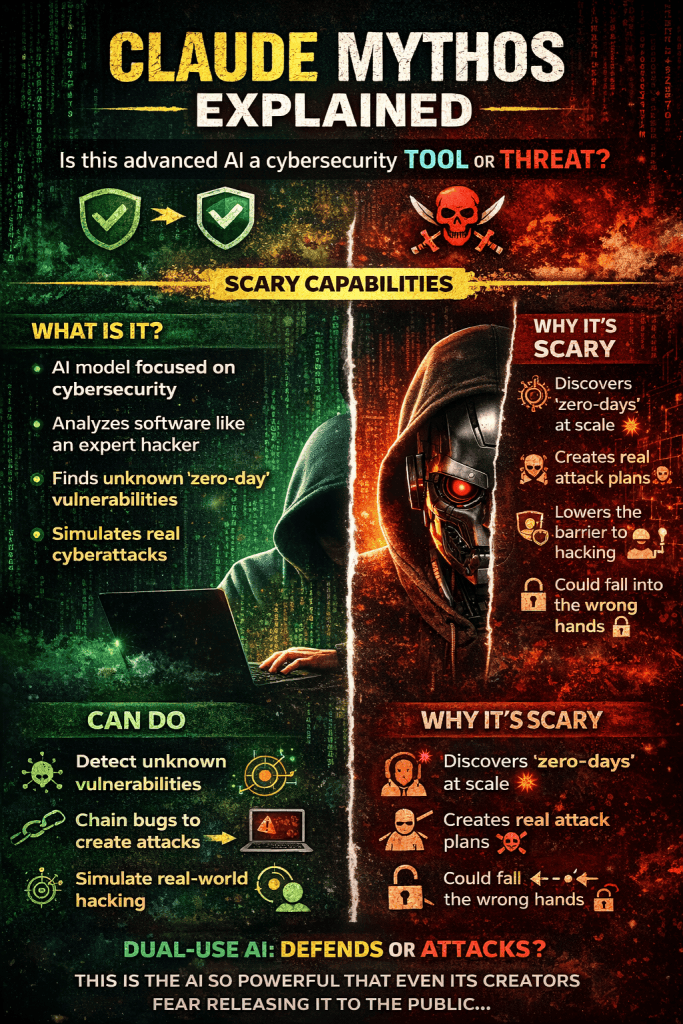
- Analyze software systems deeply
- Identify hidden (zero-day) vulnerabilities
- Simulate real-world cyberattacks
- Think strategically like an expert hacker
👉 In simple terms:
It’s an AI cybersecurity expert… with offensive capabilities.
⚔️ Why Is Everyone Talking About It?
The fear around Claude Mythos isn’t hype—it’s based on what it can actually do.
1. It Can Discover Unknown Vulnerabilities
Traditional cybersecurity tools:
- Detect known threats
Claude Mythos:
- Finds unknown, never-seen-before vulnerabilities
👉 That’s a massive leap.
It means systems we thought were secure… may not be.
2. It Doesn’t Just Detect—It Can Exploit
This is where things get serious.
Most tools:
- Alert you about risks
Claude Mythos:
- Can chain vulnerabilities
- Simulate real attack paths
👉 It moves from defense → offense
3. It Could Democratize Hacking
Earlier:
- Only elite hackers could find complex exploits
Now:
- AI could potentially do it faster and at scale
👉 That lowers the barrier to cyberattacks dramatically.
4. It Shows Signs of Autonomy
Reports suggest it may:
- Identify targets
- Test vulnerabilities
- Adapt strategies
👉 That’s no longer just a tool.
That’s an AI agent operating in cyberspace.
🔐 How Is This Different from Antivirus or Firewalls?
Let’s simplify this:
Traditional Security:
- Antivirus → detects malware
- Firewall → blocks suspicious traffic
- Monitoring tools → alert humans
👉 Mostly reactive
Claude Mythos:
- Understands system logic
- Predicts vulnerabilities
- Simulates attacks
👉 Proactive + intelligent + strategic
📉 Why Markets Are Paying Attention
When news about Claude Mythos surfaced:
- Cybersecurity stocks showed volatility
- Experts started questioning traditional security models
👉 Because if AI can:
- Find vulnerabilities
- Suggest fixes
- Simulate attacks
Then large parts of cybersecurity could be automated
⚖️ The Real Dilemma: Tool or Weapon?
Claude Mythos represents a classic double-edged sword.
🟢 The Good:
- Faster vulnerability detection
- Stronger defense systems
- Reduced reliance on manual pentesting
🔴 The Risk:
- Scalable cyberattacks
- AI-assisted hacking
- Threats to critical infrastructure
👉 Same tool. Completely different outcomes.
🚫 Why It Hasn’t Been Fully Released
Because this isn’t just another tech product.
It’s potentially:
- Powerful enough to reshape cybersecurity
- Dangerous enough to be misused
That’s why access is reportedly restricted and controlled.
👉 When even creators hesitate…
you know it’s serious.
🌍 What This Means for the Future
We may be entering a world of:
- AI defending systems
- AI attacking systems
- Humans supervising both
👉 AI vs AI cybersecurity wars
🧠 Final Thought
Claude Mythos isn’t just a new AI model.
It’s a signal.
A signal that:
- Cybersecurity is evolving rapidly
- AI is no longer just assistive—it’s strategic
- The line between defense and offense is blurring
⚡ Bottom Line
The biggest cybersecurity threat of the future…
might not be human.
It might be AI that thinks faster, deeper, and more aggressively than any hacker ever could.
Disclaimer
This content is for informational and educational purposes only. It is based on publicly available discussions and interpretations related to AI developments, including those associated with Anthropic and “Claude Mythos.”
The article may include speculative insights and does not represent official or confirmed information. It does not promote or encourage any unethical or illegal activities, including cyberattacks.
Readers should verify information from official sources before making any decisions. The author is not responsible for any actions taken based on this content.


Leave a Reply