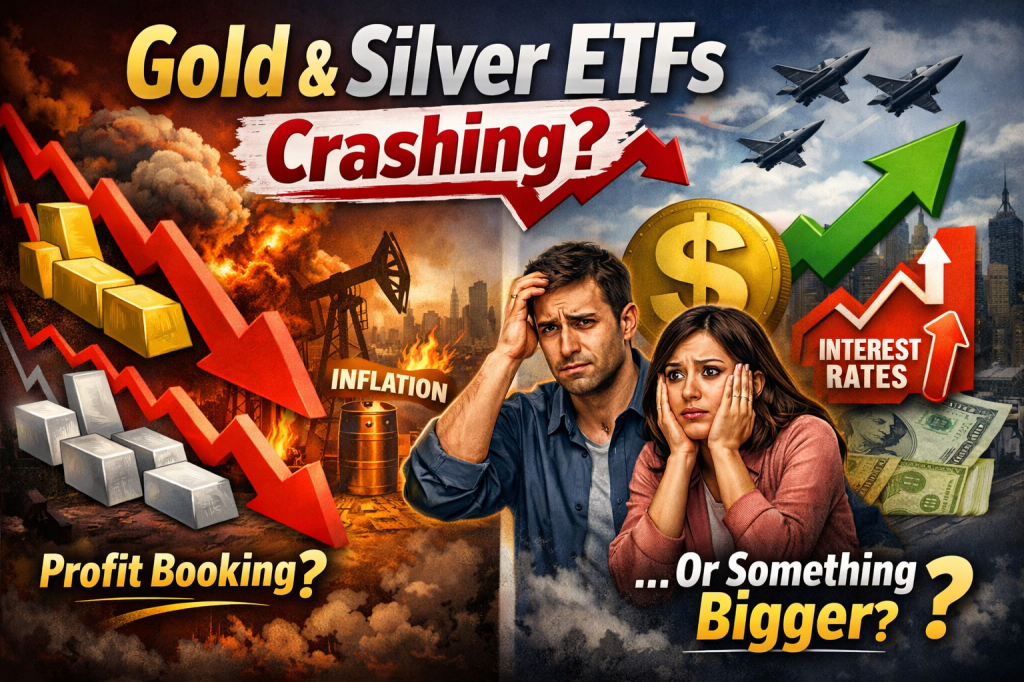
You are not alone if you suddenly opened Bing Trends or market headlines and saw “Gold ETF crash”, “Silver ETF decline”, “Precious metals correction” everywhere.
For many retail investors, this feels confusing.
Because usually when:
- wars rise,
- uncertainty increases,
- inflation fears grow…
…gold and silver are expected to rise.
Yet recently, many Gold & Silver ETFs have seen sharp corrections and extreme volatility.
So what exactly is happening?
Is this a market warning signal?
Or simply profit booking after a massive rally?
Here’s the bigger picture every investor should understand.
First — What Actually Fell?
There are three separate things people are mixing together:
1. Physical Gold & Silver Prices
These are the actual international commodity prices.
2. Gold & Silver ETFs
These trade like stocks on exchanges.
3. ETF Market Price vs ETF NAV
This is the hidden factor most retail investors ignore.
Sometimes ETF prices fall more sharply than actual gold/silver prices because panic selling creates temporary discounts or premium unwinding. (ETF Central)
That’s why some investors suddenly saw shocking red numbers even when physical metal prices had not crashed equally.
So Why Are Gold & Silver ETFs Falling?
1. Massive Profit Booking After Historic Rally
This is probably the biggest reason.
Gold and silver had already delivered extraordinary rallies over the past year.
According to the World Gold Council, gold hit more than 50 all-time highs in 2025 and returned over 60% during the bull run. (World Gold Council)
Silver became even more explosive.
After such huge rallies, many institutional traders and hedge funds simply started booking profits.
This is normal market behavior.
Markets do not move in straight lines forever.
2. Higher Interest Rate Fears Are Hurting Metals
Gold and silver are “non-yielding assets.”
That means:
- they do not pay interest,
- they do not generate cash flow like bonds,
- they do not produce earnings like companies.
So when investors believe:
- US interest rates may stay high longer,
- inflation may remain sticky,
- bond yields may rise…
…money starts shifting toward fixed-income assets.
Recent global tensions and inflation concerns increased expectations that the US Federal Reserve may remain hawkish for longer. (Reuters)
And that creates pressure on precious metals.
3. Stronger US Dollar = Pressure on Commodities
Gold and silver are priced globally in US dollars.
When the dollar strengthens:
- commodities often weaken,
- emerging market flows slow,
- metals become expensive globally.
This has been another major reason behind recent weakness in silver ETFs especially. (The Economic Times)
4. Silver Is Not Just a Safe-Haven Asset
This is important.
Gold behaves mostly like a “fear asset.”
Silver is different.
Silver is both:
- a precious metal,
- AND an industrial metal.
It is heavily used in:
- solar panels,
- EVs,
- electronics,
- green energy manufacturing.
So when markets fear:
- economic slowdown,
- manufacturing slowdown,
- weak industrial demand…
silver often falls harder than gold. (Business Standard)
That is why silver ETFs became far more volatile recently.
5. ETF Premiums & Discounts Created Extra Panic
This is the technical reason many investors missed.
During volatile phases:
- ETF buyers disappear,
- sellers rush to exit,
- liquidity gaps widen.
As a result:
- ETF market price may temporarily trade below actual NAV,
- discounts widen sharply,
- panic looks worse than reality.
Experts noted that some gold and silver ETFs fell much more than the actual metal prices because of this phenomenon. (The Economic Times)
This does not always mean the underlying asset itself collapsed.
But Wait… Why Are Stock Markets Still Strong Then?
Interestingly, global equity markets have remained surprisingly resilient despite:
- geopolitical tensions,
- oil volatility,
- inflation concerns.
Why?
Because markets are currently focusing on:
- strong corporate earnings,
- AI-led investment boom,
- liquidity flows,
- optimism about long-term growth. (Reuters)
In short:
Money is temporarily favoring “growth assets” over “defensive assets.”
That can change anytime.
But right now, this is the dominant market mood.
Is This the End of the Gold & Silver Bull Market?
That’s the biggest question.
And honestly — nobody knows with certainty.
But here’s what many analysts still believe:
Long-Term Drivers for Gold Still Exist
- Central bank buying continues.
- Global debt remains enormous.
- Geopolitical tensions remain unresolved.
- Inflation risks are not fully gone.
- Currency uncertainty still exists.
Even after corrections, many analysts still believe gold’s long-term structural story remains intact. (World Gold Council)
What Should Retail Investors Learn From This?
Lesson 1:
Never assume “safe-haven assets” only go up during crises.
Markets are more complex now.
Interest rates, bond yields, currency strength, liquidity flows, and institutional positioning matter enormously.
Lesson 2:
Silver is far more volatile than gold.
If gold feels emotional…
silver feels psychological.
Lesson 3:
ETF prices can temporarily behave irrationally.
Short-term panic in ETFs does not always reflect long-term fundamentals.
Expert’s Take on the Current Situation
This currently looks more like:
- a correction,
- profit booking,
- and repositioning…
…rather than a complete collapse of the precious metals story.
But volatility may continue.
Especially if:
- the US dollar strengthens further,
- rate cuts get delayed,
- global growth slows,
- or geopolitical tensions suddenly cool down.
At the same time…
If markets again fear:
- recession,
- financial instability,
- inflation resurgence,
- or currency weakness…
gold and silver could quickly regain momentum.
That’s how emotional and macro-driven these assets are.
Final Thought
The biggest mistake investors make is assuming markets move based only on headlines.
Reality is much deeper.
Sometimes:
- war rises → gold rises.
- But sometimes:
- war rises → inflation fears rise → rate hike fears rise → dollar strengthens → gold falls.
Markets are interconnected ecosystems.
And that is exactly why investing is never as simple as social media narratives make it sound.
⚠️ Market Disclaimer:
Investing in stocks, gold, silver, ETFs, and other financial assets involves market risk. This article is written for educational discussion and market awareness purposes only. It is not a recommendation to buy or sell any security or asset. Market conditions can change rapidly due to global events, interest rates, economic data, and investor sentiment. Always do your own research and assess your risk tolerance before investing.


Leave a Reply