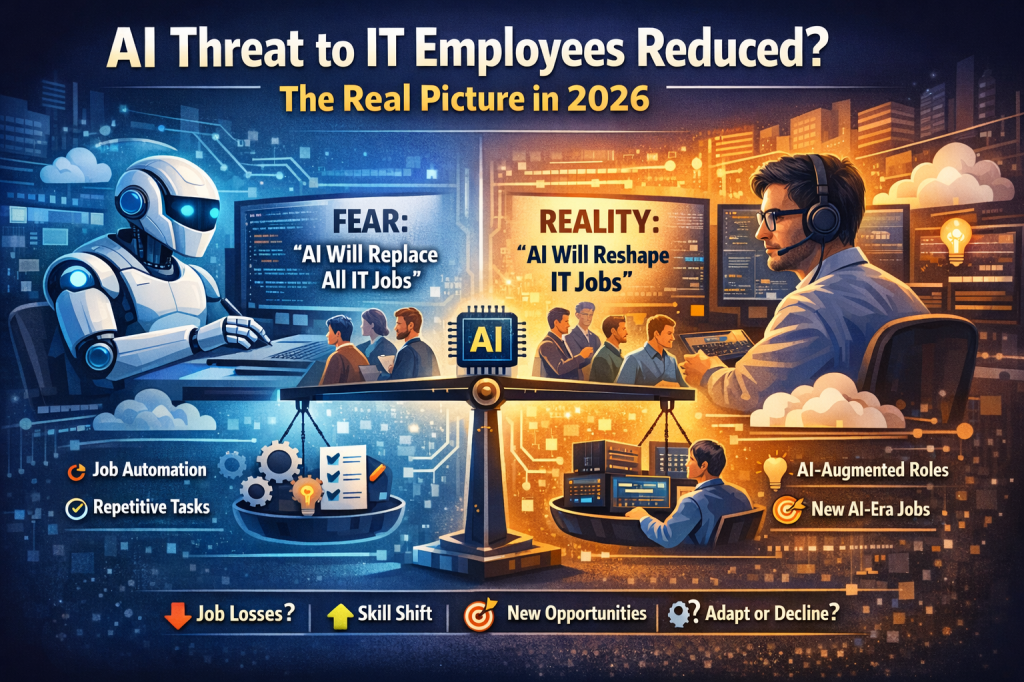
For the last few years, Artificial Intelligence has been one of the biggest fears haunting the global IT industry.
When advanced AI tools and coding assistants exploded into public view, many believed the software industry was heading toward mass layoffs and job destruction.
Social media was flooded with claims like:
- “Developers will disappear”
- “AI will replace programmers”
- “IT jobs are dead”
But now in 2026, the conversation is changing.
The fear hasn’t disappeared completely — but the narrative has become far more realistic.
So, has the AI threat to IT employees actually reduced?
The answer is both yes and no.
The Early Panic vs Today’s Reality
In 2023–2024, AI demonstrations shocked the world.
Tools from companies like OpenAI, Microsoft, and Google DeepMind showed machines writing code, generating content, debugging programs, and automating tasks in seconds.
Naturally, people assumed:
“If AI can code, why would companies need developers?”
But enterprises soon discovered an important limitation:
AI is powerful — but not autonomous.
It can assist.
It can accelerate productivity.
It can automate repetitive tasks.
But it still struggles with:
- complex business understanding
- large-scale software architecture
- legacy systems
- accountability
- security and compliance
- client communication
- real-world ambiguity
And these areas form the backbone of enterprise IT.
So What Changed?
The biggest change is this:
The fear shifted from:
“AI will replace all IT jobs”
to:
“AI will reshape IT jobs.”
That is a massive difference.
Companies are increasingly treating AI as:
- a productivity enhancer
- a software co-pilot
- an automation layer
rather than a complete human replacement.
Where the Real Pressure Exists
This does not mean the threat disappeared.
The impact is simply becoming more selective.
Most Vulnerable Areas
AI is putting pressure on:
- repetitive coding work
- template-based development
- basic testing operations
- documentation-heavy tasks
- low-level support functions
Earlier, companies may have hired:
- 10 junior developers
Now, with AI-assisted workflows:
- 3–5 developers may achieve similar output.
This is one reason fresher hiring in parts of the IT sector has become more cautious.
The Winners of the AI Era
At the same time, many professionals are becoming more valuable because of AI.
These include:
- senior developers
- AI-integrated engineers
- cloud specialists
- cybersecurity experts
- DevOps engineers
- data engineers
- solution architects
Why?
Because companies now need professionals who can:
- manage AI systems
- verify outputs
- integrate AI into workflows
- handle security and governance
- solve high-level business problems
In many cases, AI is amplifying skilled employees rather than replacing them.
New Jobs Are Emerging Too
Ironically, AI is also creating entirely new opportunities.
Demand is growing for:
- AI infrastructure
- GPU/cloud optimization
- model deployment
- AI governance
- AI security
- workflow automation
- data quality engineering
This is one reason companies like NVIDIA continue seeing enormous demand in the AI ecosystem.
Why Indian IT Is Still Standing Strong
For India, the story is even more interesting.
Indian IT companies such as:
are deeply integrated into global enterprise systems.
Their business is not just coding.
It includes:
- consulting
- migration
- integration
- maintenance
- client coordination
- compliance
- long-term support
Global corporations cannot simply replace entire enterprise ecosystems overnight with AI tools.
In fact, many clients now want help with:
“How do we adopt AI safely?”
That itself has become a business opportunity for IT firms.
Why Stock Markets Are Less Fearful Now
Initially, markets worried AI would severely damage employment-heavy IT companies.
But investors are gradually realizing:
- AI can improve productivity
- AI can improve margins
- AI transformation itself is becoming a service business
This is why IT stocks sometimes recover even amid ongoing AI disruption discussions.
Markets are beginning to view AI not only as a threat — but also as a new revenue opportunity.
Final Thoughts
The truth lies somewhere between panic and denial.
Wrong Extreme #1
“AI will destroy all IT jobs.”
Probably unrealistic.
Wrong Extreme #2
“AI changes nothing.”
Also unrealistic.
The more balanced reality is:
- repetitive jobs may shrink
- productivity expectations may rise
- skilled professionals may become more valuable
- AI tools may become standard workplace companions
Just as:
- cloud computing transformed infrastructure
- automation transformed manufacturing
- the internet transformed media
AI is now transforming the IT industry.
Not necessarily eliminating it.
Disclaimer
This article is for informational and educational purposes only and should not be considered financial, career, or investment advice. Technology trends and market conditions can change rapidly. Readers should conduct their own research before making career or investment decisions.


Leave a Reply