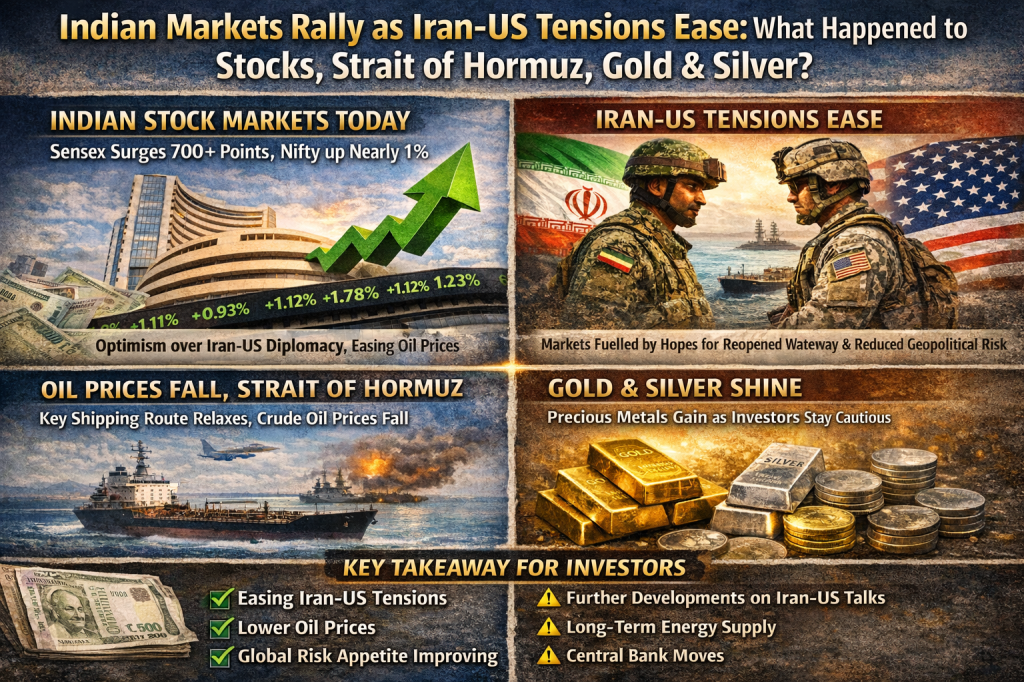
Global markets witnessed a major shift today as investors reacted to developments around the United States-Iran conflict, the Strait of Hormuz situation, crude oil prices, and precious metals.
Indian stock markets moved sharply higher, while oil prices cooled after reports of progress between the US and Iran. At the same time, gold and silver continued to attract attention because investors are still watching geopolitical risks closely.
Let us understand the complete picture.
Indian Stock Markets Today: Why Did Sensex and Nifty Rise?
Indian markets had a strong session today.
The Sensex closed around 700+ points higher, while the Nifty also gained nearly 1%. The rally was supported mainly by global optimism after news that the US-Iran situation may be moving towards a diplomatic solution and that the Strait of Hormuz could reopen.
Why did this matter for India?
Because India is heavily dependent on imported crude oil.
When crude oil prices rise:
- India’s import bill increases
- The rupee can come under pressure
- Inflation concerns increase
- Corporate margins, especially for oil-consuming industries, can get affected
So when oil prices fall, investors often see relief for the Indian economy.
Today’s market rally was not only about buying stocks — it was also about reducing a major global risk factor.
US-Iran Face-Off: What Changed?
For weeks, markets were worried about escalation between the US and Iran.
The biggest fear was that the conflict could spread further and disrupt global energy supplies.
However, reports today suggested that the US and Iran reached an understanding aimed at ending hostilities and reopening the Strait of Hormuz.
Markets reacted immediately because geopolitical uncertainty often creates a risk premium.
When investors fear war:
- They move towards safe assets
- Oil prices usually rise
- Stock markets become volatile
When tensions reduce:
- Risk appetite returns
- Equity markets often recover
- Oil prices can cool
However, investors should remember that geopolitical agreements can take time to fully materialise. Markets may celebrate headlines first and then analyse the actual details later.
Strait of Hormuz: Why Is It So Important?
The Strait of Hormuz is one of the world’s most important energy routes.
A large portion of global oil and gas shipments pass through this narrow waterway.
Any disruption can create:
- Higher crude oil prices
- Increased transportation costs
- Inflation pressure across countries
This is why every headline related to Hormuz creates immediate reactions in stock markets and commodities.
The recent easing of tensions pushed crude prices lower, with reports showing oil falling sharply as hopes increased that shipping activity through the Strait could resume normally.
What Happened to Gold?
Interestingly, gold did not collapse even after geopolitical fears reduced.
Gold prices actually moved higher, with reports showing a strong rise as investors continued to monitor global risks and currency movements.
Why can gold rise even when war fears reduce?
Because gold is influenced by many factors:
1. Central bank buying
Many central banks continue to view gold as a reserve asset.
2. Interest rate expectations
Markets are watching the US Federal Reserve closely. Expectations about future interest rates influence gold because lower rates generally make non-interest-bearing assets like gold more attractive.
3. Currency movements
A weaker US dollar can support gold prices because gold becomes cheaper for holders of other currencies.
So gold is not only a “war asset”. It is also a monetary and inflation-related asset.
What About Silver?
Silver also gained attention.
Unlike gold, silver has two personalities:
- Precious metal
- Industrial metal
Silver is used in:
- Solar energy equipment
- Electronics
- Industrial applications
So silver prices depend not only on fear and uncertainty but also on global economic growth expectations.
Reports indicated silver also moved higher along with other precious metals during today’s market activity.
What Does This Mean for Indian Investors?
Today’s rally is positive, but investors should avoid looking at one day’s movement in isolation.
The market is currently balancing multiple factors:
Positive factors:
✔ Lower crude oil pressure
✔ Improved geopolitical sentiment
✔ Better global risk appetite
Risks:
⚠ Final details of the US-Iran understanding
⚠ Future oil supply developments
⚠ Inflation trends
⚠ Global interest rate decisions
The biggest lesson is that markets react quickly to headlines, but long-term investors should focus on business quality, valuations and economic fundamentals.
Final Thoughts
Today’s market movement shows how connected the world has become.
A geopolitical event in the Middle East can influence:
- Indian stocks
- Rupee movement
- Crude oil
- Gold and silver prices
- Inflation expectations
For investors, the key is not predicting every headline. The key is understanding how these events flow through the economy and impact different assets.
Markets will now watch whether the US-Iran developments translate into a lasting agreement or whether uncertainty returns.
For now, the market has received a temporary relief signal — but investors should continue watching the bigger picture.
Disclaimer: This article is for educational and informational purposes only and should not be considered investment advice. Investors should conduct their own research and consult a qualified financial advisor before making investment decisions.


Leave a Reply