Introduction
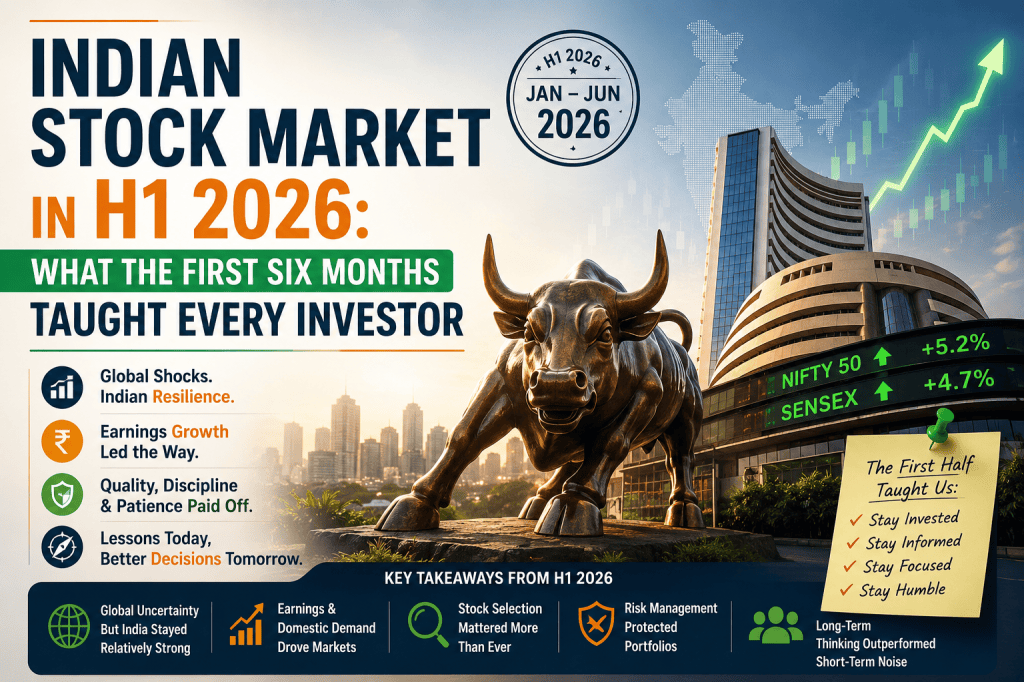
The first half of 2026 reminded investors of an important truth:
Markets rarely move in a straight line.
Between January and June, Indian equity markets witnessed periods of optimism, panic, relief rallies, sector rotations and renewed buying interest. Investors had to digest everything—from geopolitical conflicts and volatile crude oil prices to changing interest-rate expectations, foreign institutional investor (FII) flows, corporate earnings and sector-specific developments.
Yet despite all the uncertainty, one thing stood out.
The Indian market remained remarkably resilient.
That does not mean everything was perfect.
Several risks that emerged during the first half of the year continue to deserve attention. At the same time, many fears that dominated headlines turned out to be temporary.
Rather than celebrating every rally or worrying about every correction, investors should understand what actually happened—and what lessons it offers for the second half of 2026.
1. Geopolitics Dominated Headlines More Than Corporate News
If someone followed only financial news during the first half of 2026, they might think every market movement was caused by geopolitics.
The Iran conflict, the involvement of the United States, concerns around the Strait of Hormuz, shipping disruptions and fears of higher crude oil prices repeatedly shook investor confidence. Markets experienced sharp swings whenever headlines suggested escalation or de-escalation. (Navia)
For India, these developments were particularly important because:
- India imports most of its crude oil.
- Higher oil prices increase inflationary pressure.
- A wider trade deficit can weaken the rupee.
- Companies dependent on imported energy face higher costs.
Fortunately, investors gradually realised that not every geopolitical event translates into a long-term economic crisis. Markets began distinguishing between temporary news shocks and structural economic damage.
That maturity helped limit panic selling.
2. Corporate Earnings Became the Real Driver
While headlines focused on war, quarterly results quietly determined which stocks rewarded investors.
The market increasingly differentiated between:
- companies delivering strong earnings,
- companies merely meeting expectations,
- and companies disappointing investors.
This is exactly how healthy markets are supposed to function.
Several companies continued to deliver robust profit growth, while others struggled with slowing demand, weaker margins or cautious management guidance. Recent results from TCS, for example, reassured investors with better-than-expected revenue and AI-related growth, although analysts remained cautious about a broad-based IT recovery. (Reuters)
The lesson was simple:
Good businesses recovered faster than weak businesses.
3. Sector Rotation Became the Theme of 2026
One of the biggest characteristics of H1 2026 was sector rotation.
Money did not leave the market entirely.
Instead, it kept moving from one sector to another.
Throughout the six months, investors witnessed changing leadership among:
- Banking
- Information Technology
- Defence
- Capital Goods
- Infrastructure
- Pharmaceuticals
- Metals
- Consumer sectors
Whenever one sector looked expensive, investors searched for value elsewhere.
This prevented the market from becoming entirely one-sided.
4. IT Sector: Signs of Recovery, But Not Full Strength
The Indian IT sector entered 2026 carrying the burden of global uncertainty.
Concerns included:
- slower US economic growth,
- cautious corporate technology spending,
- delayed client decisions,
- and uncertainty surrounding AI investments.
However, the picture slowly became more balanced.
Large IT companies began demonstrating that AI is creating new revenue opportunities even though traditional outsourcing growth remains moderate. Recent earnings from TCS reflected this trend, but analysts continue to expect a gradual, rather than rapid, sector recovery. (Reuters)
Investors expecting explosive growth immediately may still need patience.
5. Banking Continued to Support the Market
Indian banks largely remained one of the strongest pillars of the market.
Healthy credit growth, relatively stable asset quality and continued economic activity helped maintain investor confidence.
Private sector banks, in particular, continued attracting long-term investors whenever valuations became attractive.
The banking sector once again proved why it occupies such a large weight in benchmark indices.
6. Foreign Investors Changed Their Behaviour
The first half of the year also highlighted the changing role of foreign investors.
Instead of continuous selling seen during earlier phases, foreign institutional investors became more selective.
Whenever valuations became attractive and global risk appetite improved, FIIs returned to Indian equities, particularly financial stocks. (The Economic Times)
At the same time, domestic institutional investors continued acting as an important stabilising force.
India’s growing SIP culture has fundamentally changed market dynamics.
Retail participation is no longer a temporary phenomenon.
7. Valuations Finally Started Mattering Again
One encouraging development during H1 2026 was that investors gradually became more valuation-conscious.
In previous years, many stocks rose simply because money kept flowing into the market.
This year was different.
Companies with expensive valuations but weak earnings were punished.
Meanwhile, fundamentally stronger companies attracted fresh buying after corrections.
That is healthier for long-term investors.
8. Not Every Rally Was Built on Strong Fundamentals
This is where investors should remain cautious.
Some rallies were driven more by:
- improving sentiment,
- short covering,
- easing geopolitical fears,
- or liquidity,
than by significant improvements in business performance.
Markets often move ahead of earnings.
Eventually, however, earnings must justify valuations.
If profits fail to catch up, volatility usually returns.
9. The Indian Economy Continued Showing Structural Strength
Despite multiple global challenges, India’s broader economic story remained intact.
Several supportive factors continued throughout the first half:
- Infrastructure spending
- Manufacturing expansion
- Domestic consumption
- Digitalisation
- Financial inclusion
- Increasing retail participation in capital markets
These structural drivers explain why corrections repeatedly attracted buyers instead of triggering prolonged panic.
However, challenges such as inflation risks, crude oil dependence, global growth concerns and weather-related uncertainties—including the impact of the monsoon on rural demand—still require monitoring. (The Times of India)
10. The Biggest Lesson Investors Should Learn
Perhaps the biggest lesson from H1 2026 is this:
Markets react immediately. Economies change slowly.
Every geopolitical headline moved prices.
Every quarterly result moved stocks.
Every inflation number influenced expectations.
But long-term wealth creation continued rewarding investors who focused on business quality rather than daily noise.
Trying to predict every market movement remained nearly impossible.
Understanding businesses remained far easier.
What Investors Should Watch in H2 2026
The second half of the year could be influenced by:
- Corporate earnings consistency
- Crude oil prices
- Global interest-rate decisions
- Geopolitical developments in West Asia
- FII and DII investment trends
- Inflation trajectory
- Rural demand and monsoon performance
- Government policy initiatives
- Valuations across sectors
None of these factors alone will decide the market.
Together, however, they will shape investor sentiment.
Final Thoughts
The first half of 2026 was not a story of uninterrupted optimism or constant fear.
It was a reminder that markets constantly balance hope against uncertainty.
Yes, geopolitical tensions created volatility.
Yes, some sectors underperformed.
Yes, certain companies disappointed investors.
But the broader Indian equity market demonstrated resilience because it is increasingly supported by domestic capital, improving corporate governance and long-term economic growth.
Investors should neither become complacent after rallies nor fearful after corrections.
Instead, H1 2026 reinforces a timeless investing principle:
Short-term market movements are driven by headlines. Long-term returns are driven by business fundamentals, earnings growth and disciplined investing.
Disclaimer: This article is for educational and informational purposes only and should not be considered investment advice. Investors should conduct their own research and consult a qualified financial advisor before making investment decisions.
Please read Winners & Laggards of H1 2026 and 10 Lessons Every Indian Investor Should Take from H1 2026


Leave a Reply