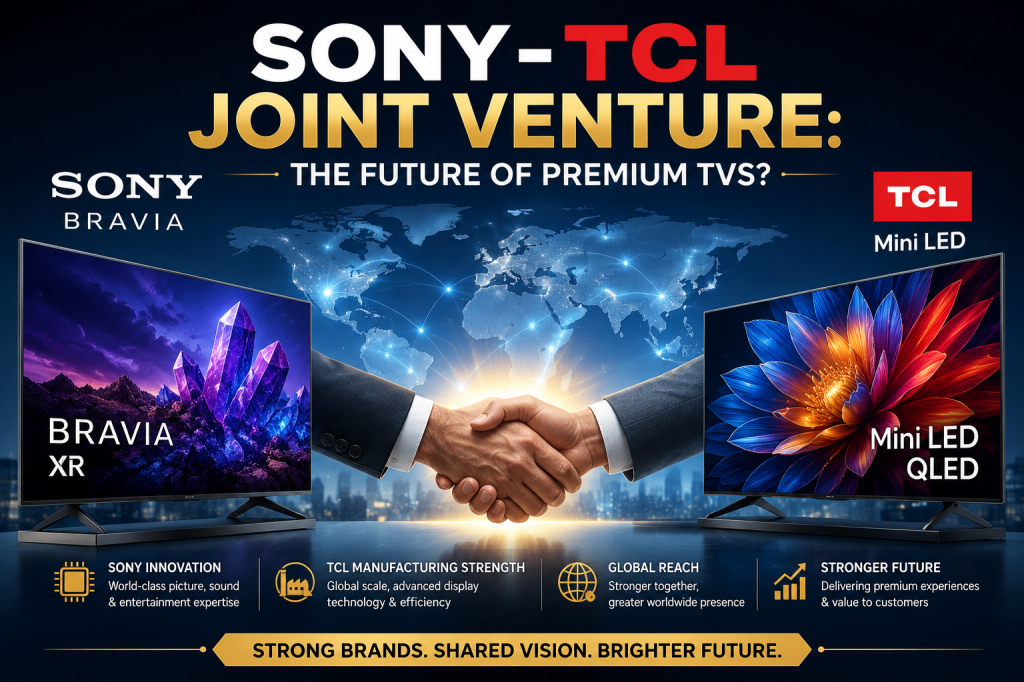
The global television industry has witnessed one of its biggest strategic developments in recent years. Japanese electronics giant Sony and Chinese consumer electronics leader TCL Electronics have officially entered into a strategic joint venture that will combine Sony’s premium home entertainment business with TCL’s manufacturing strength and display technology.
For consumers, investors, and technology enthusiasts alike, the announcement raises several important questions.
- Is Sony selling its television business?
- Will BRAVIA TVs still be Sony products?
- Why would Sony partner with TCL?
- What does this mean for competition with Samsung and LG?
- Will television prices become more competitive?
Let’s understand everything in detail.
What Exactly Is the Sony-TCL Joint Venture?
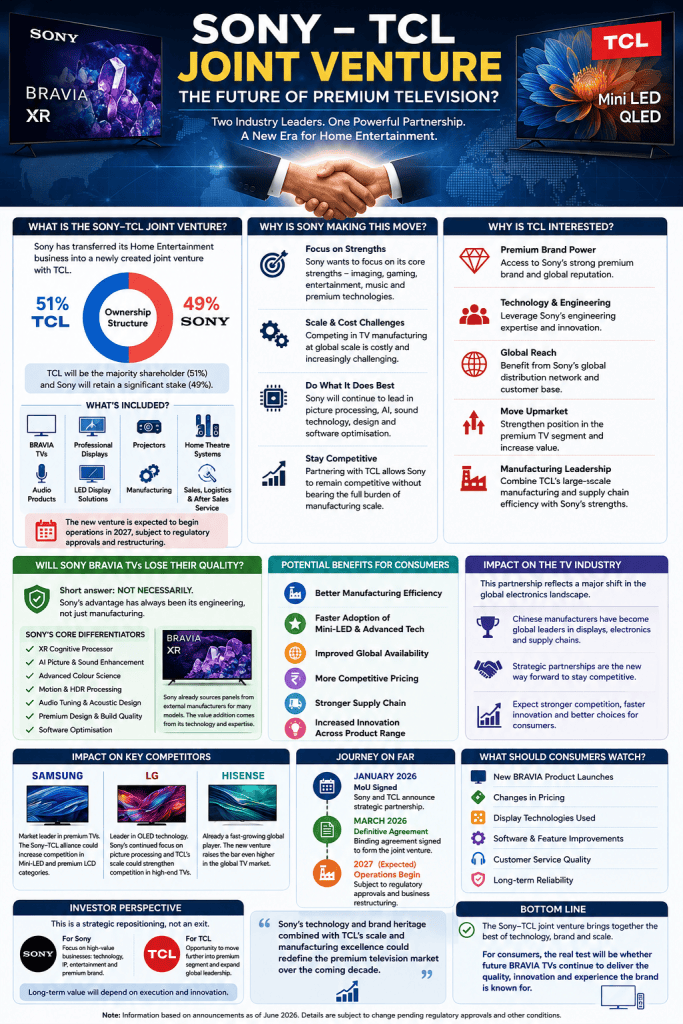
Sony has decided to transfer its Home Entertainment business into a newly created joint venture.
Under the agreement:
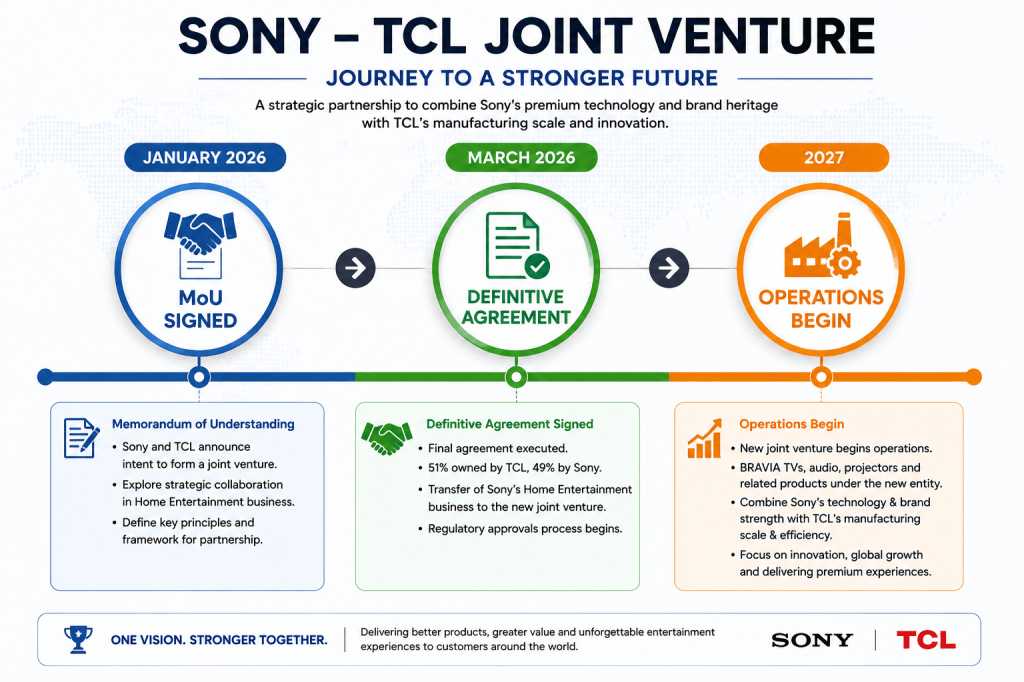
- TCL will own 51%
- Sony will retain 49%
This means TCL will become the majority shareholder while Sony continues as a significant strategic partner. The new company will manage Sony’s home entertainment operations globally.
The business transferred includes:
- BRAVIA consumer televisions
- Professional BRAVIA displays
- LED display solutions
- Projectors
- Home theatre systems
- Audio components
- Manufacturing
- Sales
- Logistics
- Customer service
The new venture is expected to begin operations in 2027 after regulatory approvals and business restructuring.
Why Did Sony Make This Move?
Many people initially assumed Sony was exiting the TV business.
That is not the case.
Sony has struggled for years with maintaining scale in television manufacturing.
The television market today is dominated by companies capable of producing millions of panels every year at lower costs.
Meanwhile, Sony has increasingly focused on:
- Imaging sensors
- Gaming (PlayStation)
- Entertainment
- Music
- Films
- Professional imaging
Televisions remain important to Sony’s brand, but manufacturing them independently has become increasingly challenging.
Instead of competing solely on manufacturing volume, Sony wants to focus on what it does best:
- Picture processing
- AI image enhancement
- Sound technologies
- Premium design
- Software optimisation
- BRAVIA brand value
TCL, on the other hand, excels in large-scale manufacturing and supply chain efficiency. The partnership allows Sony to stay competitive without bearing the full cost of production.
Why Is TCL Interested?
For TCL, this partnership is equally significant.
Over the past decade, TCL has become one of the world’s largest television manufacturers by investing heavily in:
- LCD panels
- Mini-LED technology
- Global production facilities
- Vertical integration
- Display innovation
Despite its technological capabilities, Sony continues to enjoy stronger premium brand recognition in many global markets.
Through this partnership, TCL gains access to:
- Sony’s engineering expertise
- Premium brand association
- Global distribution experience
- High-end customer base
- Professional display business
This could significantly strengthen TCL’s position in the premium television segment.
Will Sony BRAVIA TVs Lose Their Quality?
This is probably the biggest concern among consumers.
The short answer is:
Not necessarily.
Sony’s reputation has never been based solely on manufacturing panels.
Instead, Sony has differentiated itself through:
- XR Cognitive Processor
- Advanced picture calibration
- Motion processing
- Colour science
- Audio tuning
- Software optimisation
Even today, Sony already sources display panels from external manufacturers for many models.
The value addition comes from Sony’s engineering rather than manufacturing every component in-house.
Therefore, if Sony continues controlling software, image processing, and product design, BRAVIA televisions could retain their premium experience despite changes in manufacturing arrangements.
Could Consumers Benefit?
Potentially yes.
If the partnership succeeds, buyers may benefit through:
- Better manufacturing efficiency
- Faster adoption of Mini-LED technology
- Improved global availability
- More competitive pricing
- Better supply chains
- Increased innovation
Combining Sony’s premium technologies with TCL’s manufacturing scale could create attractive products across different price segments.
What Does This Mean for the TV Industry?
The partnership reflects a much larger industry trend.
Years ago, Japanese companies dominated consumer electronics.
Today, Chinese manufacturers have emerged as global leaders in:
- Display manufacturing
- Consumer electronics
- Component production
- Supply chain management
Brands such as TCL and Hisense have invested aggressively in research, manufacturing capacity, and display technologies.
Rather than competing independently, established brands are increasingly choosing strategic partnerships to remain competitive.
This Sony-TCL collaboration is a clear example of that transformation.
Impact on Competitors
The deal could intensify competition across the television industry.
Samsung
Samsung remains the global market leader in premium televisions. A stronger Sony-TCL alliance could increase competition in Mini-LED and premium LCD categories.
LG
LG continues to dominate OLED technology. Sony’s continued focus on picture processing, combined with TCL’s manufacturing capabilities, could strengthen competition in high-end televisions.
Hisense
Hisense has expanded rapidly worldwide. The new Sony-TCL venture raises the competitive bar further in global consumer electronics.
What Should Consumers Watch?
Over the next few years, consumers should monitor:
- New BRAVIA product launches
- Changes in pricing
- Display technologies used
- Software improvements
- Customer service quality
- Long-term reliability
The first televisions fully developed under the joint venture will provide the clearest indication of how successful the partnership becomes.
Investor Perspective
Although televisions represent only one part of Sony’s diversified business, the partnership demonstrates a broader strategic trend:
Rather than investing heavily in low-margin manufacturing, Sony is increasingly focusing on higher-value activities such as technology, software, intellectual property, entertainment, and premium branding.
For TCL, the deal represents an opportunity to move further into the premium segment while strengthening its global presence.
Investors should view this as a strategic repositioning rather than simply a change in ownership.
Final Thoughts
The Sony-TCL joint venture is not merely a corporate restructuring—it represents the changing balance of power in the global electronics industry.
Sony contributes decades of expertise in picture quality, software optimisation, audio engineering, and premium branding. TCL contributes manufacturing scale, display innovation, cost efficiency, and a robust global supply chain.
If both companies successfully leverage their respective strengths, the partnership could redefine the premium television market over the coming decade.
For consumers, the ultimate question will not be who owns a larger stake in the venture, but whether future BRAVIA televisions continue to deliver the picture quality, reliability, and user experience that have made the brand a trusted name for years.
Disclaimer: This article is for educational and informational purposes only and should not be construed as investment advice. Investors should conduct their own research or consult a qualified financial advisor before making any investment decisions.


Leave a Reply