The lake appeared first as a shimmer.
Then as a wide, still expanse of gold — the evening sun laid across its surface like something poured rather than reflected. The hill station fell away on both sides, pine trees descending to the water’s edge, the mountains rising behind them in their familiar layers of green and blue and distant grey.
As Raag walked towards the shore, the calls of wild and migratory birds flying were the first to grab his attention, along with the devotional songs floating through the wind from the temples located on the shores of the lake.
The crowd and the Hindi, Punjabi and Haryanvi songs from the small shops near the shore were trying to compete with the overall ambience.
Raag stopped walking when he saw it. Just for a moment. Just long enough for it to settle somewhere inside him.
“Bhaiya.” Chandra tugged his sleeve. “The boats are this way.”
Rahul had booked two boats.
The elders took the first — Ramesh and Raghuram settling in with the comfortable authority of men who had spent their lives solving practical problems, Padmaja and Mythili immediately continuing a conversation that had apparently been going on since the car, both of them already laughing about something nobody else had heard.
The young men and children took the second.
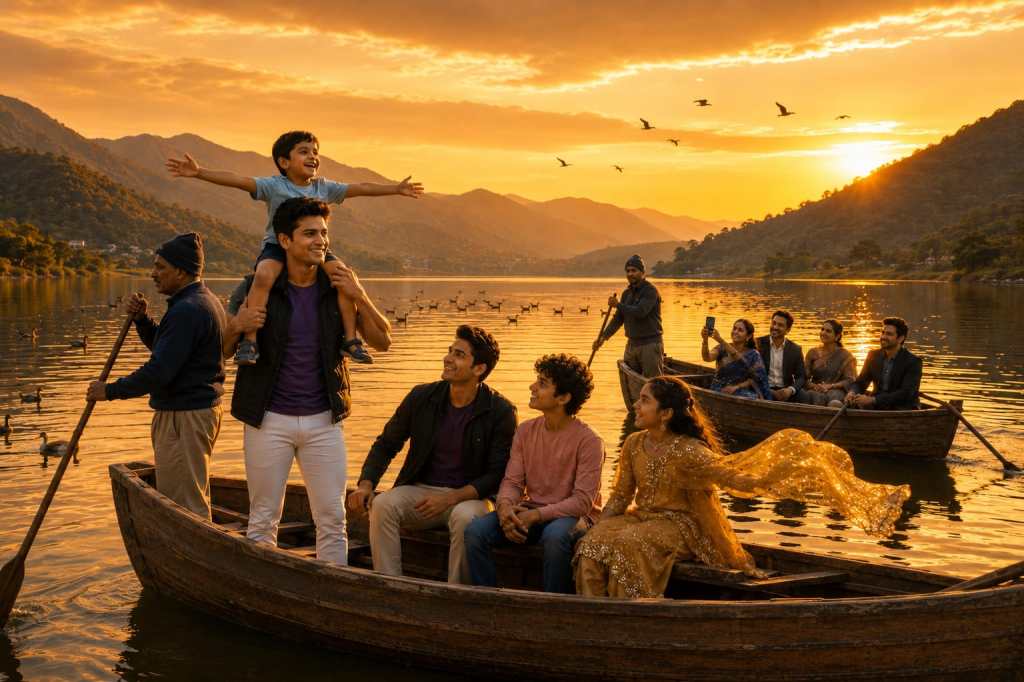
Rahul sat at the front. Shri beside him. Raag in the middle. Bhoomi and Chandra on either side of him — both already looking over the edge at the water with the focused attention of scientists examining something new.
The boatman pushed off. The golden lake opened around them.
For a few minutes, nobody spoke.
The water was extraordinary — still enough to hold the sky, moving just enough to break the light into shifting fragments. The mountains looked different from here. Lower, somehow. More approachable. As though the lake had brought them closer to earth.
Migrating birds moved across the surface in long, unhurried formations — some flying, some floating, some doing both at different moments, completely indifferent to the two boats carrying their cargo of wonder through the middle of their evening.
Bhoomi’s dupatta caught the breeze.
It lifted behind her like a flag — the sequins catching the light and scattering it in every direction, tiny sparks of gold against the golden sky. She didn’t notice immediately. When she did, she grabbed it with one hand and held it down firmly.
Then — slowly — let it go again.
Because it was too beautiful not to.
It was Chandra who started it.
He had been watching Rahul — specifically watching the way Rahul sat at the front of the boat, broad-shouldered and completely at ease, one hand trailing in the water.
Chandra stood up.
“Bhaiya.”
“Hmm.”
“Can you lift me?”
Rahul turned. Looked at Chandra. Looked at the front of the boat. Looked back at Chandra.
“Why?”
“I want to see properly.”
A pause.
Then Rahul stood — with the unhurried balance of a swimmer who had never once been afraid of water — and lifted Chandra onto his shoulders in one smooth movement.
Chandra spread his arms.
Immediately. Instinctively. Without anyone suggesting it. The wind hit him.
His sky-blue T-shirt flattened against him. His hair flew back. His face — already the face of someone receiving exactly what they had always wanted — broke into the widest, most uncontained smile he had produced all day.
“JACK, I’M FLYING—”
The elders’ boat, which had pulled slightly ahead, turned at the sound.
Raghuram took one look at his son standing on a young man’s shoulders with his arms spread over a lake — and covered his face with both hands.
Mythili was already laughing. Padmaja was not laughing. She was taking a video.
Ramesh, beside her, was laughing at Raghuram covering his face.
In their own boat — Shri and Bhoomi were watching with the expressions of siblings who found something simultaneously mortifying and wonderful.
Raag just looked at Rahul.
Rahul looked back at Raag.
“Don’t,” Raag said.
“I didn’t say anything,” Rahul said.
Chandra, entirely unaware of any of this, continued flying.
They heard the temple before they saw it.
A bhajan drifted across the water — Anuradha Paudwal’s voice, warm and unhurried, moving through the evening air the way the birds moved across the lake surface. Unhurried. Completely certain of its direction.
🙏🏻
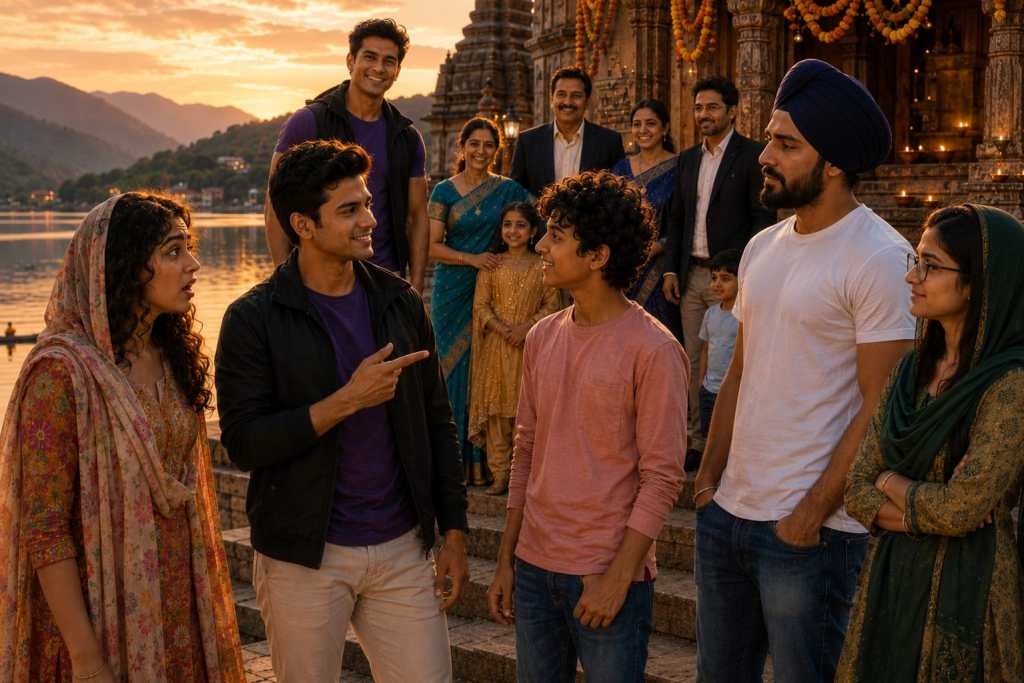
The Sarovar Durga Temple emerged from the far shore as the boats drew closer — stone steps descending to the water’s edge, lamps already lit though the sun had not yet fully set, marigold garlands bright against the old stone walls. The bhajan grew clearer as they approached. The mountains behind the temple had gone a deeper blue now. The water between the boats and the shore was pure gold.
Raag sat very still for a moment, listening.
Something about the music and the water and the light arriving together felt — not planned. Just right. The way some moments do.
He didn’t say anything. He didn’t need to.
It was on the temple steps, coming out, that Raag heard a voice he recognised.
“—I’m telling you, it’s good for the soul, just do darshan for two minutes—”
“Leena. But what if someone stops us—”
“—No one will. Trust me. I dragged you here with love. This is dosti jihad; you should be thanking me—”
“Leena. I don’t have any problem. But—”
“—Pritam, why is your face like that? It’s a temple, not an examination hall—”
“LEENA.”
Raag turned.
There they were.
Leena in a bright printed kurta and churidar, her curls escaping in every direction, a matching dupatta over her head, holding an umbrella she clearly hadn’t needed but had brought anyway. Ulfat beside her in a simple parrot-green salwar kameez, with a dark-green dupatta over her head, calm and amused in equal measure. Pritam behind them both, in a white T-shirt and blue jeans, wearing the expression of a man who had been told they were going for a walk and had somehow ended up at a temple on the other side of a lake.
All three of them froze when they saw Raag.
Then they saw Rahul.
Then they saw the families — Raghuram, Mythili, Ramesh, Padmaja — gathered on the temple steps behind him.
Then their eyes moved, naturally, through the group.
The elders.
Rahul.
Shri.
Raag.
A girl in a golden salwar kameez with a sequinned dupatta. A small boy still slightly damp from where Chandra had trailed his hand over the lake.
Back to Raag.
Leena’s eyes were moving very quickly now.
“Raag,” she said carefully.
“Hi,” Raag said.
“Hi.” A pause. “These are…?”
“My family.” He gestured toward Ramesh and Padmaja. Then toward Raghuram and Mythili. “And Shri’s family.”
The words landed in the middle of the temple steps and stayed there.
Leena processed them.
Shri’s family.
Her eyes moved again — scanning, searching — landing finally on the thirteen-year-old boy with curly hair and sparkling eyes standing beside Raag, looking at her with open, uncomplicated curiosity.
“This is Shri,” Raag said.
The world stopped.
Or at least — the small corner of it occupied by Leena, Ulfat and Pritam stopped.
Leena looked at Shri.
Shri looked at Leena.
“Hi,” Shri said, with complete ease. “Are you Raag bhaiya’s friend?”
Behind Leena, Pritam made a sound. It was not a word. It was more like the sound a person makes when a carefully constructed theory they have been maintaining for several weeks quietly collapses.
Ulfat looked at the sky.
Specifically — she looked at the mountains behind the temple, the last of the golden light, the birds crossing the water. She looked at all of these things with the particular expression of someone who has known something for a long time and has been patiently waiting for everyone else to find out.
Leena’s mouth opened. Closed. Opened again.
“You are Shri,” she said.
“Yes,” Shri said helpfully. “Shrikar.”
“Shrikar.” She repeated it. Very carefully. The way you repeat something when you are trying to make sure the information has actually arrived in your brain and is not just passing through it. “Shri is — you are a—”
“He’s thirteen,” Raag said. Helpfully. “Eighth grade. Composer. You’ve heard me mention him approximately forty times.”
Another sound from Pritam.
This one was slightly closer to a word but still didn’t quite make it.
Leena turned to look at him.
Pritam’s face was a masterpiece of controlled expression. Every muscle in it was working very hard to remain neutral. None of them were entirely succeeding.
Leena turned back to Shri.
Shri was watching this entire exchange with the focused attention of someone who sensed something interesting was happening but couldn’t quite identify what.
“Bhaiya,” he said to Raag quietly, “why does your friend look like she just watched an alien or something?”
The temple steps erupted. Even Raghuram laughed. Even Ramesh — who had been observing the whole thing with the quiet pleasure of a man watching an excellent film — laughed.
Leena — to her enormous credit — laughed the loudest of all.
Introductions were made.
Leena, Ulfat and Pritam — Rahul’s junior friends from La Banda Única, his college batch — were introduced to Raghuram and Mythili by Padmaja aunty with the easy authority of someone who had known them for years rather than months.
Raghuram shook Pritam’s hand with the approving expression of a man who respected height.
Mythili spoke to Ulfat for approximately four minutes and looked at Raag afterward with an expression that said — you have good people around you.
Leena, having recovered her composure with impressive speed, looked at Shri — really looked at him, the curly hair and the sparkling eyes and the complete absence of self-consciousness — and immediately understood everything Raag had ever said about him.
“So you’re the one,” she said.
Shri tilted his head. “The one what?”
“The one who started all of this.”
He looked at Raag. Then back at Leena. Then at Bhoomi, who was watching Leena with the sharp-eyed assessment of someone deciding whether a person is worth knowing.
“I just made a tune,” Shri said simply.
Leena put her hand over her heart.
“I know,” she said. “That’s exactly what I mean.”
Bhoomi, who had been watching Leena very carefully throughout all of this, said — without any preamble whatsoever —
“I like your curls.”
Leena turned.
Bhoomi held her gaze steadily, with the particular composure of someone who had paid a compliment and was prepared to stand behind it.
Leena’s face broke into her widest, most genuine smile.
“I like your dupatta,” she said immediately.
Bhoomi’s sequins caught the last of the evening light.
“I chose it myself,” Bhoomi said.
“Obviously,” Leena said. “Someone with taste chose it.”
And that — simply, completely, without any further ceremony — was that.
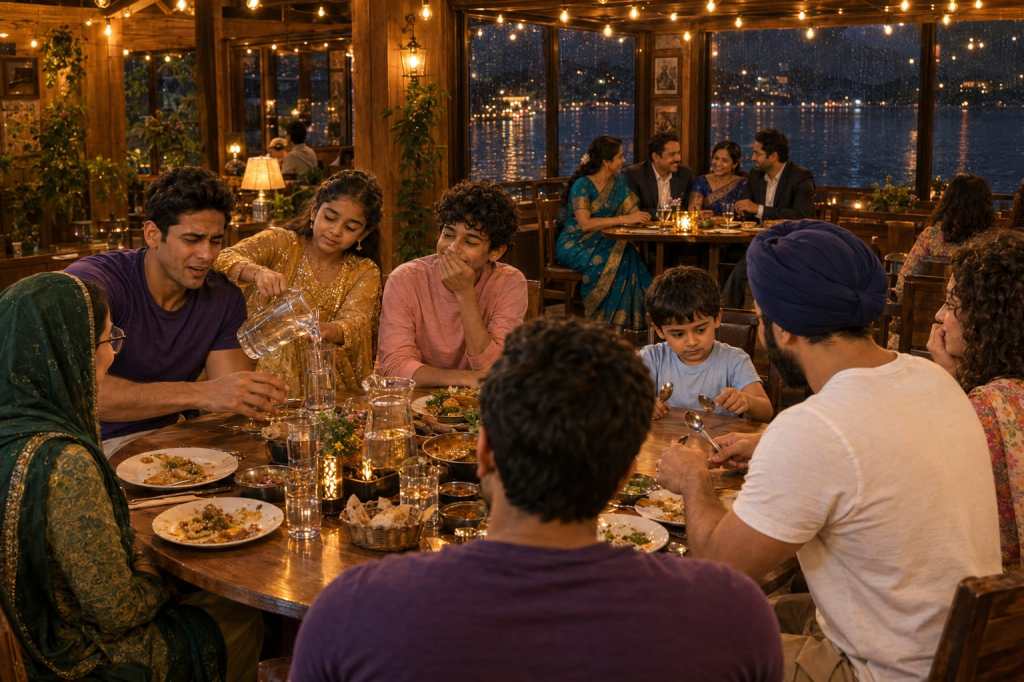
The restaurant Rahul had booked was warm and wooden-walled, built into the hillside above the lake, its windows offering a view of the water now turning silver in the early dark. String lights ran along the ceiling. The smell of spices and fresh bread and something sweet baking somewhere filled the room.
The elders took a table near the window.
Raghuram, Ramesh, Mythili, Padmaja — settled in with the comfortable ease of people who had been friends for thirty years rather than one day.
The young men and children took the round table in the centre.
Rahul. Shri. Raag. Bhoomi. Chandra.
The same order as lunch. The same warmth as lunch.
Only — this time — three additional people appeared. Leena, Ulfat and Pritam.
They had meant to find a separate table. They had genuinely intended to give the families their space. But the restaurant was full, and the only remaining seats were at the round table, and somehow — the way things always somehow happened around Leena — they sat down.
“We are not kabab mein haddi,” Leena announced, settling into her chair with great dignity.
“No one said anything,” Pritam said.
“I’m saying it preemptively.”
“That’s not how preemptive works.”
“Pritam.”
“Yes?”
“Eat your bread.”
The menus arrived.
Bhoomi and Chandra, without consulting anyone, ordered exactly what they wanted to eat for a while in that restaurant.
Raag ordered a curry. A spicy one.
He didn’t realise quite how spicy it was until the first proper bite — at which point his eyes watered, his throat closed politely, and he began making the particular sequence of sounds that meant something had gone wrong.
He reached for his water.
It was empty.
Bhoomi — sitting beside him, already watching because she had suspected the curry was too spicy and had been about to say so — picked up the water jug immediately and refilled his glass.
Raag drank. Bhoomi patted his back twice.
Then returned to her own plate with the brisk efficiency of someone who had handled a situation and was moving on.
Leena, across the table, had watched the whole thing.
She looked at Bhoomi with open admiration. Bhoomi caught her eye. Her rosy lips blossomed into a jasmine-like smile.
Chandra, who had been examining Pritam since they sat down with the focused interest of a researcher studying a new subject, finally spoke.
“You are very tall,” he said.
“Yes,” Pritam agreed.
“And very big.”
“Also yes.”
“Do you play any sports?”
“I swim. And I play keyboard.”
Chandra processed this. “What is a keyboard?”
Pritam looked at him for a moment. Then picked up two spoons and demonstrated — tapping them against the table edge in a simple rhythm.
Chandra’s eyes widened.
“Can you teach me?”
“Right now?”
“Yes.”
Pritam handed him one spoon.
They spent the next several minutes tapping rhythms on the table edge together — Pritam patient and genuinely engaged, Chandra focused with the seriousness of someone learning something important.
Shri watched them. Then looked at Raag. Raag looked back. Neither of them said anything. But they were both smiling.
Ulfat had somehow found herself in a conversation with Mythili and Raghuram that had migrated naturally from the children’s table to the elders’ table — nobody had planned it, it had simply happened, the way Ulfat’s conversations often did.
She sat with her hands folded on the table, listening more than speaking, asking the occasional precise question that showed she had heard everything and understood most of it. Mythili responded to her with the warmth she reserved for people who didn’t need to fill silence with noise. Raghuram watched her with the quiet approval of a man who recognised steadiness in a young person and valued it.
At one point, Padmaja appeared beside Ulfat and placed an extra serving of dessert in front of her without asking.
Ulfat looked up. Padmaja smiled. Ulfat smiled back. Nothing more was needed.
Leena and Bhoomi, by this point, had moved their chairs approximately six inches closer to each other than when they had started.
Nobody had noticed. Or perhaps everyone had noticed and chosen not to comment.
Bhoomi asked how she knew Rahul. Leena smiled and said, “We have been friends since our sixth standard. Since then, he has been our senior. We used to spend weekends at his home, listening to songs, singing old Hindi songs as antakshari, what’s not.”
Bhoomi blinked twice and recalled that giant Madhubala poster at Rahul’s house.
Coincidentally, when they were talking about Madhubala, Leena explained who she was with the enthusiasm of someone sharing a personal discovery, Bhoomi listening with the focused attention of someone who had already encountered this information at Padmaja aunty’s house and was now getting a second, more dramatic version.
“She was the most beautiful woman in Indian cinema,” Leena said. “But it’s not just beauty. She had this— this thing. Like she knew something the camera didn’t.”
Bhoomi considered this.
“Padmaja aunty has her poster,” she said.
Leena pointed at her immediately. “EXACTLY. People with taste always have her poster.”
Bhoomi looked at Padmaja across the room. Then back at Leena.
“I want to see her films,” she said.
“I will send you a list,” Leena said, with the gravity of someone making an important commitment.
“Okay,” Bhoomi said.
They shook hands.
Officially.
When the desserts had been finished and the string lights had grown warmer against the darkening windows and the conversation had reached that particular comfortable stage where nobody was saying very much but nobody wanted to leave either — Leena, Ulfat and Pritam began gathering their things.
Leena stood up and pointed at Raag.
“Party,” she said.
“What?”
“You won Raghuram sir’s heart. You deserve a party. La Banda Única tradition.”
“We don’t have that tradition,” Pritam said.
“We do now.”
Raag laughed. “Fine.”
“This week.”
“Fine.”
“Café Jazz.”
“Fine.”
“Shri is invited, obviously.” She looked at Shri. “You’re invited.”
Shri looked at Raag.
Raag nodded.
Shri looked back at Leena. “Okay.”
Leena turned to Bhoomi. “You too.”
Bhoomi blinked.
“Me?”
“Obviously you. You helped him. You deserve to celebrate too.”
Bhoomi looked at her mother.
Mythili, who had heard every word, nodded.
Bhoomi looked back at Leena.
“Okay,” she said.
With complete composure.
And zero attempt to hide that she was pleased.
Leena looked at Pritam. “See? That’s how you accept an invitation.”
Pritam looked at the ceiling.
Ulfat touched Raag’s shoulder as she passed. “Well done,” she said simply. And moved on.
Pritam stopped beside Raag and shook his hand once — firm, certain, the handshake of someone saying something without words.
Raag understood.
They left — Leena already talking, Pritam already responding, Ulfat already three steps ahead of both of them — and the restaurant felt quieter and warmer at the same time.
The families left together not long after.
Outside, the hill station night had arrived fully. The string lights from restaurants and shops reflected on the wet road — it had begun to rain while they were inside. Softly at first. Then with more intention.
They stood under the restaurant awning for a moment — both families, the children drowsy now, the elders making the small comfortable sounds of people ending a day that had been longer and richer than they had planned.
Raghuram’s car was brought around first.
Bhoomi and Chandra climbed in — both of them quieter than they had been at any point in the day, the comfortable quiet of children running low on energy but not wanting to admit it.
Raag stepped in next and sat between them. Shri sat beside Rahul, who was in the driver’s seat.
Bhoomi looked at Raag.
“Next Sunday, the flag ceremony.”
Raag nodded. “I’ll be there.”
“Don’t be late.”
“I won’t.”
She looked at him for one more moment. Then leaned back in her seat and closed her eyes.
The drive back was quiet.
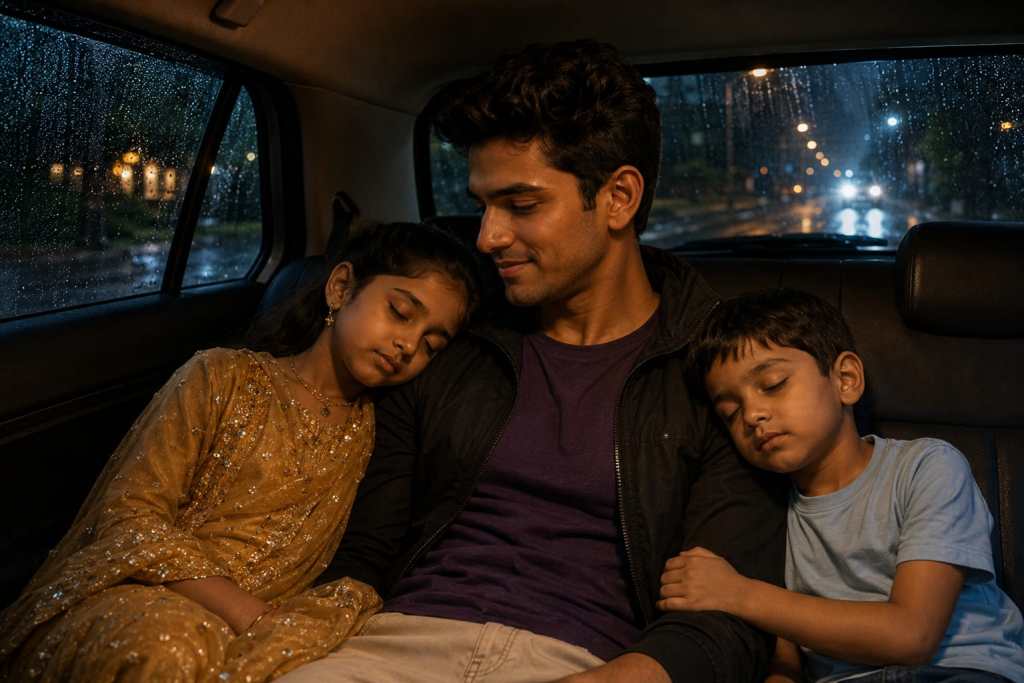
Ramesh’s car followed Raghuram’s through the rain-washed hill station roads — the headlights catching the wet tarmac, the pine trees dark on either side, the valley invisible now beneath cloud and rain.
In the backseat — Bhoomi and Chandra had settled on either side of Raag.
Bhoomi went first — her head finding his shoulder with the naturalness of someone finding something they had been looking for without knowing it.
Chandra followed — his head against Raag’s other shoulder, his breathing slowing immediately.
Raag sat very still. He looked at Rahul in the rear-view mirror. Rahul looked back at him. Neither of them spoke.
At Shri’s house, the lights were on, the rain falling steadily on the silver oak trees above the front gate.
Raag and Rahul carried Bhoomi and Chandra inside — one each, carefully, the way you carry something precious and sleeping. Up the steps. Through the door. Down the corridor to their room. Onto their beds.
Raag pulled Bhoomi’s blanket over her. She stirred slightly.
“Raag bhaiya,” she murmured. Not a question. Not a request.
Just — his name. Said the way you say the name of someone you trust, in the half-space between sleep and waking.
He stood there for a moment. Then left the room quietly.
After that, Rahul and Raag carried the pickle jars from Raghuram’s car into the house.
Shri watched them with a sleepy grin.
In the living room — Raghuram and Mythili stood with Ramesh and Padmaja in the warm circle of the lamplight, the rain loud now on the roof and windows.
Mythili applied kumkum on her forehead and then on Padmaja’s. They both hugged each other.
Raghuram and Ramesh shook hands first. Then Ramesh pulled him into a tight hug.
“Let’s meet again,” he said.
“At our home,” said Raghuram, looking at Mythili.
Both Mythili and Padmaja nodded.
Shri was watching with a sleepy yet satisfied face.
Rahul and Raag were waiting for Ramesh and Padmaja after carefully parking Raghuram’s car.
Raghuram, Mythili and Shri saw them off, not before Shri hugged Raag.
Raag didn’t say anything.
Rahul started driving after Raag stepped in.
Raag was looking back at Shri’s house until the car took a turn.
He sighed with relief.
“Ude jab jab zulfein teri” started playing on the music system.
Everyone except Raag started singing along.
He just smiled and nodded.
The car cruised through the rain-washed roads. No one talked as they were lost in the song.
But everyone knew what the vibe was.
To be continued…
“Thank you for not giving up.”
“Our elders did the work. I just showed up.”
— End of Episode 24—
Please read the previous episode: Shri Raagam – Episode 23: Green Flags and Golden Evenings


Leave a Reply