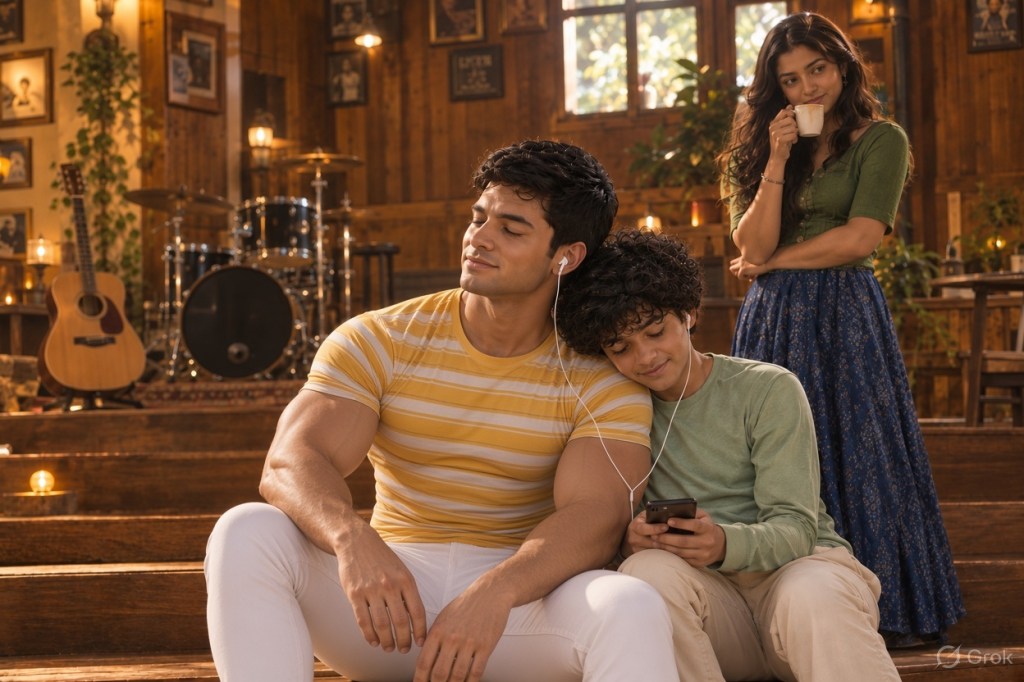
Shri had been quiet for almost ten minutes.
For Shri, that was a record.
The jamming session had ended in laughter and coffee refills. Pritam was arguing with Leena about whose turn it was to carry the keyboard stand. Ulfat was counting cups for Swami Murugan. Xavier was wiping his bass with a soft cloth, slowly, the way he did everything.
Shri sat on the stage steps beside Raag, holding his phone with both hands.
“Raag bhaiya.”
“Hmm?”
“I want you to listen to something.”
“What is it?”
“Just listen. Don’t say anything until it ends.”
Raag took the earphone he offered and put it in one ear. Shri put the other in his own.
It was a rough recording, made on the low-end phone his parents had bought him. The melody came softly, a little hesitant at first, and then it settled into itself. Raag recognised the shades immediately. It was Shri’s first-ever composition, the one Raag had heard at the vantage point on a beautiful morning.
The shades of Sindhu Bhairavi now flowed through it profoundly, without any effort at all. The voice was Shri’s, and the lyrics were in Telugu.
Raag listened with wide-open eyes, as if he were hearing it through them. His mind followed the lyrics in Shri’s voice.
When it ended, Shri was looking at the floor.
“I wrote it the day after you taught me the first chord,” he said. “I didn’t know if it was good. I didn’t want to show anybody, except you.”
Raag looked at him carefully. Shri was looking at him with trust. His eyes were asking for an answer. Raag smiled.
Raag removed the earphone.
“Play it again.”
“Now?”
“Now.”
Shri pressed play. This time Raag closed his eyes.
Neither of them noticed Komal standing a few steps behind them, a coffee cup halfway to her lips. She had come over to ask Raag something about the recording levels. She stayed because of the melody.
When it ended, she spoke.
“What was that?”
Shri jumped. He looked at her, looked at Raag, and pressed his face into Raag’s shoulder.
“Nothing!”
“I haven’t asked anything yet!”
“You were going to!”
Komal laughed. “Shri, that didn’t sound like nothing.”
“It’s his own composition,” Raag said, resting a hand on Shri’s head. “Telugu lyrics. He’s been working on it for weeks. To be honest, this is the melody that gave me the idea of composing an album with him,” he said, ruffling Shri’s hair. Shri was blushing crimson and hid his face between his knees.
Komal’s expression changed. She set down her cup.
“Shri, I’m not teasing you. Let me hear it properly.”
“Komal Didi,” Shri searched for words, red to his ears. “Mmm… you really want to listen to it?”
Komal smiled. “Yes, I’m serious. Play it.”
This time Shri played it through the café speaker.
Everyone turned their heads. They stopped whatever they were doing so they could pay attention.
They recognised Shri’s voice, but they hadn’t known he could sing that well. None of them understood the lyrics, but the melody and the emotion in his voice made them stand still. It was just a song, without any instruments except for the occasional clap, yet none of them felt it was incomplete.
Komal, who was standing near them, didn’t understand the language, but she didn’t need to. She stood completely still until the last line faded. Then she said, quietly:
“Shri. That is a very special song.”
He lifted his head a little.
“Really?”
“Really. I couldn’t understand a single word and it still reached me. That’s the real test.” She turned to the others. “Everybody, tell me. Right now. How did you feel?”
“Spellbound!” Leena said.
“Exactly,” agreed Ulfat.
Pritam bowed.
Xavier was still processing the song. He took his electric guitar and played an opening riff that sounded exactly like a perfect prelude to Shri’s song.
Everyone clapped, including Shri. Xavier stood up and walked towards Shri. He tapped Shri’s shoulder and said, “Keep going. Don’t stop!” Xavier’s eyes were sparkling.
Two twinkling droplets rolled down Shri’s cheeks. He tried to say, “Thank you, bhaiya,” but his lips only moved. Raag held him. He looked at Xavier with gratitude. The two young men nodded silently.
“What if we play along to the song while Shri sings live? Right now?” Komal proposed.
“No,” Shri said, hiding his face in Raag’s shoulder.
“Hell, yes. And Raag will do ad-libs,” said Leena, getting ready with her guitar.
Ulfat said yes with a drumroll. Pritam had already downloaded the song onto his keyboard.
They gathered around the speaker, six musicians and Swami Murugan holding a tea towel. Shri sat in the middle of them with his hands pressed between his knees, looking as though he wished the floor would swallow him.
Pritam closed his eyes. Ulfat tapped one finger against her knee. Leena read the Hindi and English translation Shri had sent to the WhatsApp group weeks ago, her lips moving silently. Xavier listened once, expressionless, and then once more. He would open with the riff on his electric guitar, then switch to his bass for the rest of the song.
Shri looked at Raag. He smiled and nodded silently. Shri understood that Raag had confidence in him. He could hear his own heartbeat pounding like a drum.
He offered a pranam to Lord Ganesh and started singing. He was nervous at first, but he never went off key. He sang almost exactly as he had recorded it, improvising in a few places.
Raag did ad-libs and layering.
Everyone in the band was focusing on synchronising with the melody and Shri’s singing rather than on their individual sounds. They knew it was an impromptu performance. They had only just heard the melody, there were no notations, and they relied on their experience. Together, they provided a minimalistic orchestration, suited to the situation. Yet it was soulful and beautiful.
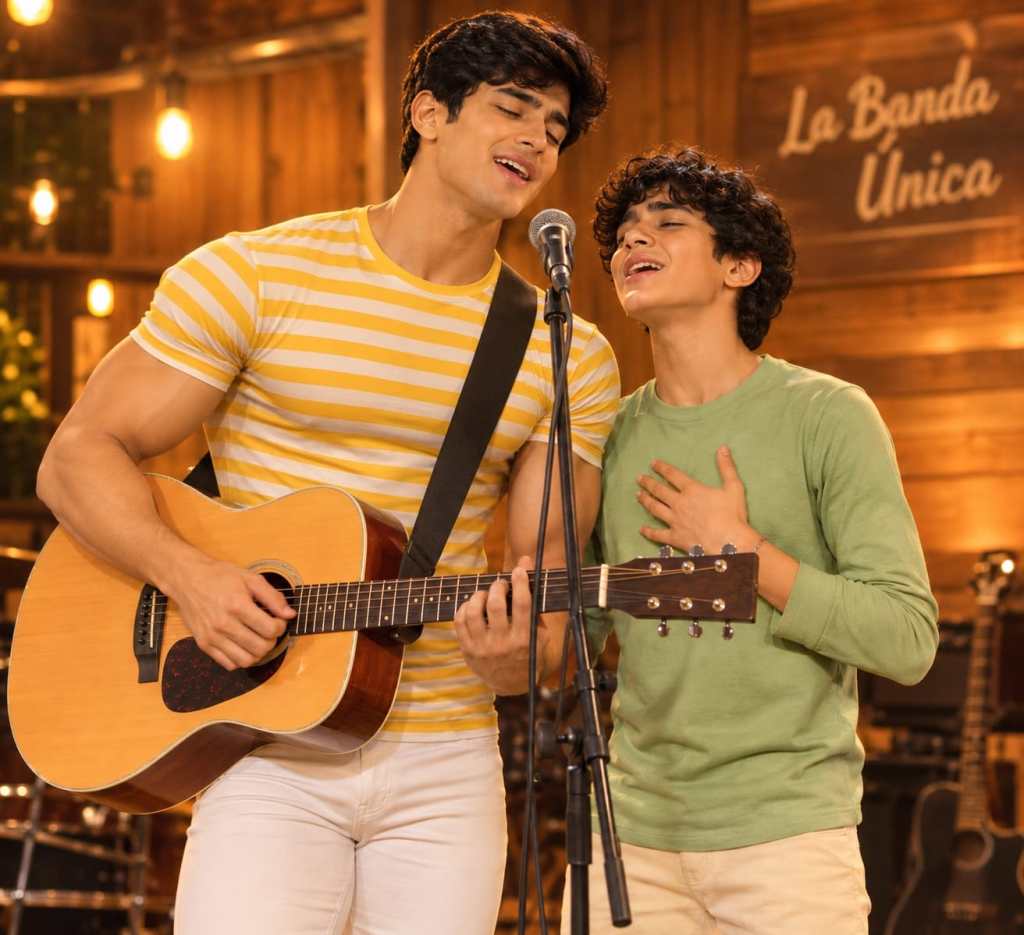
When it ended, nobody spoke for a moment.
“Bhaiya,” Shri said finally, looking at Xavier. “Does it sound bad?”
Xavier took a moment before answering.
“No,” he said. “It sounds honest.”
Shri blinked.
“When you were singing the last line,” Xavier continued, “the melody wanted something underneath it. Something low. I could hear exactly where it would go.” He paused. “That doesn’t happen to me with most songs.”
Shri stared at him.
“Bhaiya, when you played the electric guitar first, it felt like someone opened a door,” he said slowly, “then I knew where the song was going. And when you played the bass, it felt like there was a floor to walk on. Before that, the song was floating.”
Xavier’s eyes widened a little.
“A floor,” he repeated.
“Yes. I don’t know the technical word.”
“That’s a better word than the technical one,” Xavier said.
Komal and Raag exchanged a glance across the circle. Neither said anything. Neither needed to.
“This should be on the album,” Leena said. “The second song.”
“A lead single,” Pritam suggested.
“Definitely,” Ulfat said.
Komal looked at Xavier. “And you should produce it.”
Xavier nearly dropped his cloth.
“Me?”
“Yes.”
“Komal Didi!” Shri gasped, delighted.
“I only played a few notes!” Xavier protested.
“The right ones,” Komal said.
“I don’t want to change the song just to prove I did something.”
“Nobody asked you to change anything,” Komal replied calmly. “That’s exactly why you should be the one.”
Xavier opened his mouth. Closed it. Looked down at his bass. His ears had turned pink.
“Let’s leave this for another day,” Raag said gently. “We have a song. That’s enough for today.”
Xavier gave him a grateful look.
The matter was set aside, though not forgotten.
By the time the instruments were packed and goodbyes exchanged, the sky had turned the colour of wet slate.
Raag looked at the clouds. “We should leave before the rain.”
Shri followed his gaze. “It’s only a little cloudy, bhaiya.”
“That’s what you said last time.”
“And it didn’t rain that time!”
“It rained for three hours.”
“That was different.”
“How?”
Shri thought about it seriously.
“Different clouds.”
Raag stared at him.
Then he laughed. “Fine. Different clouds. Get on.”
They had barely left the main road when the first drops landed.
Then a shower. Then a steady, silver rain that blurred the pines on either side and made the road shine like a river.
“Bhaiya! It’s getting heavier!”
“Excellent observation!”
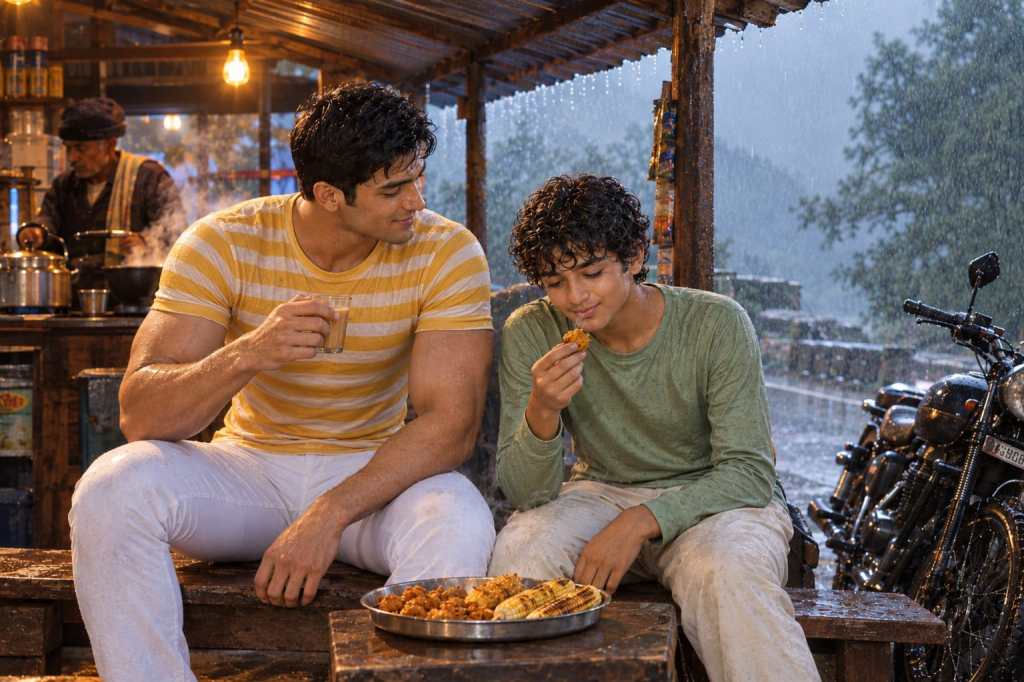
Raag spotted a small tea stall under a corrugated roof and pulled over. They ran in, laughing, thoroughly soaked. Shri’s curls clung to his forehead. He tried to wring his sleeves out until Raag stopped him.
“You’ll make a puddle.”
“It’s raining everywhere!”
“Inside the stall, we prefer to keep the rain outside.”
The tea seller, who had clearly witnessed this argument between many pairs before them, handed over two rough towels.
“Sit, boys. This rain isn’t going anywhere.”
They sat on a wooden bench at the open edge of the stall. The road had vanished behind a curtain of water. Raag ordered tea for himself and, for Shri, a plate of hot pakode and roasted corn.
Shri grabbed a pakoda, yelped and dropped it.
“Hot!”
“That’s generally what happens with food that has just come out of boiling oil.”
“Why do you always have an answer?”
“Experience.”
“That’s not an answer.”
“Eat. Carefully.”
Shri blew on the next one and took a bite. His eyes closed.
Raag watched him, and something in his chest eased. No schedule. No instruments to tune. Nothing to prove to anyone. Only rain, wet earth, hot tea and a boy who treated every ordinary moment as an adventure.
“Raag bhaiya?”
“Hmm?”
“When we record the song, will it sound different?”
“A little. A recording shows us things we miss while playing.”
“But we shouldn’t lose the feeling.”
Raag looked at him.
“No. That’s the only thing we must never lose.”
Shri nodded slowly. Then he reached for the corn.
“Can I have one more?”
“That was a very thoughtful musical conversation,” Raag sighed. “Ruined by your next sentence.”
Shri grinned, unrepentant.
When the rain softened to a drizzle, they started again.
The world looked washed. Leaves glistened. Thin streams trickled down the slopes beside the road. Mist hung among distant trees and the evening light slipped through gaps in the clouds.
“Bhaiya, look!”
“I saw.”
“And there!”
“Saw that too.”
“You can’t possibly see everything I see.”
“No,” Raag agreed. “You have a talent for noticing what nobody else does.”
Shri accepted this as a compliment, which it was.
A little farther on, Raag slowed down.
“Want to stop for a bit?”
Shri nodded so hard his wet curls bounced.
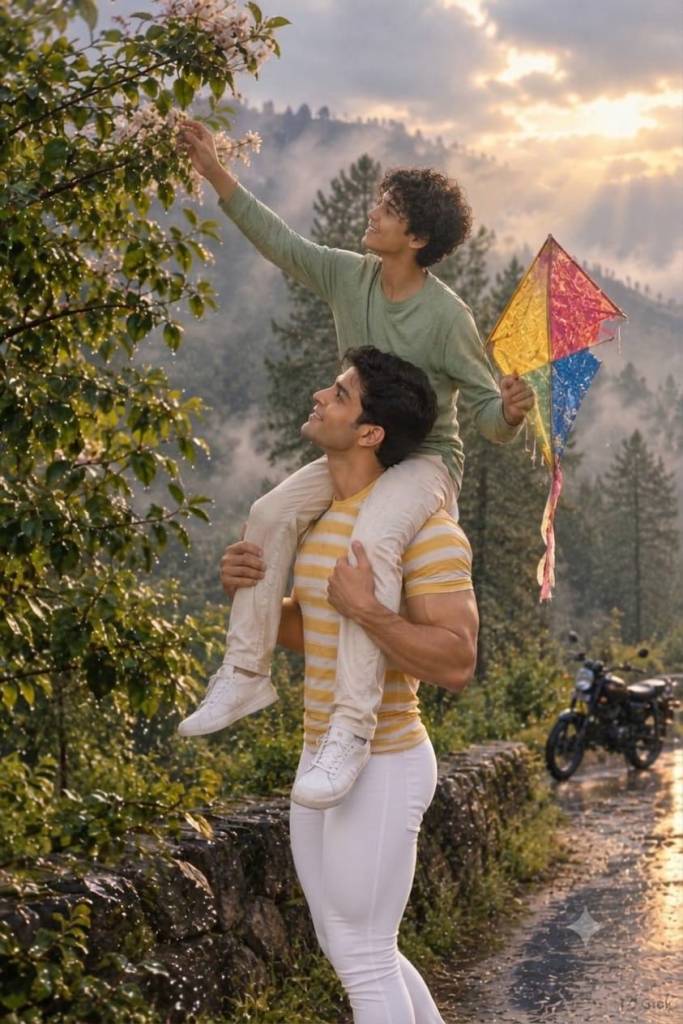
Beside the road ran a low stone wall, dark with rain. Shri climbed on and walked along it with his arms spread for balance, and Raag walked below on the road, holding his hand.
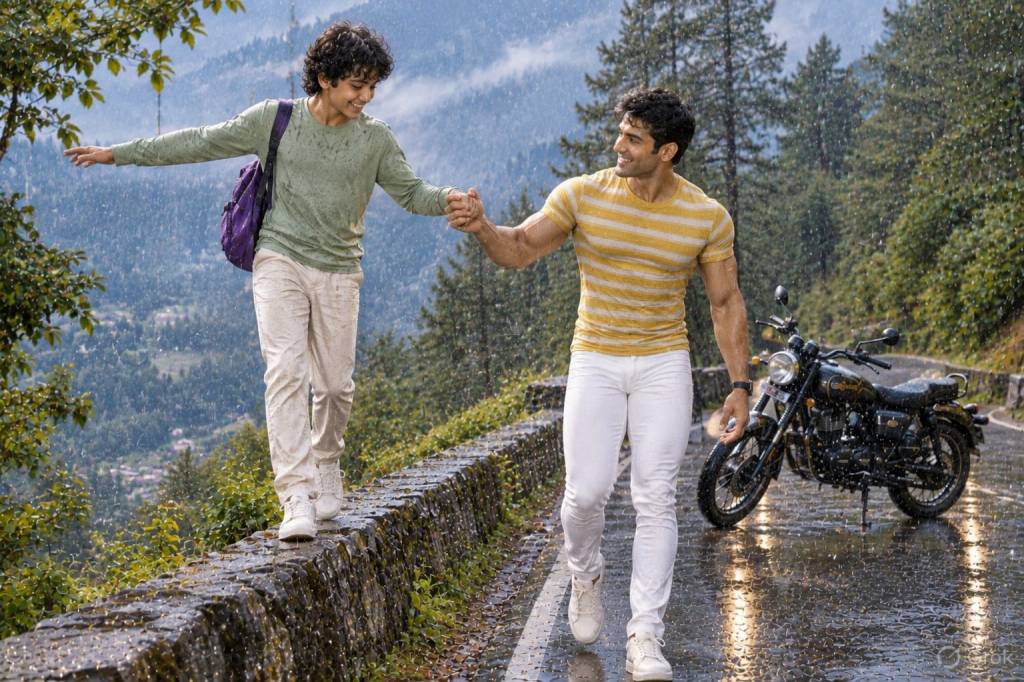
“Look where you put your feet. Not at the flowers.”
“But the flowers are beautiful!”
“They’ll still be beautiful when you reach the end of the wall.”
“What if someone takes them?”
“Wildflowers rarely have a queue.”
Shri laughed and kept walking. Whenever his foot slipped on the wet stone, Raag’s hand tightened, steady and quiet. Neither of them mentioned it.
At the far end, Shri stopped.
“Bhaiya!”
A tall plant grew just beyond the wall, its slender stem bending under a cluster of delicate wildflowers. They were just out of his reach. He stretched. Almost. Stretched again. Still no.
Raag folded his arms.
“Shall I negotiate with the plant?”
“Bhaiya!”
“All right, all right.”
He bent down and lifted Shri onto his shoulders. Shri squealed, then steadied himself, delighted by the sudden height.
“Now I can reach!”
“That is the general idea.”
Shri picked a few flowers, taking care not to pull up the plant. Then something glittering caught his eye among the branches.
A kite.
Bright and glittery, its colours dulled by rain, one corner torn, the string tangled in the leaves.
“Bhaiya! A kite!”
Raag helped him free it. Shri held it like a priceless discovery.
“It’s almost perfect.”
“Almost?”
“This corner is torn. And the string is tangled.”
“We can fix that.”
Shri looked up. “Really?”
“Why not? It only needs a little care.”
Shri’s face lit up like a lamp.
They were walking back to the bike when Shri’s head snapped to the road.
“Bhaiya, stop!”
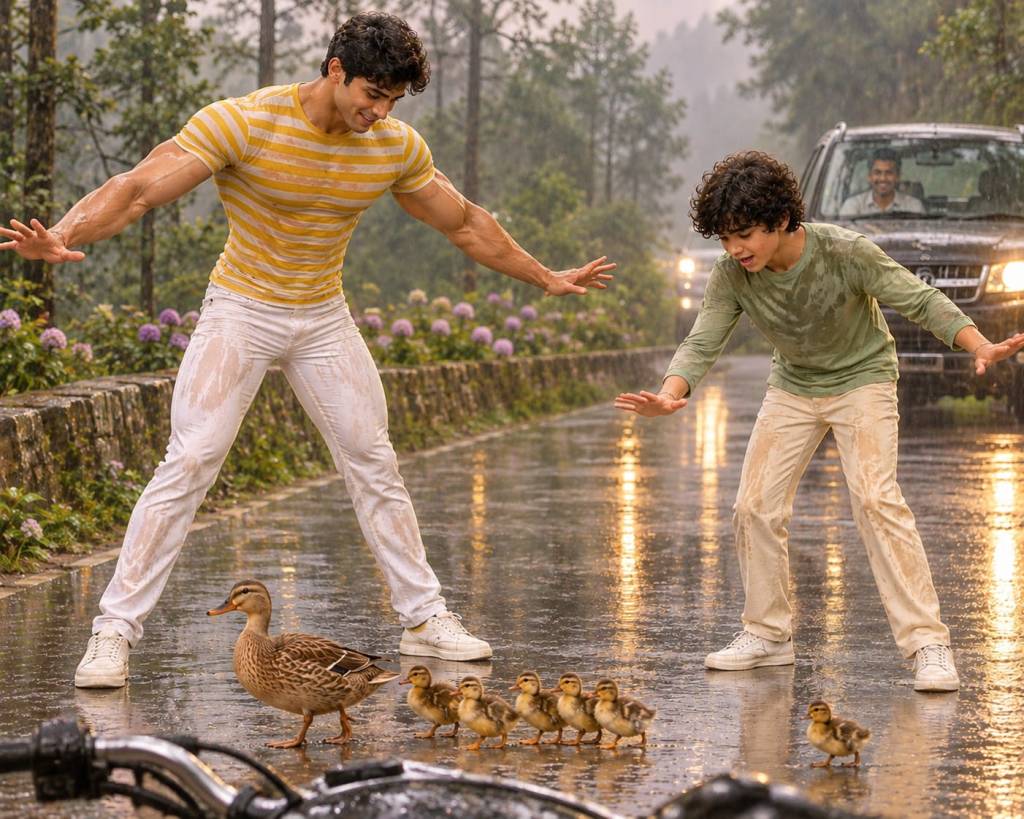
A wild duck was leading a line of ducklings across the tarmac. The little ones scurried after her, but the road was wider than they seemed ready for. One duckling froze in the middle while the rest pressed on.
Raag glanced down the road. A vehicle was approaching.
He wheeled the bike across the lane like a barricade, switched off the engine and walked back to Shri.
“Come.”
They stood on either side of the duck family with their arms stretched wide, hands raised, a barricade of two boys and one motorcycle. The vehicle slowed. The driver, grinning, stopped.
The mother duck waddled onward. The ducklings followed in a wobbly line between the human barriers.
One lagged behind.
“Come on, little one,” Shri whispered. “Come on.”
The duckling hurried and caught up.
Only when the last of them had vanished into the grass did Shri breathe out.
“They made it!”
“They did.”
“Good thing we stopped.”
“Very good thing.”
The driver gave them a wave and drove on. Shri tucked the flowers and the kite safely under his jacket, and they rode on slowly. He kept tapping Raag’s shoulder whenever he spotted something. Raag didn’t mind at all.
Some journeys, he decided, were meant to take longer than planned.
The rain had returned by the time they reached Shri’s gate.
Mythili was at the door before they could knock.
“Shri! You are completely drenched!”
Shri looked down at himself, then at Raag.
“Raag bhaiya is also wet.”
Mythili gave both of them the look of a woman who had already reached her own conclusions.
“Inside. Both of you. Now!”
Raghuram appeared behind her. He took in their dripping clothes and the flowers poking from Shri’s jacket.
“What happened?”
“Rain,” Shri said.
“Thank you, Shri,” Raghuram said dryly. “I was wondering whether it was a swimming competition.”
Raag laughed. He turned toward the gate. “I should go, Mythili akka. I’ll leave once it eases a little.”
Mythili glanced at the sky, where the rain was hammering down again.
“And when exactly do you expect that to happen?”
Raag followed her gaze.
“Stay for dinner,” she said. “And for the night. You’re not riding down that mountain in this.”
“Akka, I don’t want to trouble—”
“Raag.”
One word. It was enough.
He smiled in surrender.
“All right, akka.”
To be continued…
“Bhaiya, when you played the electric guitar first, it felt like someone opened a door,” he said slowly, “then I knew where the song was going. And when you played the bass, it felt like there was a floor to walk on. Before that, the song was floating.”
— End of Episode 30—
Please read the previous episode: Shri Raagam – Episode 29: Shri Meets La Banda Única


Leave a Reply