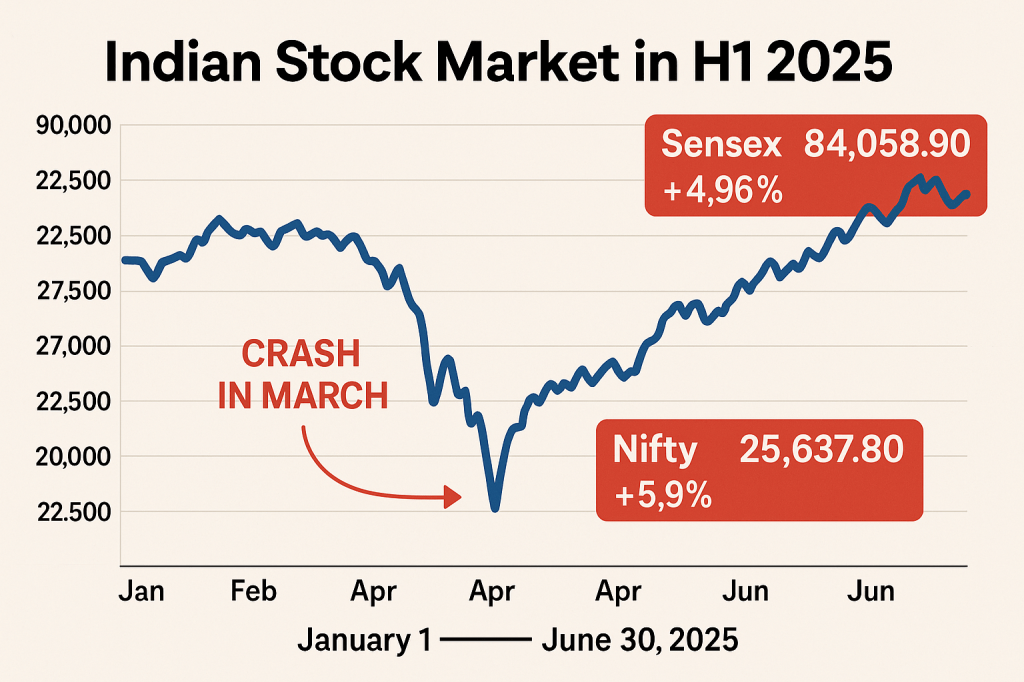
The first half of 2025 was a rollercoaster for the Indian stock market, with the BSE Sensex and NSE Nifty 50 swinging between sharp declines and a spirited recovery. From January 1 to June 30, 2025, the Sensex gained 4.96% to close at 84,058.90, while the Nifty rose 5.9% to 25,637.80, despite a brutal crash in March and a rebound from April. This period, marked by global trade tensions, foreign investor outflows, and domestic economic challenges, offered critical lessons for investors. Here’s a breakdown of the key takeaways from the Indian stock market’s performance in H1 2025, complete with actionable insights, and specific stock examples.
Lesson 1: Patience Pays During Volatility
The Indian stock market faced a significant crash between March 3 and April 7, 2025, with the Sensex dropping 16% and the Nifty 15% from their September 2024 highs of 85,978 and 26,277. A single-day drop of over 1,000 points on February 28 highlighted the panic, driven by global trade tensions and weak corporate earnings. Yet, the market rebounded sharply, gaining 7% in March alone, fueled by domestic institutional buying and renewed foreign portfolio investor (FPI) interest.
Takeaway: Staying calm during turbulent times is crucial. Investors who held onto quality stocks like ICICI Bank (CMP: ₹1,450) and Tata Consultancy Services (TCS) (CMP: ₹4,200) through the March dip saw gains as these stocks recovered by June, with ICICI up 1.61% and TCS benefiting from value buying. A “buy on dip” strategy, focusing on fundamentally strong large-caps, proved effective, as Trivesh D from Tradejini emphasized.
Lesson 2: Diversification Is Your Safety Net
The market’s volatility in H1 2025 underscored the importance of spreading investments across asset classes and sectors. While banking shone (Nifty Bank +9.16%), sectors like IT (-5.5%), energy (-25.6%), and auto (-20%) took heavy hits. Gold and silver, however, surged 31.37% and 35.56% YTD, respectively, as safe-haven assets amid equity turmoil. Investors who diversified into precious metals or bonds alongside equities weathered the storm better.
Takeaway: Don’t put all your eggs in one basket. Investors with exposure to Bharti Airtel (CMP: ₹1,600) in telecom and gold ETFs alongside equity-heavy portfolios mitigated losses. Ravi Singh from Religare Broking noted that diversified investors were better positioned in 2024’s volatility, a lesson that held true in 2025. Consider allocating 10–15% to gold or debt instruments to hedge against equity corrections.
Lesson 3: Global Events Drive Local Markets
Global trade tensions, particularly US tariffs averaging over 15% post-Trump’s re-election in April 2025, rocked Indian markets. Export-heavy sectors like pharmaceuticals and chemicals suffered as global demand weakened. The Indian rupee’s depreciation to 85.75 against the US dollar by April 3 added pressure, with FPIs pulling out ₹61,000 crore ($7.3 billion) from January to March. Meanwhile, global peers like China’s Shanghai Composite (+0.23%) and Hong Kong’s Hang Seng (+17%) outperformed India.
Takeaway: Keep an eye on global cues. Stocks like Sun Pharmaceutical (CMP: ₹1,489) faced headwinds from US market slowdowns but were rated a buy by BoB Capital for a Q4 FY25 rebound. Monitoring international policies, like US tariff deadlines (e.g., July 9, 2025), can help time entries and exits.
Lesson 4: Earnings Matter More Than Hype
Weak corporate earnings in Q3 2024, with 60% of Nifty 50 companies missing estimates, triggered sell-offs in early 2025. High valuations in midcaps (PE=43) and smallcaps (PE=34) led to underperformance, with the BSE Midcap and Smallcap indices down 1.3% and 3.9% YTD. Large-caps, trading at a more reasonable PE of 22, outperformed, as noted by analysts at LiveMint.
Takeaway: Focus on earnings growth over speculative bets. Reliance Industries (CMP: ₹1,500), with its diversified revenue streams and a projected 15% PAT CAGR through FY27 (per JM Financial), was a safer pick than overhyped smallcaps. Bottom-up stock picking with a focus on “Growth at a Reasonable Price,” as Deepak Ramaraju from Shriram AMC suggested, is key.
Lesson 5: Domestic Strength Can Offset FPI Outflows
Despite FPI outflows, domestic institutional investors (DIIs) poured over ₹3.5 lakh crore into equities in H1 2025, offsetting foreign selling of ₹1.2 lakh crore. This domestic buying, coupled with government tax incentives and RBI’s repo rate cut to 6.25% in February, fueled the March recovery. India’s resilient economy, despite a GDP slowdown to 6.4% in FY25, supported market stability.
Takeaway: Trust in domestic fundamentals. Stocks like HDFC Bank (CMP: ₹1,700) and Axis Bank (CMP: ₹1,250), despite short-term profit-taking, benefited from domestic credit growth and are backed by Jefferies for long-term stability. Nikunj Doshi from Bay Capital highlighted India’s macro stability as a draw for global funds.
Looking Ahead to H2 2025
Analysts like Morgan Stanley project the Sensex could hit 105,000 by year-end in a bull-case scenario, but risks like US tariffs and global slowdowns loom. Focus on large-caps like ICICI Bank, Reliance, TCS, Bharti Airtel, and Sun Pharma, backed by Jefferies and Axis Securities for their resilience. Monitor RBI policies, state elections, and global trade talks (e.g., July 9 tariff deadline) for cues.
Conclusion
The first half of 2025 taught investors to stay patient, diversify wisely, track global events, prioritize earnings, and lean on domestic strength. Stocks like ICICI Bank, Reliance, and Bharti Airtel proved reliable, while gold shone as a hedge. Use the chart to visualize the market’s ups and downs, and stick to a disciplined, long-term strategy. As Trivesh D from Tradejini said, “Thorough research and disciplined investing are key to long-term success.” Consult a financial advisor, keep researching, and ride the market’s waves with confidence!
Disclaimer: The information provided in this article, including financial projections and market estimates, is based on publicly available data, industry reports, and analyst insights as of June 30, 2025. These projections are estimates and subject to change due to market dynamics, economic conditions, and company performance. The author and publisher are not responsible for any inaccuracies or losses incurred from decisions based on this content. Readers are encouraged to verify data with official sources before making financial or investment decisions.


Leave a Reply