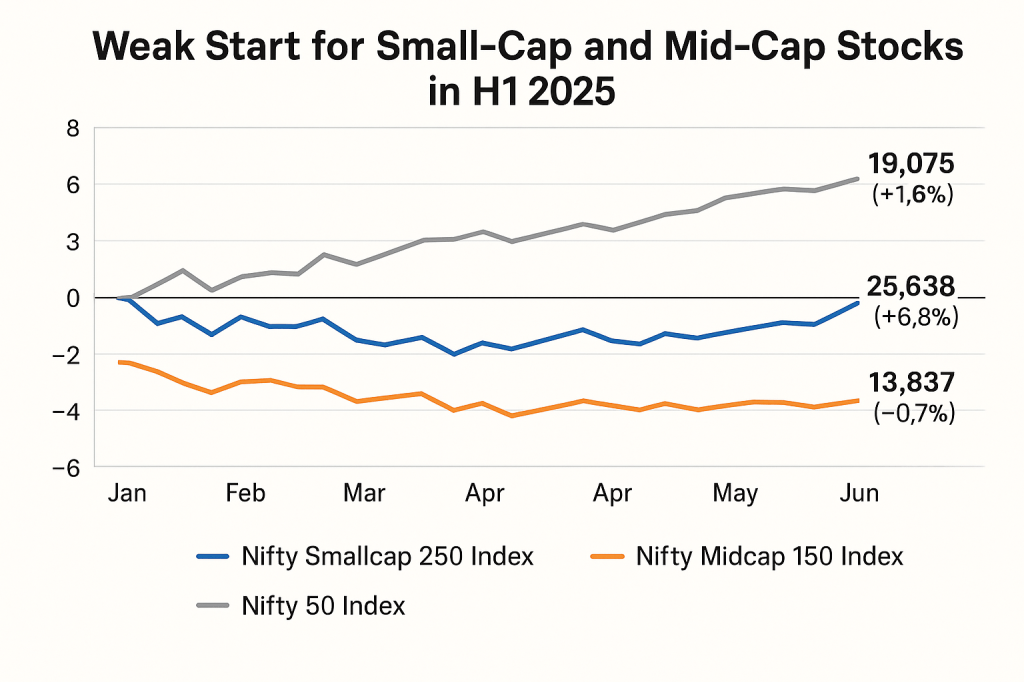
The first half of 2025 has been a challenging period for small-cap and mid-cap stocks in the Indian stock market, marked by volatility, corrections, and a shift in investor sentiment toward safer large-cap stocks. While these segments have historically been known for their high growth potential, the period from January to June 2025 saw significant underperformance compared to their large-cap counterparts. This article dives into the performance of small-cap and mid-cap stocks, key factors driving their trends, and what investors can take away from this phase.
A Turbulent Start to 2025
The Nifty Smallcap 250 Index and Nifty Midcap 150 Index, which track the performance of small-cap and mid-cap companies respectively, faced significant headwinds in the first half of 2025. According to market data, the Nifty Smallcap 250 Index recorded a modest gain of approximately 1.6%, rising from 18,775 points on January 1, 2025, to 19,075 points by June 30, 2025. The Nifty Midcap 150 Index, on the other hand, experienced a slight decline of about 0.7%. In stark contrast, the benchmark Nifty 50 Index and Sensex surged by 6.8% and 6%, respectively, reflecting investor preference for large-cap stocks amid uncertain market conditions.
This underperformance follows a remarkable rally in 2024, when small-cap and mid-cap indices gained 26.7% and 25.7%, respectively, outperforming global benchmarks. However, the exuberance of 2024 gave way to a correction in 2025, with the Nifty Smallcap 250 plunging by 9% and the Nifty Midcap 150 dropping by 7% earlier in the year. By mid-2025, 70% of small- and mid-cap stocks were trading below their 200-day moving averages, signaling sustained selling pressure.
Key Factors Behind the Decline
Several factors contributed to the underperformance of small-cap and mid-cap stocks in the first half of 2025:
- Overvaluation Concerns: After a multi-year rally, small-cap and mid-cap stocks reached lofty valuations, with the median price-to-earnings (P/E) ratio for these segments soaring to 43x, deemed “absurd” by industry experts like Sankaran Naren, CIO of ICICI Prudential Mutual Fund. This overvaluation prompted a correction as investors reassessed the sustainability of these price levels.
- Foreign Institutional Investor (FII) Outflows: FIIs were net sellers in Indian equities, with a significant outflow of ₹87,374 crore in January 2025 alone. The strengthening US dollar, high global bond yields, and the US Federal Reserve’s tight monetary policy diverted capital toward developed markets and other emerging economies like Indonesia and Vietnam. This withdrawal put pressure on small- and mid-cap stocks, which are more sensitive to liquidity changes.
- Weak Corporate Earnings: Subdued earnings in the December 2024 quarter (Q3 FY25) disappointed investors, leading to downward revisions in earnings estimates. Sectors like real estate, MSMEs, consumer goods, IT, textiles, and industrials faced challenges due to high interest rates, inflationary pressures, and slowing global demand, particularly in export-oriented industries.
- Macroeconomic and Geopolitical Headwinds: Global uncertainties, including fears of US tariffs under a new administration and ongoing geopolitical tensions, further dampened sentiment. The depreciation of the Indian rupee near record lows increased import costs and strained the profitability of companies with foreign currency debt.
- Shift to Large-Cap Safety: Amid these uncertainties, investors gravitated toward large-cap stocks, perceived as safer bets due to their stability and liquidity. The Nifty 50’s resilience, with only a 2% slip compared to the sharper declines in small- and mid-cap indices, underscores this trend.
A Glimmer of Recovery in Q1 FY26
Despite the overall underperformance in H1 2025, there were signs of recovery toward the end of the period. Posts on X and market reports indicate that small- and mid-cap indices posted double-digit gains in the first quarter of FY26 (April–June 2025). Of 527 small- and mid-cap stocks, 73 rose more than 50%, driven by selective domestic institutional investor (DII) interest and improved Q4 FY25 earnings. DIIs, in particular, showed confidence in India’s growth story, with net inflows of ₹86,591 crore in January 2025, partially offsetting FII outflows.
This rebound suggests that while the broader small- and mid-cap segments faced challenges, select stocks with strong fundamentals outperformed, offering opportunities for discerning investors. Analysts attribute this recovery to a gradual realignment of valuations with fundamentals and renewed interest in quality small-cap and mid-cap companies.
Performance of Mutual Funds
Small-cap and mid-cap mutual funds, which saw significant inflows in January 2025 (₹5,720.87 crore for small-cap funds and ₹5,147.87 crore for mid-cap funds), also experienced volatility. Despite the correction, some funds delivered impressive long-term returns. For instance:
- Quant Small Cap Fund: Delivered 32.99% annualized returns over the past three years and 46.23% over five years.
- Nippon India Small Cap Fund: Recorded 31.24% annualized returns over three years and 38.76% over five years.
- Motilal Oswal Midcap Fund: Achieved 36.79% annualized returns over three years and 37.78% over five years.
- Invesco India Mid Cap Fund: Posted a 10-year SIP return of 23.2%, turning a ₹1.2 million investment into ₹4.08 million by May 2025.
These figures highlight that while short-term performance was lackluster, well-managed funds with a focus on quality stocks continued to reward long-term investors.
Investor Sentiment and Outlook
Sentiment on platforms like X reflects a mix of caution and opportunity. Some users warned of a bear phase, with the Nifty Smallcap 250 down 20% from its peak and the Nifty Midcap 150 down 16% by February 2025. Others, however, saw the correction as a chance to pick up quality small-cap stocks at attractive valuations, especially for long-term investors. For instance, one user noted that the Nifty Smallcap 250 was trading at 21x FY26E EPS, below its 10-year average of 28x, suggesting potential undervaluation.
Market experts believe the correction in small- and mid-cap stocks could persist until mid-2025 due to global and domestic challenges. However, they also see long-term potential, particularly for investors who focus on companies with strong fundamentals. Shridatta Bhandwaldar of Canara Robeco Mutual Fund noted that while large-caps are trading at fair valuations (18.5x FY27 earnings), mid- and small-caps remain 15–20% above historical averages, suggesting a possible time correction over the next few quarters.
Key Takeaways for Investors
- Volatility is Part of the Game: Small-cap and mid-cap stocks are inherently more volatile than large-caps, making them riskier but also offering higher growth potential. Investors should align their investments with their risk tolerance and time horizon.
- Focus on Fundamentals: The correction has highlighted the importance of selecting companies with strong financials, competitive advantages, and sustainable growth. Tools like the Tickertape Stock Screener can help identify such opportunities.
- Diversification is Key: Spreading investments across sectors and market caps can mitigate risks. Mid-cap and small-cap mutual funds or ETFs tracking indices like the Nifty Midcap 150 or Nifty Smallcap 250 offer diversified exposure.
- Long-Term Perspective: While H1 2025 was challenging, historical data shows that small- and mid-cap funds have delivered superior returns over the long term. Patience and disciplined investing are crucial.
- Monitor Market Trends: Keeping an eye on indices like the Nifty Midcap 100 and Nifty Smallcap 100, along with FII/DII flows, can provide insights into market sentiment and potential turning points.
Conclusion
The first half of 2025 was a reality check for small-cap and mid-cap investors in the Indian stock market. After a stellar 2024, these segments faced corrections driven by overvaluation, FII outflows, weak earnings, and global uncertainties. However, selective opportunities emerged toward the end of the period, supported by DII inflows and improving fundamentals in certain stocks. For investors, the key is to remain cautious yet opportunistic, focusing on quality companies with long-term growth potential. As the market evolves, staying informed and diversified will be critical to navigating the dynamic world of small- and mid-cap investing.
Disclaimer: This article is for informational purposes only and should not be construed as investment advice. Please consult a SEBI-registered financial advisor before making investment decisions.


Leave a Reply