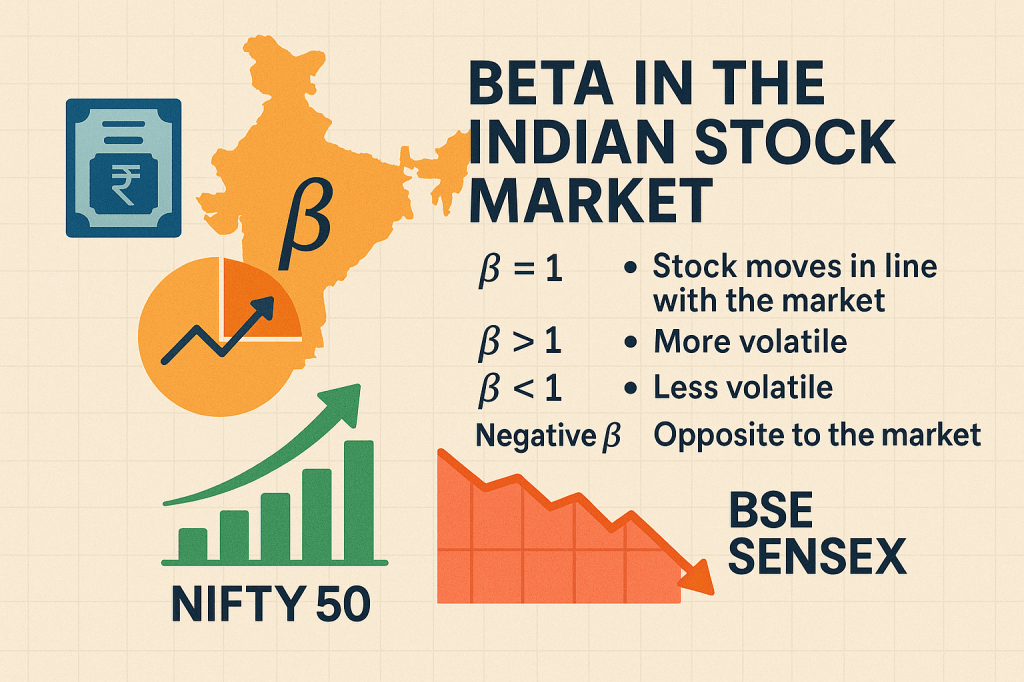
In the dynamic world of the Indian stock market, where indices like the Nifty 50 and BSE Sensex dictate trends, understanding risk is crucial for investors. One essential tool for assessing risk is “beta.” This metric helps you gauge how a stock moves relative to the broader market, empowering you to make informed investment decisions. In this article, we’ll explore what beta is, why it matters in the Indian context, and how you can use it to navigate the markets effectively.
What Is Beta?
Beta measures a stock’s volatility compared to a benchmark index, such as the Nifty 50 or BSE Sensex, which represent the Indian market. It shows how sensitive a stock’s price is to market movements.
- Beta = 1: The stock moves in line with the market. If the Nifty 50 rises or falls by 1%, the stock is expected to do the same.
- Beta > 1: The stock is more volatile. A beta of 1.5 means the stock moves 1.5% for every 1% change in the market.
- Beta < 1: The stock is less volatile. A beta of 0.5 indicates a 0.5% move for a 1% market shift.
- Beta = 0: The stock’s price doesn’t correlate with the market.
- Negative Beta: Rare, but suggests the stock moves opposite to the market, like gold-related stocks during market slumps.
Why Beta Matters in the Indian Market
Beta is a vital tool for Indian investors, given the market’s unique characteristics—rapid growth, sector diversity, and occasional volatility driven by global cues or domestic events like budget announcements. Here’s why beta is important:
- Risk Assessment: Beta helps you understand the risk a stock adds to your portfolio. High-beta stocks, like those in tech or auto sectors, can offer higher returns but come with greater risk. Low-beta stocks, like FMCG or pharma, provide stability.
- Portfolio Diversification: Combining high- and low-beta stocks can balance risk. For instance, pairing a volatile IT stock with a stable PSU stock can cushion against market swings.
- Market Context: India’s market is influenced by monsoons, policy reforms, and global trends. High-beta stocks may surge during bullish phases (e.g., post-reform rallies) but dip sharply during corrections.
- Strategy Alignment: Conservative investors might prefer low-beta stocks like Hindustan Unilever, while aggressive investors may opt for high-beta stocks like Tata Motors.
How to Use Beta in the Indian Stock Market
Here’s how you can apply beta to your investment strategy in India:
- Match Your Risk Appetite: If you’re risk-averse, consider low-beta stocks like ITC (beta ~0.6) or Dabur, which tend to be stable during market turbulence. For higher returns, high-beta stocks like Adani Enterprises (beta ~1.8) or Bajaj Finance could be appealing.
- Consider Market Trends: During bullish phases, such as post-election rallies, high-beta stocks like Reliance Industries (beta ~1.2) may outperform. In bearish phases, low-beta stocks like Dr. Reddy’s Laboratories provide safety.
- Combine with Other Metrics: Use beta alongside P/E ratios, dividend yields, or ROE. For example, a high-beta stock like Infosys might look attractive, but check its valuations to ensure it’s not overpriced.
- Sector Insights: Indian sectors have distinct beta profiles. IT and auto stocks (e.g., Tata Motors, beta ~1.4) often have higher betas, while utilities or PSU banks (e.g., SBI, beta ~0.8) are lower. Align your sector bets with your risk tolerance.
Real-World Examples
Let’s look at some popular Indian stocks to illustrate beta:
- Tata Motors (Beta ~1.4): A high-beta stock in the auto sector. If the Nifty 50 drops 5% due to a global economic slowdown, Tata Motors might fall ~7%. Conversely, in a market rally, it could outperform, gaining 7% for a 5% Nifty rise.
- Hindustan Unilever (Beta ~0.6): A low-beta FMCG stock. A 5% Nifty decline might lead to only a 3% drop in HUL, making it a defensive choice during volatility.
- HDFC Bank (Beta ~1.0): Moves closely with the market. A 10% Nifty surge would likely see HDFC Bank rise by a similar margin, offering balanced exposure.
- Titan Company (Beta ~1.3): As a consumer discretionary stock, Titan is sensitive to market sentiment. During festive seasons, its high beta could amplify gains if the market rises.
These examples show how beta can guide stock selection based on market conditions and your investment goals.
Limitations of Beta
While beta is useful, it has limitations, especially in India’s complex market:
- Historical Data: Beta is based on past data (typically 3-5 years). A stock like Adani Green Energy may see its beta shift due to rapid expansion or policy changes.
- Market Benchmark: Beta is relative to indices like the Nifty 50. If your portfolio includes mid-cap or small-cap stocks, the Nifty Midcap 100 might be a better benchmark.
- Event-Driven Volatility: India-specific events (elections, RBI rate changes, or monsoons) can impact stocks beyond what beta predicts.
- Company-Specific Risks: Beta doesn’t account for internal risks, like management issues at a company like Yes Bank or regulatory challenges in pharma.
Where to Find Beta for Indian Stocks
Beta values for Indian stocks are available on financial platforms like Moneycontrol, BSE India, NSE, or screener.in. Brokerage apps like Zerodha, Groww, or Upstox also display beta. Note that beta calculations may vary slightly based on the time frame or benchmark index used (e.g., Nifty 50 vs. Sensex).
Practical Tips for Indian Investors
- Monitor Macro Events: Beta’s relevance increases during events like Union Budgets or RBI policy announcements. High-beta stocks like Larsen & Toubro may react strongly to infrastructure-focused policies.
- Diversify Across Betas: A portfolio with low-beta stocks like Nestlé India and high-beta stocks like Bajaj Auto can balance stability and growth.
- Reassess Periodically: Beta can change as companies evolve. For instance, Reliance Industries’ beta may shift as it expands into green energy or retail.
- Use Sector ETFs: If picking individual stocks feels complex, consider ETFs like the Nifty Bank ETF (high beta) or Nifty FMCG ETF (low beta) to align with your risk profile.
Final Thoughts
In the vibrant Indian stock market, beta is a powerful tool to understand how stocks dance to the market’s tune. Whether you’re eyeing the stability of low-beta giants like Hindustan Unilever or the growth potential of high-beta players like Adani Enterprises, beta helps align your portfolio with your risk tolerance and market outlook. However, don’t rely on beta alone—combine it with fundamental analysis and stay attuned to India’s unique market drivers.
By mastering beta, you can navigate the ups and downs of Dalal Street with greater confidence. Happy investing!
Note: Beta values mentioned are illustrative and based on typical ranges for these stocks. Always check current beta values on reliable platforms.


Leave a Reply