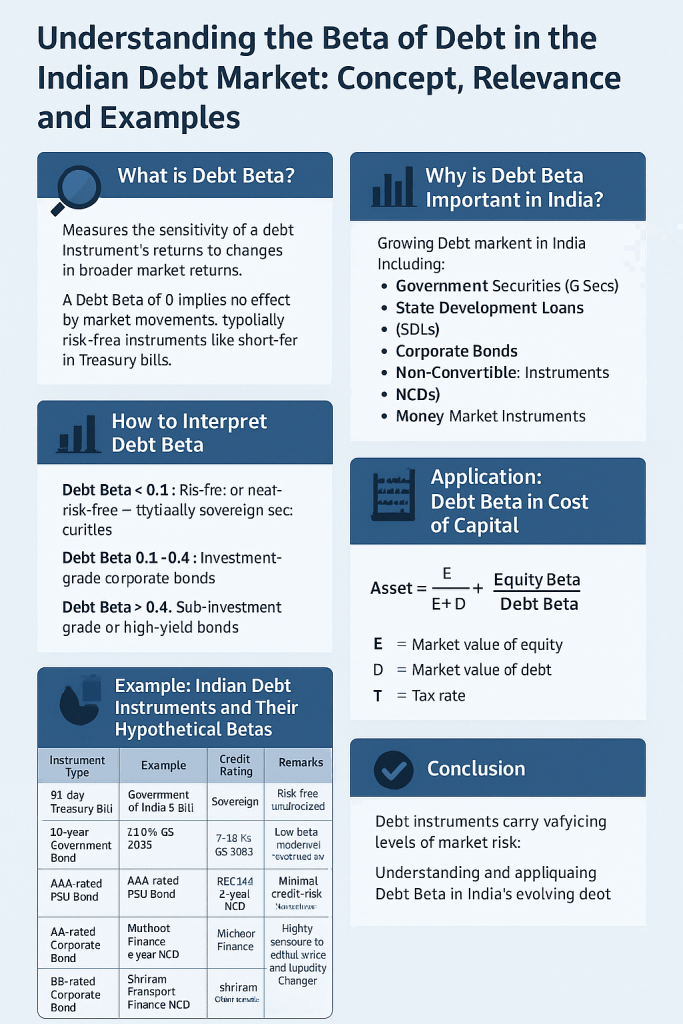
In the Indian financial markets, where equity investments often steal the spotlight, debt instruments like bonds and debentures play a crucial role in building balanced portfolios. While beta is a well-known metric for assessing the risk of stocks, its application to debt instruments is less discussed but equally important. This article dives into the concept of beta in the context of debt, specifically within the Indian debt market, and explains how investors can use it to make informed decisions.
What Is Beta in the Context of Debt?
Beta, in general, measures an asset’s volatility relative to a benchmark, typically the broader market. For debt instruments like bonds, beta quantifies how sensitive a bond’s price is to changes in a benchmark, such as interest rates or a bond market index (e.g., the Nifty 10 Yr Benchmark G-Sec Index in India). Unlike equity beta, which is tied to stock market movements, debt beta is primarily driven by interest rate fluctuations and credit risk.
- Beta = 1: The bond’s price moves in line with the benchmark. If the benchmark index falls 1%, the bond’s price is expected to fall by 1%.
- Beta > 1: The bond is more volatile, meaning its price reacts strongly to changes in interest rates or market conditions.
- Beta < 1: The bond is less volatile, offering more price stability.
- Beta ≈ 0: The bond’s price is largely unaffected by the benchmark, often seen in short-term or floating-rate bonds.
- Negative Beta: Rare, but indicates the bond’s price moves opposite to the benchmark, such as in certain inflation-linked bonds.
Why Beta Matters in the Indian Debt Market
The Indian debt market, comprising government securities (G-Secs), corporate bonds, and other fixed-income instruments, is influenced by factors like Reserve Bank of India (RBI) policies, inflation, and global yields. Understanding the beta of debt instruments helps investors navigate this landscape:
- Interest Rate Sensitivity: Bonds are sensitive to interest rate changes. A high-beta bond will see larger price swings when RBI adjusts repo rates or when market yields shift.
- Risk Assessment: Debt beta helps gauge the risk of price fluctuations in a bond portfolio, especially for long-term bonds or those with lower credit ratings.
- Portfolio Diversification: Combining bonds with different betas (e.g., short-term G-Secs with low beta and corporate bonds with higher beta) can balance risk and return.
- Market Timing: In a rising interest rate environment, low-beta bonds may offer stability, while high-beta bonds could provide higher returns when rates fall.
How Beta Works in the Indian Debt Market
In India, the debt market includes G-Secs, State Development Loans (SDLs), corporate bonds, and debt mutual funds. Beta for debt instruments is typically calculated relative to a bond index (e.g., Nifty Composite G-Sec Index) or interest rate movements (e.g., 10-year G-Sec yield). Here’s how it applies:
- Government Securities (G-Secs): These are considered low-risk, but their beta varies with maturity. A 10-year G-Sec might have a beta of ~0.8 relative to the Nifty G-Sec Index, meaning it’s moderately sensitive to market yield changes. Short-term G-Secs (e.g., 91-day T-Bills) have near-zero beta due to low interest rate sensitivity.
- Corporate Bonds: These often have higher betas (e.g., 1.2–1.5) due to credit risk and market sentiment. For instance, a bond from a mid-tier NBFC like Shriram Finance may be more volatile than a AAA-rated bond from HDFC Ltd.
- Debt Mutual Funds: Funds like liquid funds have low betas (~0.2–0.4) due to short-duration assets, while long-duration gilt funds may have betas closer to 1 or higher, reflecting greater interest rate risk.
Real-World Indian Examples
Let’s explore beta with examples from the Indian debt market:
- 10-Year G-Sec (Beta ~0.8): If the 10-year G-Sec yield rises by 1% (e.g., from 7% to 8%), the bond’s price might fall by ~0.8% (assuming a modified duration of 8). Its beta reflects moderate sensitivity to yield changes.
- AAA Corporate Bond (e.g., Reliance Industries, Beta ~1.0): A high-quality corporate bond moves closely with the bond market index. If the Nifty Corporate Bond Index drops 1%, this bond’s price might fall by a similar margin.
- High-Yield NBFC Bond (e.g., Muthoot Finance, Beta ~1.4): These bonds are more volatile due to credit risk. A 1% rise in market yields could lead to a 1.4% price drop, amplified by investor sentiment toward NBFCs.
- Liquid Fund (e.g., SBI Liquid Fund, Beta ~0.3): With short-term instruments, these funds have low beta, making them stable even when yields fluctuate.
Note: Betas are indicative and depend on prevailing market data and regression analysis.
How to Use Debt Beta in Investing
Here’s how Indian investors can leverage beta in the debt market:
- Match Risk Tolerance: Conservative investors might prefer low-beta instruments like short-term G-Secs or liquid funds. Those seeking higher returns could opt for high-beta corporate bonds or long-duration debt funds.
- Anticipate RBI Policy Moves: In a rate-hike cycle (e.g., RBI tightening to curb inflation), low-beta bonds like Treasury Bills or ultra-short duration funds are safer. In a rate-cut cycle, high-beta gilt funds could offer capital gains.
- Diversify Debt Holdings: Combine low-beta G-Secs with high-beta corporate bonds to balance stability and yield. For example, pair a 5-year G-Sec with a AAA-rated bond from Bajaj Finance.
- Monitor Economic Indicators: Inflation, fiscal deficit, and global yields impact bond betas. For instance, rising US 10-year yields can push Indian G-Sec yields, affecting high-beta bonds more.
Limitations of Debt Beta in India
While useful, debt beta has limitations in the Indian context:
- Limited Liquidity: The Indian debt market, especially corporate bonds, can be illiquid, making beta calculations less reliable due to infrequent trading.
- Credit Risk Overshadowing: For lower-rated bonds (e.g., BBB-rated), credit events like defaults can drive price changes more than market yields, reducing beta’s relevance.
- Data Availability: Beta for individual bonds may not be as readily available as for stocks. Investors often rely on mutual fund betas or proxy indices.
- Short-Term Focus: Beta may not suit long-term buy-and-hold investors who focus on yields to maturity rather than price volatility.
Where to Find Debt Beta in India
Beta for debt instruments or funds can be found on platforms like Moneycontrol, Morningstar India, or Value Research. Mutual fund fact sheets (e.g., ICICI Prudential or HDFC Mutual Fund) often list beta for debt funds. For individual bonds, you may need to consult brokerage platforms like Zerodha’s Coin or ICICI Direct, though beta might be implied through duration or yield sensitivity.
Practical Tips for Indian Investors
- Track RBI Announcements: Beta’s relevance spikes during Monetary Policy Committee (MPC) meetings. High-beta bonds may react sharply to rate changes.
- Use Debt Funds for Simplicity: If calculating beta for individual bonds is complex, consider debt mutual funds, where beta is often disclosed. For example, HDFC Dynamic Debt Fund may have a higher beta than SBI Magnum Constant Maturity Fund.
- Watch Duration: Beta is closely tied to a bond’s modified duration. Long-duration bonds (e.g., 30-year G-Secs) have higher betas, while short-duration bonds (e.g., 364-day T-Bills) have lower betas.
- Diversify Across Maturities: A mix of short-term (low beta) and long-term (high beta) bonds can hedge against interest rate volatility.
Final Thoughts
In the Indian debt market, beta is a valuable lens for understanding how bonds and debt funds respond to interest rate shifts and market dynamics. Whether you’re investing in stable G-Secs, high-yield corporate bonds, or debt mutual funds, beta helps align your portfolio with your risk appetite and market expectations. However, combine beta with other factors like credit ratings, yield curves, and macroeconomic trends for a holistic approach.
By mastering debt beta, you can navigate India’s fixed-income landscape with confidence, balancing safety and returns in a market shaped by RBI policies and global cues. Happy investing!
Note: Beta values are illustrative and based on typical ranges. Check current data on reliable platforms.


Leave a Reply