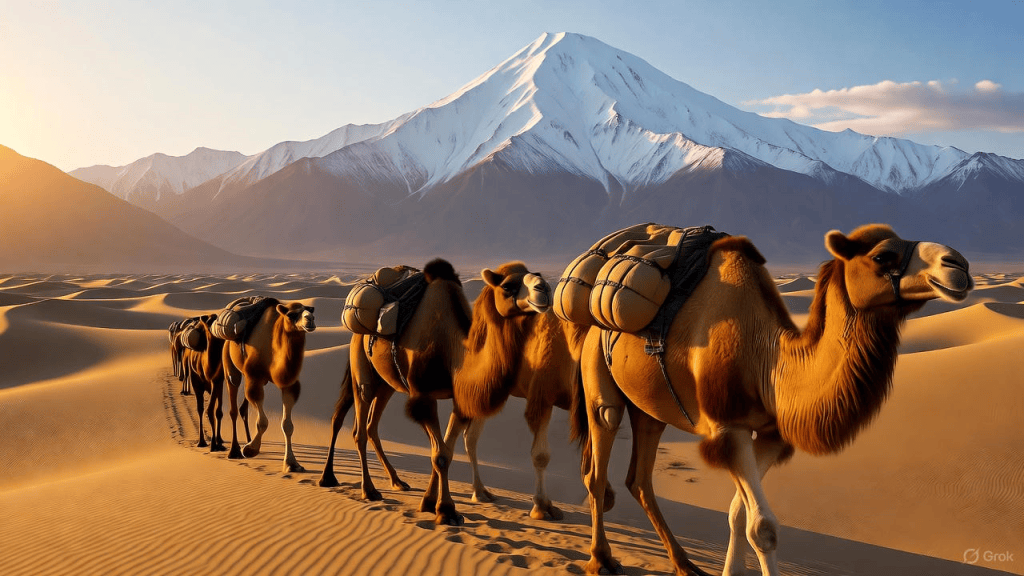
A panoramic view of a camel caravan winding through golden dunes at sunrise, with the snow-capped Pamir Mountains in the background. Silk bales and spice sacks are visible on the camels.
The Silk Route, an intricate network of trade routes spanning thousands of miles across Asia, Europe, and the Middle East, stands as one of history’s most remarkable conduits of commerce, culture, and connection. Established around the 2nd century BCE, it facilitated the exchange of goods, ideas, and peoples, shaping civilizations and leaving an enduring legacy. This article explores the origins, geographical influences, economic impacts, cultural exchanges, and political ramifications of the Silk Route, as well as its relevance to the modern geopolitical landscape.
The Need for the Silk Route
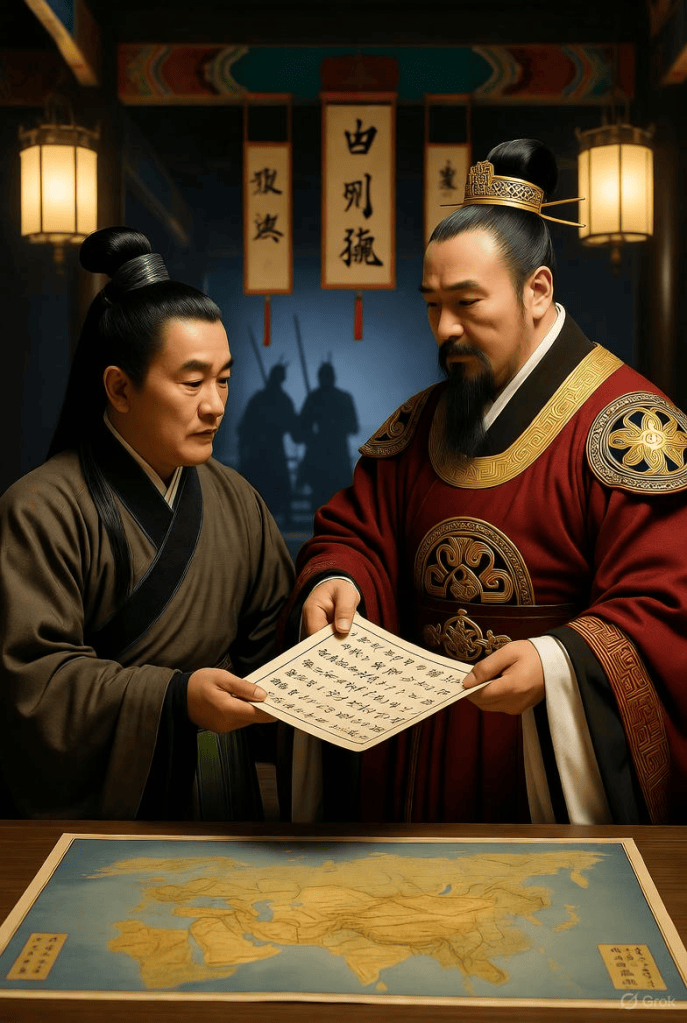
Emperor Wu Sends Zhang Qian
The Silk Route emerged from a fundamental human need: the desire for goods and resources not available locally. By the 2nd century BCE, the Han Dynasty in China sought to secure valuable commodities like horses, jade, and furs from Central Asia, while offering silk, a luxurious and highly coveted fabric, in return. Similarly, the Roman Empire, the Parthians, and the Kushans craved silk, spices, and other exotic goods, while exporting glassware, wool, and gold. The absence of direct access to these resources drove the creation of trade networks that connected distant empires.
Beyond material needs, the route addressed strategic and diplomatic necessities. The Han Dynasty, for instance, aimed to forge alliances with Central Asian tribes to counter the threat of nomadic Xiongnu raiders. Trade became a tool for diplomacy, fostering mutual dependence and stability. The Silk Route thus arose as a response to economic, political, and security imperatives, linking regions as diverse as China, Persia, India, and the Mediterranean.
Initiation of the Silk Route
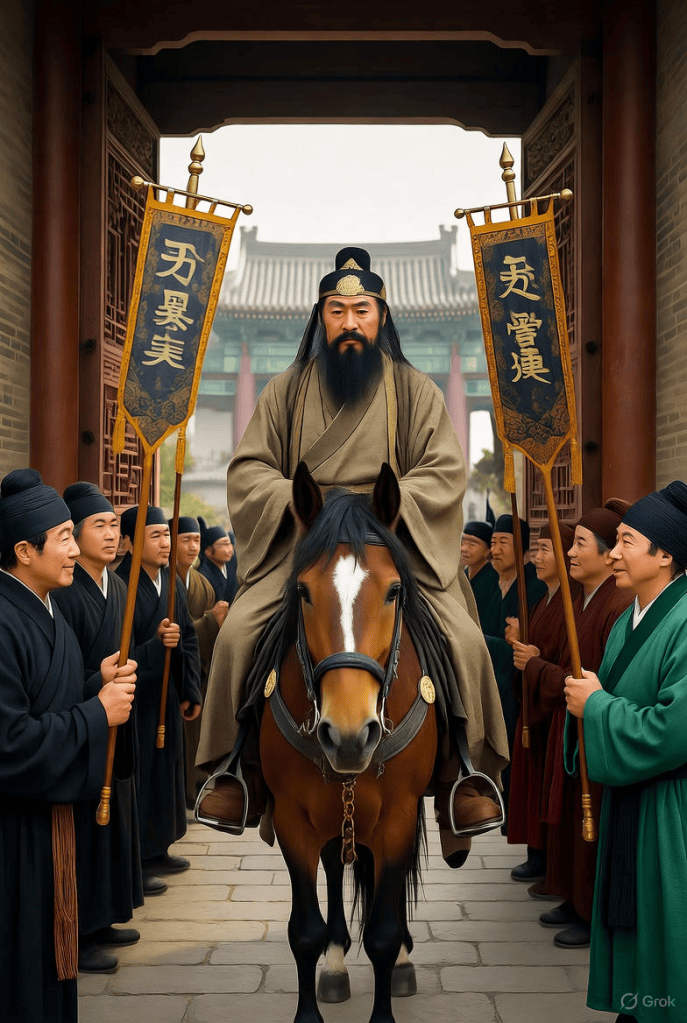
Zhang Qian, weathered and bearded after 13 years, entering the gates of Chang’an on horseback, greeted by Han officials. A crowd holds silk banners.
The Silk Route’s formal initiation is often attributed to the Han Dynasty’s efforts under Emperor Wu (r. 141–87 BCE). The emperor sent envoy Zhang Qian to Central Asia around 139 BCE to secure alliances and explore trade opportunities. Despite being captured and held for a decade by the Xiongnu, Zhang Qian’s missions laid the groundwork for diplomatic and commercial ties with Central Asian kingdoms like the Yuezhi and Bactria. His reports on the wealth and resources of the “Western Regions” spurred Chinese interest in establishing regular trade.
The route itself was not a single road but a sprawling network of overland and maritime paths. Overland routes stretched from Chang’an (modern Xi’an) through the Tarim Basin, across the Pamir and Tian Shan mountains, into Persia, and onward to the Mediterranean. Maritime routes, often considered part of the broader Silk Route, connected ports in South China, India, and the Red Sea. Middlemen, including Sogdian, Parthian, and Indian merchants, played a critical role in bridging these regions, as direct travel from one end to the other was rare.
Geography’s Influence on the Route
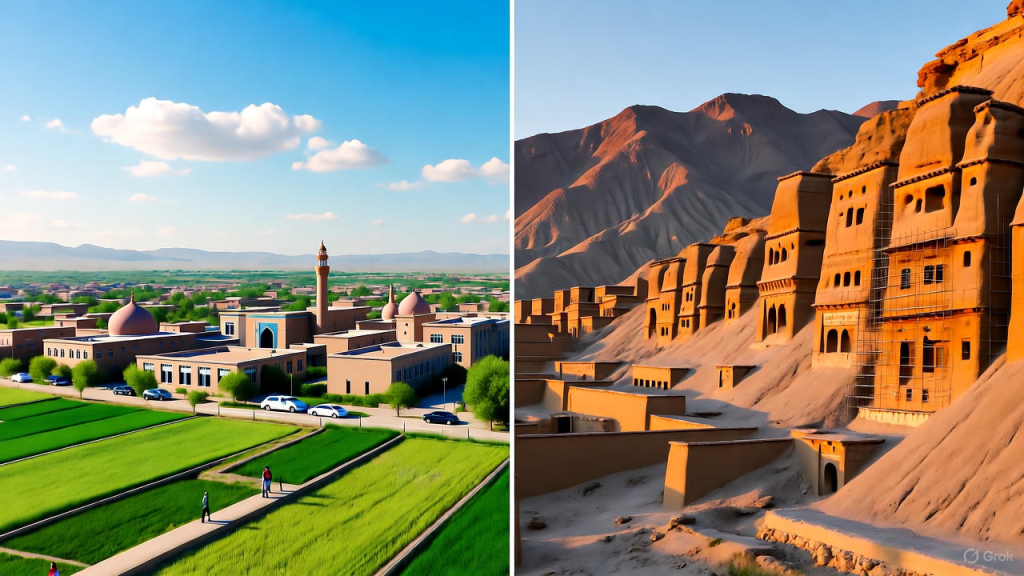
The Taklamakan Crossroads
Left: Northern route around the Taklamakan with oasis city (e.g., Turpan). Right: Southern route with Dunhuang’s Mogao Caves glowing at sunset.
The Silk Route’s paths were profoundly shaped by geography. The vast Eurasian continent presented formidable barriers: the Gobi Desert, the Taklamakan Desert, and the towering Himalayas and Pamir mountains. Traders navigated these challenges by following oases, river valleys, and mountain passes. Key hubs like Dunhuang, Kashgar, Samarkand, and Bukhara emerged at strategic points where geography allowed for rest, resupply, and exchange.
The Taklamakan Desert, for instance, forced traders to choose between northern and southern routes around the Tarim Basin, both dotted with oases that became thriving trade centers. The Pamir Knot, a convergence of mountain ranges, was a critical juncture linking China, India, and Central Asia. Maritime routes, meanwhile, relied on monsoon winds and coastal geography, with ports like Muziris in India and Berenike in Egypt serving as vital nodes.
Geography also posed risks. Harsh climates, banditry, and political instability in regions like the steppe lands made travel perilous. Yet, these same geographical features fostered interdependence, as communities along the route relied on one another for survival, creating a web of economic and cultural ties.
Impact on Trade and Economy
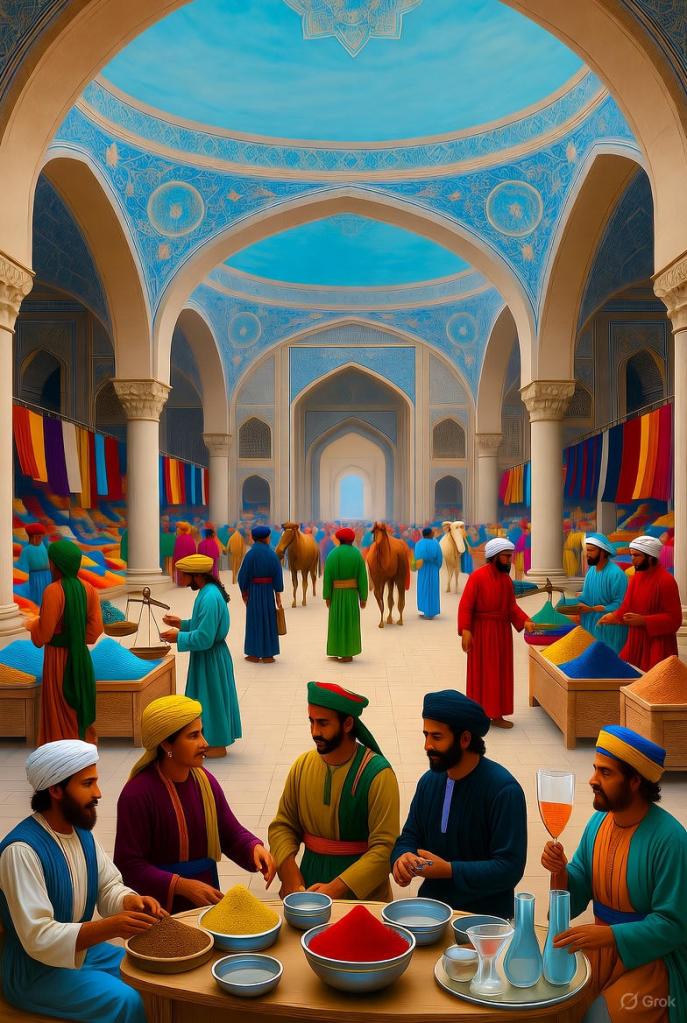
The Bazaar of Samarkand – A vibrant, crowded market under blue-tiled domes. Sogdian merchants weigh silk, Indian traders display pepper, a Roman buys glassware. Camels and horses in the background.
The Silk Route was a catalyst for economic transformation. It enabled the exchange of high-value goods like silk, spices, precious stones, and metals, which were lightweight and profitable enough to justify the arduous journey. China’s silk, prized for its rarity and quality, became a global currency, while Indian spices, Persian carpets, and Roman glassware found eager markets across continents.
The route stimulated local economies by creating demand for services like caravanserais, guides, and pack animals. Cities like Samarkand, Palmyra, and Chang’an flourished as commercial hubs, their wealth fueled by taxes, tolls, and trade. The economic ripple effect extended to agriculture and artisanal production, as regions specialized in goods for export, such as Indian cotton textiles or Central Asian horses.
However, the route also highlighted economic disparities. Wealth concentrated in urban centers and among elite merchants, while poorer communities often served as laborers or intermediaries. The high cost of long-distance trade meant that only luxury goods were typically exchanged, limiting direct benefits for ordinary people.
New Opportunities for Local Products
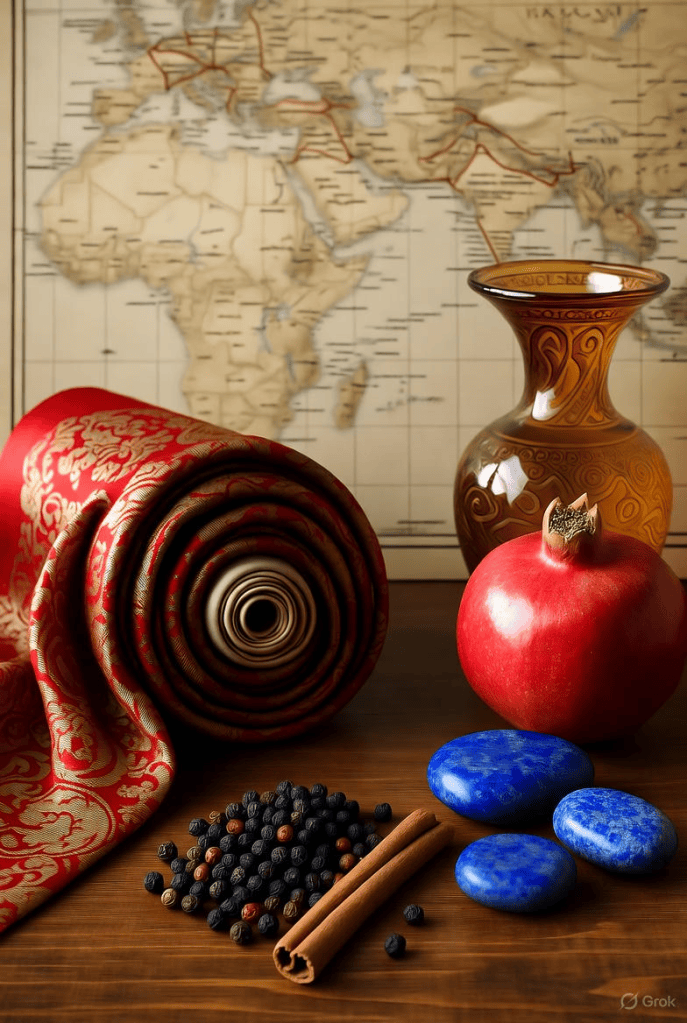
Goods of the Silk Route:
- Chinese silk bolt (red/gold)
- Indian black pepper & cinnamon
- Afghan lapis lazuli
- Persian pomegranate
- Roman glass vase
The Silk Route opened new markets for local products, transforming regional economies. Chinese silk, initially a closely guarded secret, became a global commodity, with techniques eventually spreading to Persia and Byzantium. Indian spices, such as pepper and cinnamon, became staples in Roman cuisine, while Central Asian regions like Ferghana gained fame for their superior horses. Lesser-known products, like Sogdian textiles, Afghan lapis lazuli, and Arabian frankincense, also found international buyers.
Local artisans and producers adapted to meet foreign demand, fostering innovation and specialization. For example, the Sogdians became renowned as traders and cultural intermediaries, their language serving as a lingua franca along parts of the route. This exchange of goods diversified economies and encouraged cross-cultural craftsmanship, such as the blending of Greco-Roman and Persian motifs in Central Asian art.
Bringing Kingdoms Closer and Creating Distances
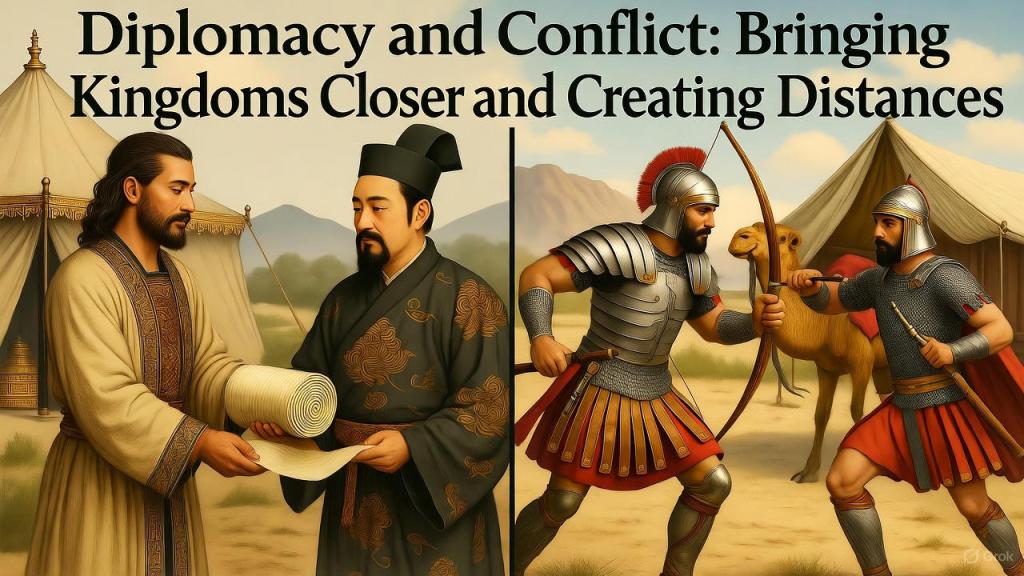
Diplomacy and Conflict:
- Left: A Parthian and Han envoy exchanging gifts (silk for horses).
- Right: Roman and Parthian soldiers clashing over a trade caravan.
The Silk Route was a double-edged sword in its impact on relations between kingdoms. On one hand, it fostered closeness through trade and diplomacy. The Han and Parthian empires, for instance, maintained cordial relations, with silk and horses flowing between them. Cultural exchanges, including the spread of Buddhism from India to China via Central Asia, created shared religious and philosophical ties. Intermarriage, migration, and the movement of scholars further knit societies together.
On the other hand, the route exacerbated tensions and rivalries. Competition for control over key trade hubs, such as the Tarim Basin or the Persian Gulf, sparked conflicts. The Parthians and Romans clashed repeatedly, partly over dominance of Silk Route trade. Nomadic groups like the Xiongnu and later the Mongols disrupted trade through raids, creating insecurity. Political fragmentation, as seen in the shifting alliances of Central Asian city-states, sometimes deepened divisions rather than bridged them.
Did the Silk Route Unite the World?
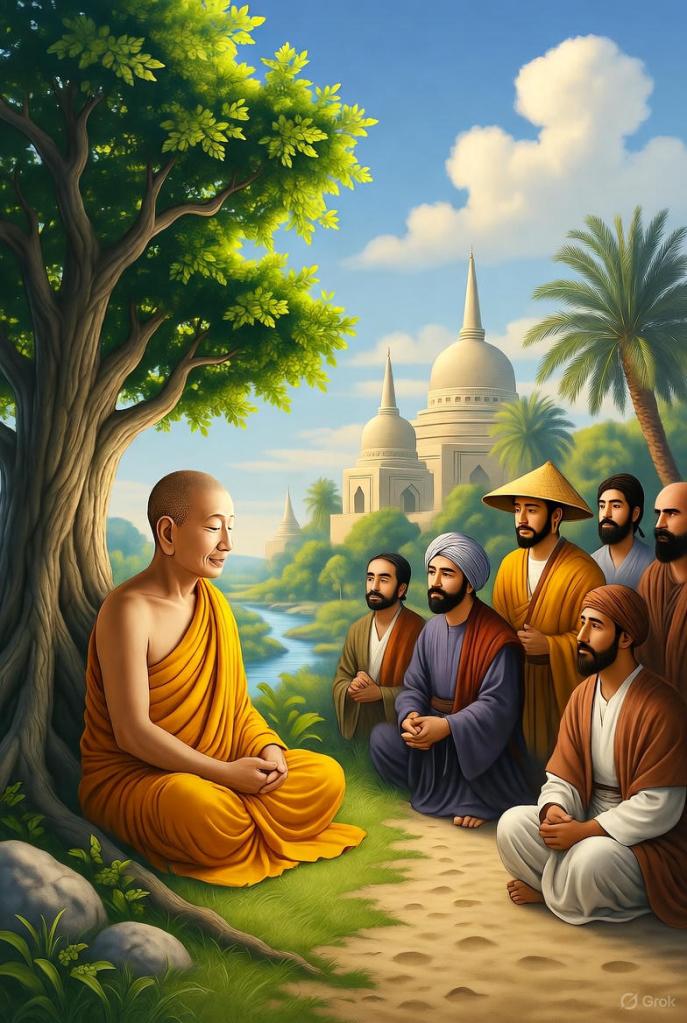
The Buddha Travels West: A monk in saffron robes teaching under a bodhi tree in a Central Asian oasis, with Chinese, Indian, and Persian pilgrims listening. Buddhist stupas dot the horizon.
The Silk Route united the world in a limited but profound sense. It created a framework for interaction across vast distances, linking disparate cultures through shared economic interests and cultural exchanges. The spread of Buddhism, Zoroastrianism, and later Islam along the route attests to its role as a conduit for ideas. Technologies, such as papermaking and gunpowder, also traveled westward, reshaping societies.
However, this unity was incomplete. The route connected elites and merchants more than ordinary people, and cultural exchanges often remained superficial. Linguistic, religious, and political differences persisted, and conflicts over trade routes underscored divisions. The Silk Route was less a global unifier than a selective bridge, fostering interdependence among certain regions while leaving others on the periphery.
Linkages to the Present Political Map
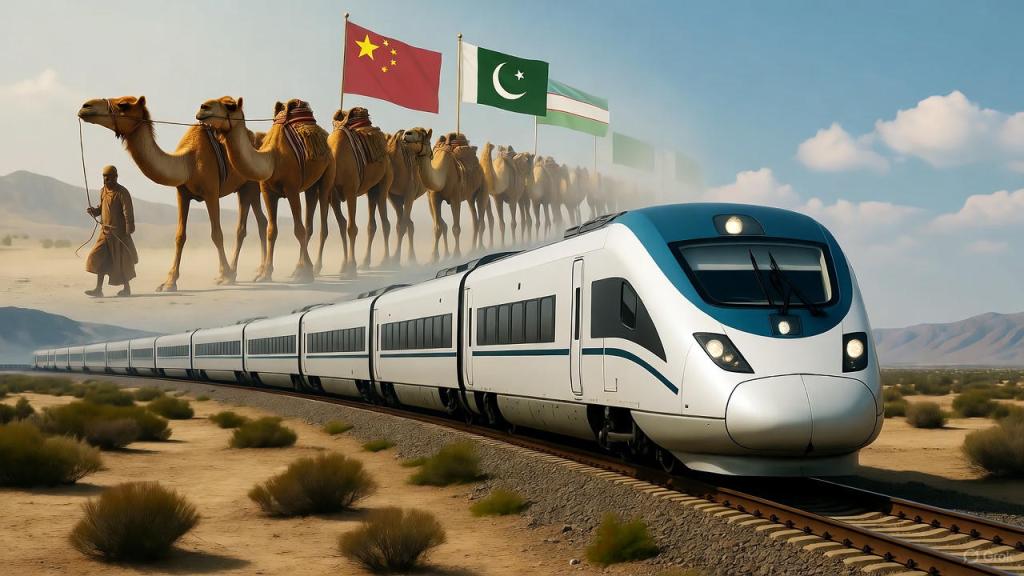
From Silk Route to Belt and Road:
- Foreground: A high-speed train in Xinjiang.
- Background: Faded translucent image of an ancient caravan on the same path (with subtle flags of China, Pakistan, Uzbekistan).
The legacy of the Silk Route is evident in the modern political map of its regions, though the connections are complex. Many of today’s Central Asian states—Uzbekistan, Turkmenistan, Kyrgyzstan—encompass ancient trade hubs like Samarkand and Bukhara, and their economies still reflect a blend of pastoral and commercial traditions shaped by the route. The strategic importance of Afghanistan, a historical crossroads, persists in modern geopolitics, though now tied to conflict rather than trade.
China’s Belt and Road Initiative, launched in 2013, explicitly draws on the Silk Route’s legacy, aiming to revive connectivity through infrastructure and trade. However, modern borders and national identities, shaped by colonialism and 20th-century geopolitics, complicate direct parallels. For instance, the division of the Indian subcontinent into India, Pakistan, and Bangladesh reflects historical invasions and migrations partially facilitated by Silk Route corridors, yet these modern boundaries are also products of later imperial and post-colonial dynamics.
Tensions in the Middle East, particularly between Iran and its neighbors, echo ancient rivalries over trade routes, though now framed by oil, ideology, and global alliances. The Silk Route’s legacy thus lingers in the economic and cultural fabric of these regions, but modern political realities are shaped by more recent forces.
Conclusion
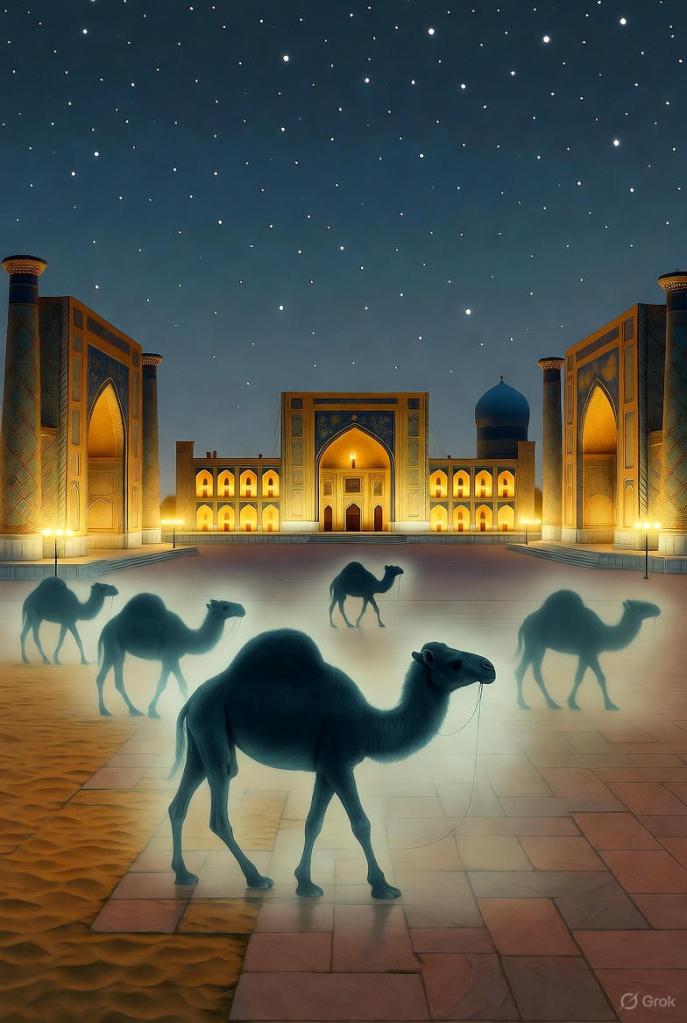
Echoes of the Silk Route: A poetic night scene — the Registan in Samarkand illuminated, with a caravan of shadows (ghostly camels) moving across the square, blending past and present.
The ancient Silk Route was a monumental network that transcended mere trade, weaving a complex tapestry of economic, cultural, and political interactions. Born from the need for resources and alliances, it navigated treacherous geographies to connect empires and foster prosperity. While it opened new markets for local products and brought some societies closer, it also fueled rivalries and fell short of true global unity. Its influence persists in the cultural heritage and strategic importance of its regions, though modern political boundaries reflect a mix of historical legacies and contemporary forces. The Silk Route remains a testament to humanity’s enduring quest for connection, even across the most daunting divides.
Disclaimer: This article, The Ancient Silk Route: A Tapestry of Trade, Culture, and Connectivity, was generated by Grok (built by xAI) upon my specific request. Instead of copying from Wikipedia or other sources, I used Grok to craft a customized piece that aligns with my vision, highlights the points I wanted to emphasize, and reflects my personal style and focus.
While the content is AI-assisted, the ideas, structure, and intent are mine. I believe in transparent creation — so full credit to Grok for helping bring this to life.
Image Disclaimer: All images in this article were generated by Grok (built by xAI). They are used for illustrative purposes only and do not depict real historical scenes, artifacts, or locations with photographic accuracy.


Leave a Reply