In the sultry haze of 2025’s financial summer, India’s stock market crooned a melancholic tune—the FII Exodus Blues. Foreign Institutional Investors (FIIs), those globetrotting whales of capital, pulled out over $18 billion (Rs 1.52 lakh crore) from Indian equities year-to-date, leaving behind a trail of volatility and a Sensex that’s waltzed nervously between hope and despair. This wasn’t just a fleeting jilt; it was a structural shift, triggered by the lingering chill of global rate hikes that made Uncle Sam’s bonds look like a safer bet than Mumbai’s bustling bourses. As the US Federal Reserve held rates high into early 2025 before easing in September, emerging markets like India felt the squeeze—higher yields abroad lured risk-averse funds back home, while a surging dollar and AI-fueled rallies in the US, China, and Taiwan painted India as the overlooked underdog in the tech race.
But here’s the silver lining in this bluesy ballad: Domestic Institutional Investors (DIIs) stepped up like a loyal bandmate, injecting a record Rs 6 lakh crore into the market, more than offsetting the foreign flight and keeping the Nifty afloat. It’s a tale of resilience, where desi money—fueled by surging SIPs, mutual funds, and EPFO inflows—has flipped the script, with DII holdings hitting an all-time high of 17.62% of the market by March 2025, surpassing FIIs for the first time in years. As we unpack this exodus, we’ll dive into the data with charts, spotlight three defensive anchors to bunker down, and end with a cheeky “what if” on RBI rate cuts that could turn the blues into a boogie.
The Great Pullout: $18B Outflows and the Global Rate Shadow
The FII sell-off kicked off with a vengeance in Q1 2025, as the Fed’s stubborn stance on inflation kept US Treasury yields elevated around 4.5-5%, drawing flows away from high-growth but volatile emerging markets. India’s premium valuations—Nifty trading at 22x forward earnings—made it an easy target amid global jitters, exacerbated by geopolitical tremors and a strong dollar that inflated import costs and pressured the rupee to 84.5 against the greenback. By September, cumulative outflows hit Rs 1.4 lakh crore, with hedge funds pivoting to AI darlings like Nvidia and TSMC, leaving Indian IT and pharma stocks in the dust.
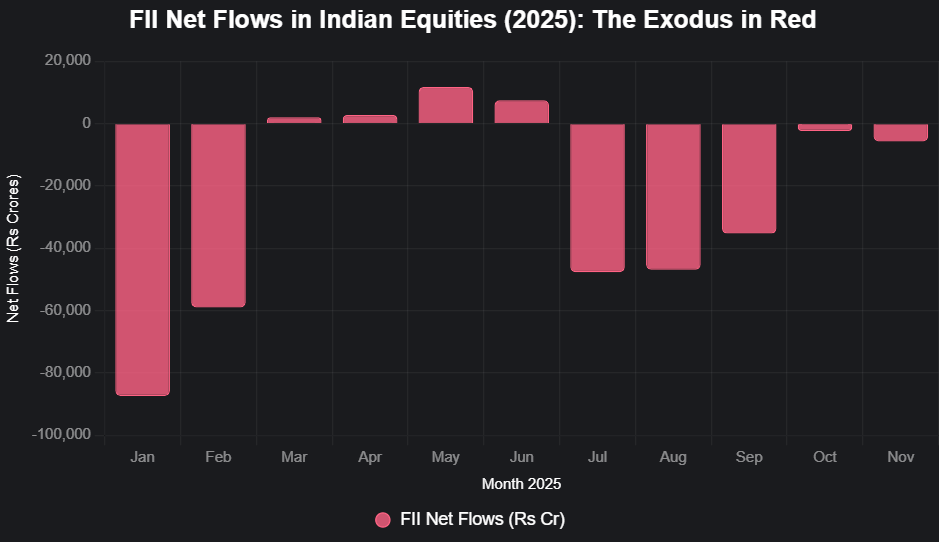
The impact? A choppy market: Nifty dipped 6.5% in Q3 despite DII ballast, with FMCG and midcaps taking the hardest hits. Yet, as the Fed finally sliced rates by 25 bps in September (to 4.75-5%) and another in October (to 3.75-4%), a brief FII buying spree in October (+Rs 14,610 crore) hinted at reversal—only for November to sour again with Rs 12,569 crore in sales. The chart below captures this rollercoaster: FII net flows turned sharply negative from July, underscoring the rate-hike hangover.
DIIs to the Rescue: The Desi Counter-Melody
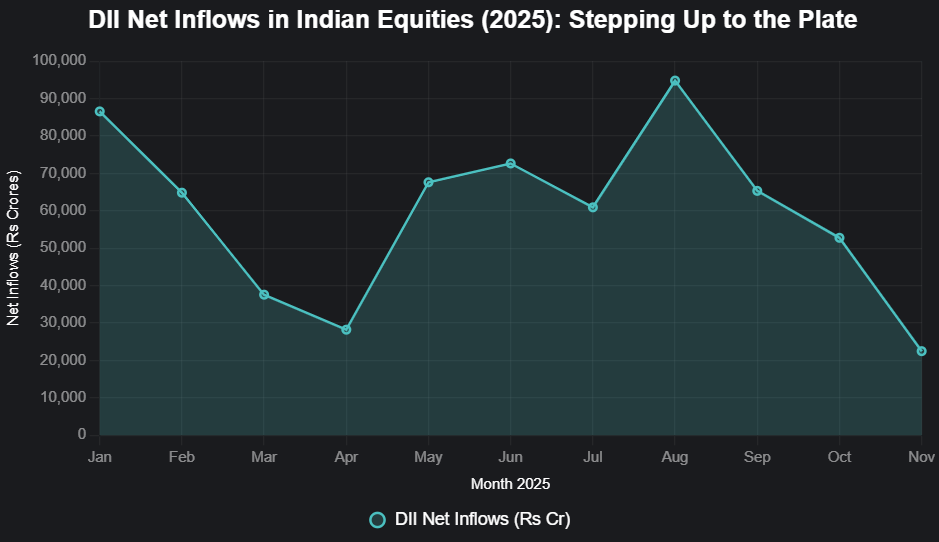
Enter the DIIs, India’s homegrown heroes. While FIIs fiddled with global yields, domestic players—buoyed by retail frenzy via Rs 25,000 crore monthly SIPs—poured in steadily, hitting a peak of Rs 94,829 crore in August to cushion the blow. Year-to-date DII inflows clocked Rs 6 lakh crore, dwarfing FII exits and driving a “structural shift” where local ownership now eclipses foreign at 17.62% vs. 17.22%. This isn’t just buying; it’s a vote of confidence in India’s 6.6% GDP growth trajectory, per IMF upgrades.
The chart below illustrates DIIs stepping up: a steady climb, with accelerations in May-June and August, turning potential market meltdowns into mild dips.
Anchors in the Storm: 3 Defensive Stocks to Hold Steady
Amid the flux, savvy investors are eyeing defensive plays—stocks with fortress-like balance sheets, steady cash flows, and insulation from FII whims. Here are three picks blending stability with upside:
- HDFC Bank (NSE: HDFCBANK): The banking behemoth’s Q2 FY26 results (ending Sep 2025) showcased robust 15% loan growth and pristine asset quality (GNPA at 1.1%), shrugging off rate pressures with a net interest margin holding at 4.2%. Trading near lifetime highs around Rs 1,750, it’s a low-beta haven (0.8) for portfolio ballast, with analysts eyeing Rs 1,900 on consumption rebound.
- Bharat Electronics Ltd (BEL) (NSE: BEL): In the defence sector’s boom—fueled by Rs 6.2 lakh crore indigenization push—BEL’s order book swelled to Rs 14,750 crore by Oct 2025, with fresh Rs 792 crore wins propelling shares up 2% to Rs 425. As a PSUs darling with 25% YoY revenue growth and debt-free ops, it’s defensive gold: minimal cyclicality, dividend yield at 0.7%, and targets at Rs 490.
- Shriram Finance (NSE: SHRIRAMFIN): This NBFC powerhouse surged 23% in the last month to Rs 785, backed by 5% Q2 jump on stable AUM growth (18% YoY) and low NPAs (1.5%). Brokerages like Motilal Oswal reiterate “buy” for its rural lending moat, offering 1.2% yield and resilience in a high-rate world.
These trio—HDFC for liquidity, BEL for policy tailwinds, Shriram for credit depth—boast average ROE >20% and beta <1, ideal for weathering outflows.
The Twist: What If RBI Cuts Rates? A Rate-Relief Riff
Picture this: As inflation cools to 2.6% for FY26 (per RBI’s Oct forecast), the central bank greenlights a 25 bps repo cut to 5.25% in December, echoing the 50 bps slash in June. EMIs dip, credit booms, and rupee steadies—FIIs trickle back, Nifty pops 5-7%, and our defensive picks? HDFC’s margins expand, BEL’s capex accelerates, Shriram’s disbursals soar 20%. The blues fade to brass: a 2026 bull run, with DIIs as the steady rhythm section. But if no cut? These anchors still hum a safe tune.
In this FII fugue, India’s market proves it’s no solo act—DII depth and defensive bets keep the symphony alive. Tune in for more riffs; what’s your hold in this harmony?
Disclaimer: This is not investment advice. Always Do Your Own Research.
Image Source: Grok (xAI). Grok can make mistakes. Always check original sources.


Leave a Reply