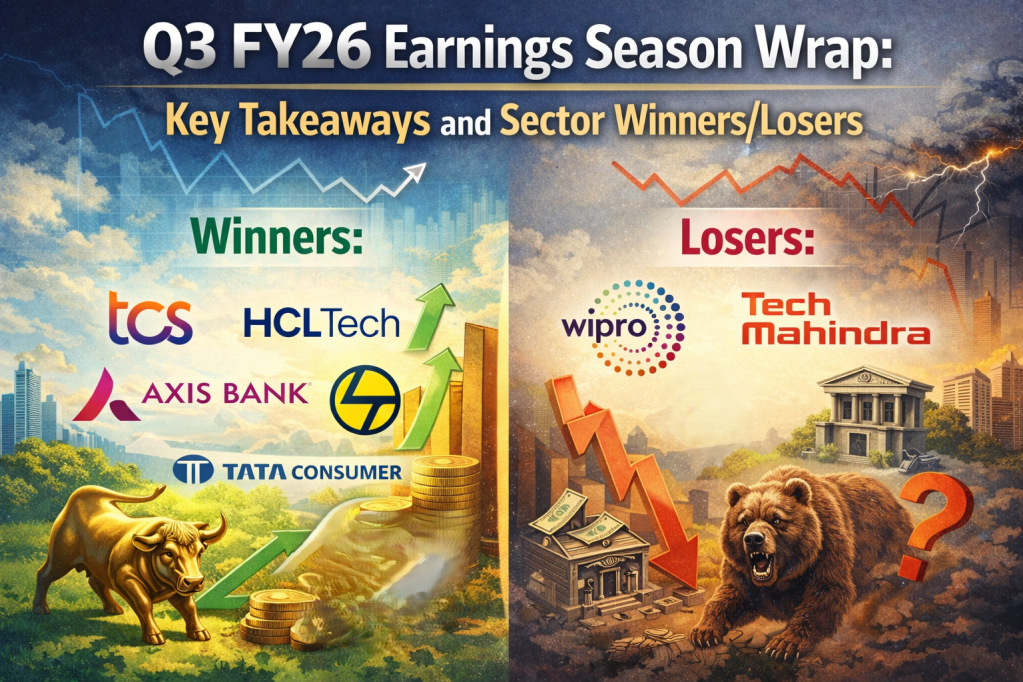
The Q3 FY26 earnings season (October-December 2025) has wrapped up with a mixed bag for India Inc., reflecting resilient revenue growth amid global uncertainties like slowing demand, AI disruptions, and fluctuating commodity prices. Overall, corporate earnings grew around 8-10% YoY, in line with expectations of steady but not spectacular performance, driven by domestic consumption and infrastructure push. However, one-off costs from new labor codes and margin squeezes tempered profitability for many. Here’s a sector-wise roundup, highlighting surprises, expectation comparisons, and signs of pressure or recovery. We’ll also dive deeper into some standout companies and how they navigated global headwinds.
IT Sector: Under Pressure but AI Sparks Hope
The IT sector faced headwinds from subdued global tech spending, with revenue growth decoupling from headcount for the first time—top firms shed nearly 3,000 roles net while pushing AI-led deals. Earnings largely met or slightly beat muted expectations, but margins remained sensitive to wage hikes and compliance costs under new labor rules, contracting by 50-100 bps for many.
- Surprises: TCS and HCLTech delivered positive shocks with record mega-deals ($3B bookings for HCLTech) and AI revenue surges (TCS at $1.8B annualized), signaling early recovery in BFSI verticals. Infosys, however, saw a 2.2% YoY profit dip due to a ₹1,289 crore one-time hit, though constant currency revenue grew 9%.
- Winners/Losers: Winners include AI-focused players like TCS (up 4-5% revenue guidance). Losers: Wipro and Tech Mahindra, where weak guidance highlighted ongoing US/Europe slowdowns.
- Margin Pressures/Recovery Signs: EBIT margins improved marginally for some (TCS to 16.1%), but overall sector pressure persists from cost resets. Recovery green shoots: AI skills ramp-up (over 217,000 at TCS) and deal TCVs point to FY27 rebound.
Banking Sector: Resilient Growth Amid NIM Squeeze
Banks shone with robust loan growth (12-15% YoY), beating expectations on asset quality improvements, but net interest margins (NIMs) faced compression from rising deposit costs and regulatory tweaks. Profitability was mixed, with private lenders outperforming PSUs.
- Surprises: Axis Bank’s PAT jumped 27.5% QoQ to ₹6,490 crore, surpassing estimates, while Yes Bank’s net profit soared 55% YoY to ₹952 crore on better NPA management (GNPA down to 1.5%). HDFC Bank led with ₹77,621 crore profit, but some misses on NIMs disappointed.
- Winners/Losers: Winners: Private giants like HDFC, ICICI, and Axis, with CASA ratios stabilizing (Yes at 34%). Losers: Smaller banks grappling with higher provisioning.
- Margin Pressures/Recovery Signs: NIMs dipped 20-30 bps QoQ due to funding costs, but core operating profits rose (e.g., 6% YoY for some). Recovery evident in falling GNPAs (Axis to 2.72%) and deposit growth outpacing sector averages, buoyed by RBI’s 7.4% Q3 GDP forecast.
Consumer Sector: Volume-Led Recovery with Pricing Pains
Consumer staples and durables saw sluggish profit growth amid weak rural demand and competitive pricing, but volume surges (10-15% YoY for some) exceeded expectations in urban markets. Margins faced pressure from input cost volatility and ad spends.
- Surprises: Tata Consumer’s profit leaped 34-38% YoY to ₹384-403 crore, driven by 14% salt business growth and international expansions. Marico’s 12% profit rise beat forecasts, while Asian Paints disappointed with a 4.6-7% dip on paint price drags.
- Winners/Losers: Winners: FMCG leaders like Tata Consumer and ITC (revenue up 15%, profit inching higher). Losers: Paints and discretionary (e.g., Dodla Dairy’s modest growth amid 37 bps margin drop).
- Margin Pressures/Recovery Signs: Gross margins contracted (e.g., Dodla to 10.15%) due to commodity hikes, but EBITDA expanded 140 bps for Tata on efficiencies. Signs of recovery: Strong order execution and urban volume growth signal FY26 H2 uptick as inflation eases.
Infrastructure Sector: Shining with Order Wins and Capex Boost
Infra emerged as a bright spot, with 6-7% volume growth in cement and strong execution beating expectations, fueled by government capex. Earnings reflected recovery from prior slowdowns, though debt concerns lingered for smaller players.
- Surprises: Rudra Global Infra’s PAT surged 367% YoY to ₹7.38 crore on project ramps, while cement firms announced ₹10-40/bag price hikes in Jan 2026, boosting short-term prospects.
- Winners/Losers: Winners: Cement and engineering (e.g., HCLTech’s infra tie-ins, Rudra). Losers: Debt-heavy firms like D&H India, where profits rose but borrowings mounted.
- Margin Pressures/Recovery Signs: Margins held steady or improved on better utilization, with EBIT growth at 5-6%. Clear recovery: Infra spending focus in Budget 2026 and 85-90% capacity utilization point to sustained 8-10% sector earnings growth.
Deeper Dives: How Some Companies Tackled Global Headwinds
- TCS (IT): Amid global tech slowdowns and AI disruptions, TCS pivoted to “AI-first” with 217,000 skilled associates, securing $1.8B in AI revenue and raising FY26 guidance to 4-4.5% CC growth. They mitigated US headwinds via mega-deals in BFSI, showing revenue up 4.2% QoQ despite flat headcount— a smart efficiency play.
- Infosys (IT): Global demand weakness hit hard, with a 2.2% profit fall, but Infosys countered by focusing on AI-driven services (19.9% sequential growth in advanced AI) and cost optimizations. Shares jumped 5% post-results, reflecting investor confidence in their $146M AI pipeline despite Europe drags.
- Axis Bank (Banking): Facing high global interest rates and liquidity crunches, Axis boosted PAT 2.9% YoY via diversified lending (retail up 20%) and digital infra investments. They handled asset quality risks (GNPA down 19 bps) through proactive provisioning, outperforming amid sector NIM pressures.
- HDFC Bank (Banking): Profit +11% YoY to ~₹18,654 cr; NII +6.4%, loans +12%. NIM ~3.35% defended via retail/deposits. Outlook: Stable quality, continued focus on CASA/growth to support steady FY26-27 performance.
- ITC (FMCG): ~7-8% revenue growth expected, margin gains from inputs/diversification. Festive/rural boost cushioned volatility. Outlook: Balanced portfolio aids resilience; expect sustained volume/margin recovery into FY26-27.
- Tata Consumer (FMCG): Global commodity volatility pressured margins, but Tata navigated with volume-led strategies (11% YoY growth) and international diversification (e.g., acquisitions). Their 34% profit jump came from efficient supply chains and premiumization, cushioning against weak exports.
- Larsen & Toubro (Infra): Execution-led growth (analysts eye strong PAT rise). Diversified orders offset energy/geopolitical risks. Outlook: Large backlog ensures FY26 visibility; capex cycle to drive FY26-27 momentum.
In summary, banking and infra were clear winners, showing resilience and recovery, while IT and consumer lagged with margin woes but AI and volume bright spots. With GDP growth at 7.4% for Q3, expect FY26 to stabilize if global headwinds ease.
Disclaimer: This is for informational purposes only and not investment advice. Past performance doesn’t guarantee future results. Consult a financial advisor before making decisions. Data based on public reports as of January 2026.


Leave a Reply