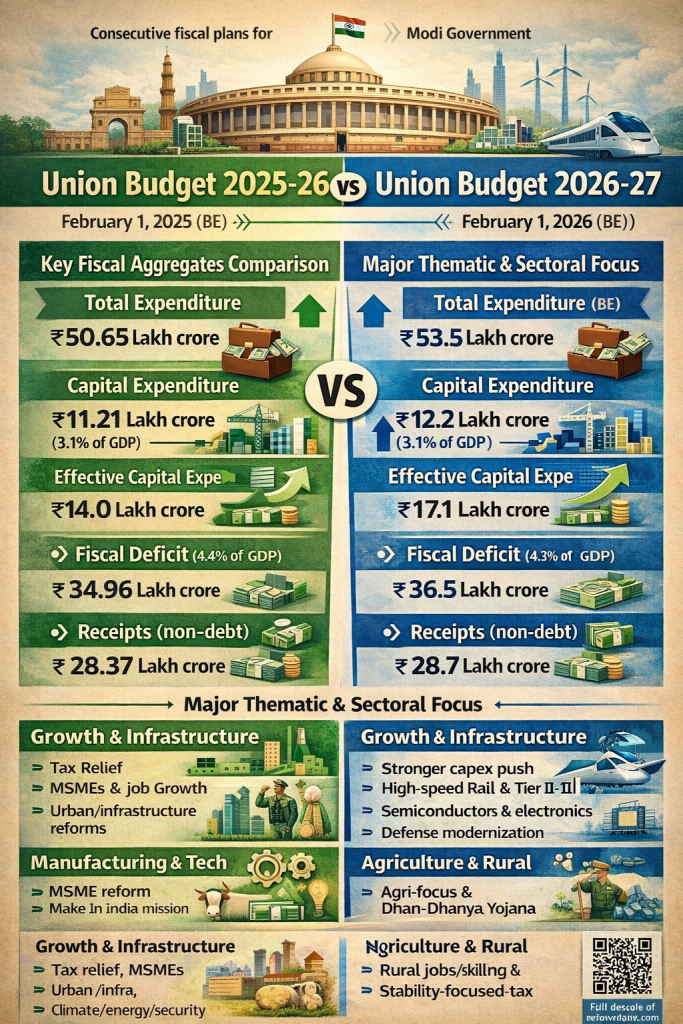
The Union Budget 2025-26 (presented on February 1, 2025) and the Union Budget 2026-27 (presented on February 1, 2026) represent consecutive fiscal plans under the Modi government, both emphasizing fiscal consolidation, infrastructure-led growth, manufacturing, and the long-term vision of Viksit Bharat (Developed India) by 2047. The 2025 Budget focused on boosting consumption via tax relief, agriculture, MSMEs, and urban/infrastructure reforms. The 2026 Budget builds on this with a stronger capex push, manufacturing and tech emphasis (e.g., semiconductors), while maintaining prudence amid global uncertainties.
Key Fiscal Aggregates Comparison
Both budgets continue reducing the fiscal deficit gradually while increasing capital expenditure (capex) to drive growth.
- Total Expenditure:
- 2025-26 (BE): ≈ ₹50.65 lakh crore
- 2026-27 (BE): ≈ ₹53.5 lakh crore (higher, reflecting expanded spending)
- Capital Expenditure (Direct Public Capex):
- 2025-26: ≈ ₹11.21 lakh crore (≈3.1% of GDP)
- 2026-27: ≈ ₹12.2 lakh crore (notable increase of ~9-11%, a key continuity and escalation in infrastructure focus)
- Effective Capital Expenditure (including grants for capital assets):
- 2025-26 (RE): ≈ ₹14.0 lakh crore
- 2026-27 (BE): ≈ ₹17.1 lakh crore (significant jump, prioritizing asset creation over revenue spending)
- Fiscal Deficit (% of GDP):
- 2025-26: 4.4% (target, with RE at similar level)
- 2026-27: 4.3% (slight improvement, continuing glide path toward lower deficits; debt-to-GDP targeted at ~55.6% in 2026-27 vs. 56.1% in 2025-26 RE)
- Receipts (non-debt):
- 2025-26: ≈ ₹34.96 lakh crore
- 2026-27: ≈ ₹36.5 lakh crore (growth driven by tax buoyancy)
- Net Tax Receipts:
- 2025-26: ≈ ₹28.37 lakh crore
- 2026-27: ≈ ₹28.7 lakh crore (modest rise)
Major Thematic and Sectoral Comparison
The 2025 Budget centered on four “engines” (agriculture, MSMEs, urban/infrastructure, energy/security). The 2026 Budget emphasizes three “kartavyas” (duties): accelerating growth, capacity building (skills/jobs), and inclusive access, with reforms in manufacturing, tech, and exports.
- Infrastructure & Capex — Strong continuity and escalation in 2026 (higher allocation, focus on high-speed rail corridors like Mumbai-Pune, Pune-Hyderabad, etc.; Purvodaya East Coast Corridor; urban Tier-II/III cities; REITs/InVITs for asset recycling).
- Defence — Notable jump in 2026-27 (≈ ₹7.8-7.85 lakh crore total; modernization/capex up sharply to ≈ ₹2.19 lakh crore, ~22% increase).
- Manufacturing & Tech — 2025 had MSME reforms, Make in India mission, footwear/leather/toy schemes. 2026 escalates with ISM 2.0 (semiconductors), ₹40,000 crore for electronics components, chemical parks, rare earth corridors, and Bio Pharma Shakti (₹10,000 crore).
- Energy & Sustainability — Continuity (nuclear/SMRs with ₹20,000 crore in both; CCUS scheme; critical minerals/battery exemptions).
- Agriculture & Rural — 2025 emphasized Dhan-Dhaanya Krishi Yojana, pulses self-reliance. 2026 sustains rural focus but shifts toward broader job/skilling.
- Tax Policy — 2025 featured major relief (zero tax up to ₹12 lakh under new regime). 2026 keeps income tax rates unchanged (focus on stability/consumption continuity).
- Other — 2026 adds girls’ hostels in every district, AI/emerging tech job impact assessment, tourism/heritage push.
Overall, Budget 2026-27 represents an evolution from 2025-26: more aggressive capex and manufacturing push, slightly tighter fiscal stance, and defense/tech emphasis, while retaining core priorities like infrastructure and inclusive growth. It reflects confidence in economic resilience post-2025 reforms. For full details, refer to official documents on indiabudget.gov.in.


Leave a Reply