The Union Budget 2026, presented by Finance Minister Nirmala Sitharaman on February 1, 2026, marked her ninth consecutive budget speech and aimed to steer India toward becoming a global manufacturing and innovation hub. However, the stock market’s response was swift and largely negative, with benchmark indices experiencing sharp declines amid announcements that prioritized fiscal discipline over immediate tax reliefs. This post breaks down the key decisions, the government’s rationale behind them, and their ripple effects on the markets and economy.
Key Announcements from Budget 2026
The budget focused on long-term growth through infrastructure, manufacturing, and innovation, while introducing measures to curb speculative trading. Here are the major highlights:
- Capital Expenditure Boost: Public capex increased to ₹12.2 lakh crore for FY27, up 9% from the revised ₹11.21 lakh crore for FY26. This includes allocations for seven high-speed rail corridors, 20 new national waterways, mega textile parks, and ₹10,000 crore for champion SMEs.
- Taxation Changes: No alterations to income tax slabs, but a new Income Tax Act effective from April 1, 2026. Duty exemptions on 17 medicines and inputs for seafood processing. Reduced TCS rates for education and medical purposes.
- Hike in Securities Transaction Tax (STT) on F&O: STT on futures raised from 0.02% to 0.05% (a 150% increase), and on options from 0.1% to 0.15%. This was the most market-sensitive move.
- Sector-Specific Initiatives: Launch of Semiconductor Mission 2.0, Bio Pharma Shakti for biopharma development, and a high-powered committee for ‘Education to Employment and Enterprise’. Exemption from Minimum Alternate Tax for non-residents.
- Fiscal Prudence: Emphasis on controlled inflation, steady growth, and a fiscal deficit target around 4.3%. No major tax cuts for individuals or investors, contrary to pre-budget expectations.
These measures reflect a shift toward supply-side reforms, aiming to build resilient infrastructure and reduce reliance on short-term speculative activities.
Reasons Behind the Government’s Decisions
The government’s choices in Budget 2026 were driven by a mix of economic priorities, global challenges, and lessons from recent market trends:
- Promoting Long-Term Growth Over Short-Term Gains: With India’s GDP projected at 6.8-7.2% for FY27, the capex hike aims to crowd in private investment, create jobs, and enhance productivity. Initiatives like high-speed rails and textile parks are designed to position India as a manufacturing powerhouse, addressing unemployment and boosting exports amid global slowdowns.
- Curbing Speculation in Derivatives: The STT hike targets the explosive growth in F&O trading, which has seen retail participation surge but also led to significant losses for many investors. By increasing transaction costs, the government seeks to discourage high-leverage, intraday trading and encourage long-term investments. This aligns with SEBI’s concerns over market volatility and retail investor protection.
- Fiscal Discipline Amid Global Uncertainties: No income tax slab changes or STT reductions (despite market hopes) underscore a commitment to fiscal prudence. The budget avoids populist measures, focusing instead on sustainable reforms like duty exemptions to support healthcare and exports, while maintaining revenue buoyancy through higher tax collections (targeting 10.5% growth).
- Sectoral Focus for Strategic Advantages: Investments in semiconductors, biopharma, and infrastructure stem from the need to reduce import dependence and capitalize on emerging technologies like AI. This is part of a broader ‘Make in India’ push, especially after the Economic Survey highlighted manufacturing exports as a key thrust area.
Pre-budget expectations from X users and analysts included STT relaxations, FII incentives, and boosts to railways and AI, but the actual announcements leaned more toward restraint.
Consequences on the Stock Market and Economy
The market’s reaction was immediate and severe, reflecting disappointment over the lack of investor-friendly tax cuts and the unexpected STT hike:
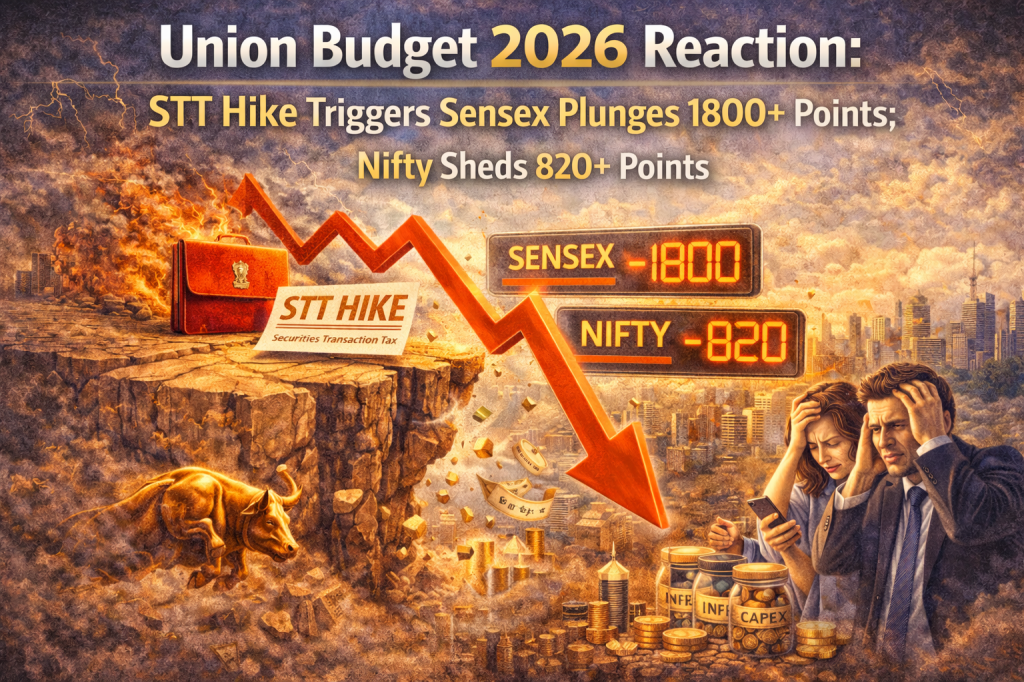
- Immediate Market Crash: The BSE Sensex plunged over 1,000 points intraday, closing down around 600-900 points, while the Nifty 50 slipped below 25,000, down 1-1.5%. Volatility spiked, with the India VIX jumping 6-14% to around 15.
- Sectoral Impacts:
- Negative: Broking and capital market stocks like BSE, Angel One, Groww, and CAMS crashed up to 17% due to higher STT reducing F&O volumes. Leveraged trading may decline short-term, potentially lowering overall market liquidity.
- Positive: Infrastructure and capital goods stocks surged nearly 1%, with companies like L&T, IRB Infra, and railway firms (RVNL, IRCTC) gaining on the capex push. Defense and power sectors (e.g., HAL, NTPC) also saw interest amid expected allocations.
- Broader Economic Consequences:
- Short-Term Pain: Higher STT could deter retail and FII inflows, exacerbating recent outflows and slowing market momentum. X sentiment highlighted caution, with users noting global factors amplifying volatility.
- Long-Term Gains: The capex focus could accelerate GDP growth, create jobs (especially via SME and employment initiatives), and attract private investment. Sectors like semiconductors and biopharma may emerge as new growth drivers, fostering innovation.
- Investor Sentiment: While the budget disappointed those expecting tax reliefs (e.g., higher standard deduction to ₹1 lakh or STT cuts), it reinforces India’s stable macro fundamentals. Markets may remain volatile in the near term but could rally if global cues improve.
Historically, budget-day reactions have been mixed, with Sensex swings averaging 1-2% over the last decade. This year’s response aligns with past instances where tax hikes triggered sell-offs.
Conclusion
Union Budget 2026 prioritizes sustainable development over immediate market boosters, leading to a sharp but potentially temporary market correction. While the STT hike stung investors, the emphasis on infrastructure and innovation could lay the foundation for robust growth. As always, markets will digest these changes over time, influenced by global events and implementation efficacy.
Disclaimer: This blog post is for informational purposes only and does not constitute financial advice, investment recommendations, or endorsements. The views expressed are based on publicly available data and may not reflect future outcomes. Stock markets are subject to risks, and past performance is not indicative of future results. Readers should conduct their own research and consult certified financial advisors before making any investment decisions. The author and blog bear no responsibility for any losses incurred based on this content.


Leave a Reply