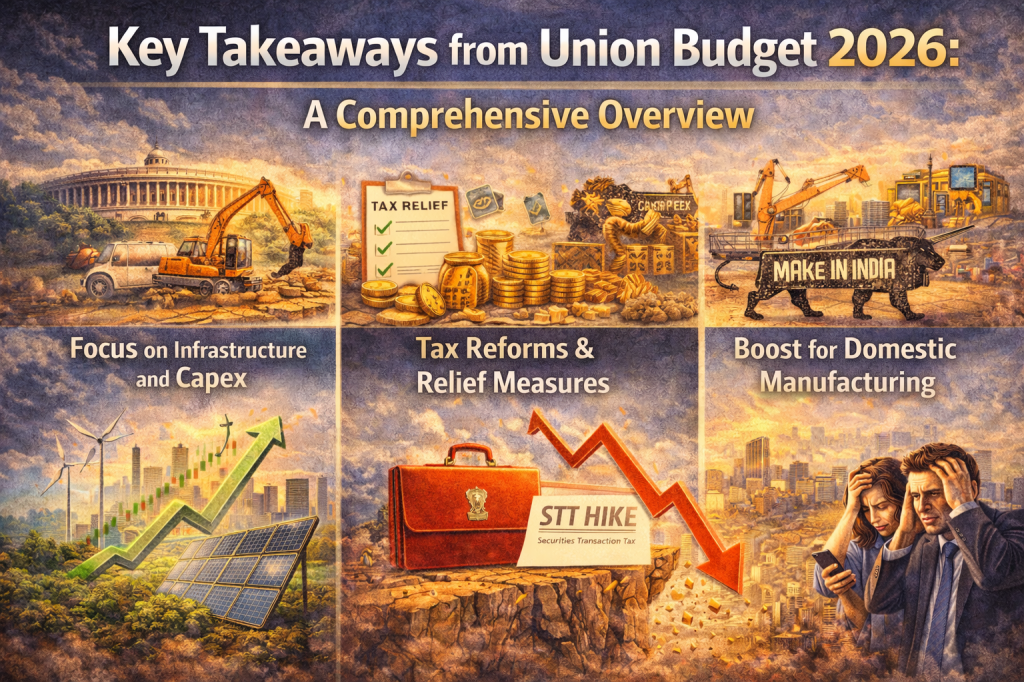
The Union Budget 2026-27, presented by Finance Minister Nirmala Sitharaman on February 1, 2026, emphasizes sustained economic growth, fiscal prudence, and strategic investments amid global uncertainties. With a focus on productivity, competitiveness, and inclusivity, the budget outlines three key “kartavyas”: accelerating growth, fulfilling aspirations, and ensuring equitable access. It projects a fiscal deficit of 4.3% of GDP, down from 4.4% in the previous year, and a debt-to-GDP ratio of 55.6%. Capital expenditure is ramped up to ₹12.2 lakh crore, the highest ever at 4.4% of GDP. This budget builds on themes of Viksit Bharat, balancing ambition with inclusion, and prioritizes sectors like manufacturing, infrastructure, and services to drive job creation and resilience.
What’s in It for the Middle Class?
The budget offers indirect benefits for the middle class through measures aimed at job stability, healthcare affordability, and tax simplification, though there are no major changes to income tax slabs. Key highlights include:
- Healthcare Relief: 17 cancer medicines have been made tax-exempt, potentially reducing treatment costs significantly. This is part of broader efforts to make essential services more accessible.
- Tax Concessions: Cuts in Tax Collected at Source (TCS) under the Liberalised Remittance Scheme from 5% to 2% for overseas education, medical treatment, and tours, easing the burden on families sending children abroad or traveling.
- Job and Income Stability: Emphasis on skilling and employment in services like tourism, healthcare, and IT, which could create more opportunities. No direct tax reliefs like slab revisions were announced, but easier compliance and reduced tariffs on personal imports (from 20% to lower rates) may help with everyday expenses.
- Indirect Boosts: Initiatives for urban development and infrastructure could improve quality of life, though the budget’s focus on long-term growth means immediate relief is limited.
Overall, the middle class may see benefits through lower healthcare costs and job-linked skilling, but the absence of income tax tweaks disappointed some expectations.
Provisions for Manufacturing Industries and MSMEs
The budget strongly pushes for “Make in India” with targeted interventions to scale up manufacturing and support small businesses. Six core areas include scaling strategic sectors, rejuvenating legacy industries, and creating champion MSMEs.
- Manufacturing Focus: Investments in seven strategic sectors—biopharma, semiconductors, electronics, chemicals, capital goods, textiles, and sports goods—to reduce import dependence and boost exports. This includes ISM 2.0 for semiconductors and a long-term strategy for rare earth ecosystems. Legacy sectors like textiles get rejuvenation support.
- MSMEs: A dedicated MSME growth fund is a game-changer, praised by industry bodies for fostering champions. Allocation of ₹5,000 crore per City Economic Region over five years to spur local manufacturing hubs. Clean energy manufacturing and tourism reforms also win backing, with incentives linked to localization milestones.
- Other Supports: Coastal Cargo Promotion Scheme to increase inland waterways and coastal shipping share from 6% to 12% by 2047, aiding logistics for manufacturers.
These measures aim to create resilient supply chains and jobs, positioning India as a global manufacturing powerhouse.
Tax Proposals and Reliefs
The budget introduces targeted tax changes to curb speculation while providing some reliefs, maintaining fiscal discipline without overhauling the income tax structure.
| Category | Key Proposals/Reliefs |
|---|---|
| Securities Transaction Tax (STT) | Hike on futures and options (F&O) trades to reduce speculation in derivatives. |
| Customs and Excise Duties | Reduction in tariffs on dutiable goods for personal use from 20%; changes in duties on batteries, semiconductors, and CKD kits for small cars, linked to localization. |
| Income Tax | No changes to slabs; tax-exempt status for 17 cancer drugs. |
| Other Reliefs | Tax breaks for hyperscalers investing in India; easier compliance for NRIs and overseas remittances. Concessional GST rates for strong hybrids. |
| Corporate Tax | Strengthening corporate bond market; incentives for R&D in alternate fuels and advanced components. |
While the STT hike drew criticism for increasing trading costs, reliefs in healthcare and remittances provide targeted support.
For the Corporate Sector
Corporates benefit from a pro-growth stance with emphasis on efficiency and innovation.
- Bond Market and Funding: Encouragement for large issuances and market-making to channel capital into infrastructure and manufacturing.
- Tax and Incentives: Tax simplification, R&D boosts in tech and autos, and support for AI data centers and cloud infrastructure, with investments projected to surpass $200 billion soon.
- Sectoral Push: Dedicated REITs for CPSE asset recycling; Infrastructure Risk Guarantee Fund for credit guarantees.
This fosters a resilient financial ecosystem and positions corporates for long-term competitiveness.
Education, Health, Employment Creation, and Infrastructure
The budget integrates social welfare with economic goals, allocating resources for human capital and physical assets.
- Education: Demand-linked skilling in AI, emerging technologies, and sector-specific training to prepare youth for future jobs.
- Health: Establishment of a second NIMHANS; tax exemptions on cancer drugs to make treatment affordable.
- Employment Creation: Jobs-led growth through manufacturing and services; initiatives for women, youth, farmers, and PwDs, including SHG empowerment. Focus on tourism and care services for demand-driven employment.
- Infrastructure: ₹12.2 trillion capex; high-speed rail corridors, rare earth corridors, and 15 archeological sites as cultural destinations. Pilot schemes for global big cat summits and coastal shipping.
These investments aim to build capacity and resilience, with a strong thrust on public-private partnerships.
Stock Market Reaction
The stock market reacted negatively to the budget, with benchmark indices experiencing sharp declines during the special trading session on February 1. The BSE Sensex plummeted over 1,800 points (down 2.23%) to close at 80,722.94, while the Nifty 50 fell 593 points (2.33%) to 24,825.45. This marked the worst budget-day drop in six years. The primary trigger was the hike in STT on F&O trades, leading to a knee-jerk sell-off, especially in brokerage and exchange stocks (down up to 18%). Despite positive long-term signals like infra and manufacturing boosts, near-term concerns over higher transaction costs and no capital gains tax relief dominated sentiment, wiping out over ₹6 lakh crore in investor wealth.
Budget’s Impact on Gold and Silver Prices
Gold and silver prices crashed sharply on Budget Day, extending a two-day sell-off driven by global factors rather than direct budget announcements. MCX gold futures fell 2.87% to ₹1,48,104 per 10 grams, while silver plunged 9% to ₹2,65,652 per kg, hitting lower circuits. Over two days, silver dropped 33% (₹1.35 lakh loss), and gold tanked 18%. The decline was attributed to profit booking, a stronger US dollar, and global market panic, with prices recovering slightly post-budget as no major import duty hikes were announced. Speculation around potential duty cuts (3-5%) could further lower prices by ₹2,000-4,000 per 10 grams for gold, but the status quo maintained stability. Investors are advised to monitor post-budget trends, as reduced duties from last year continue to curb smuggling.
Disclaimer: This blog post is based on publicly available information as of February 1, 2026, and is for informational purposes only. It does not constitute financial, tax, or investment advice. Readers should verify details from official sources like the India Budget website and consult qualified professionals before making decisions. The author and blog bear no responsibility for any actions taken based on this content.


Leave a Reply