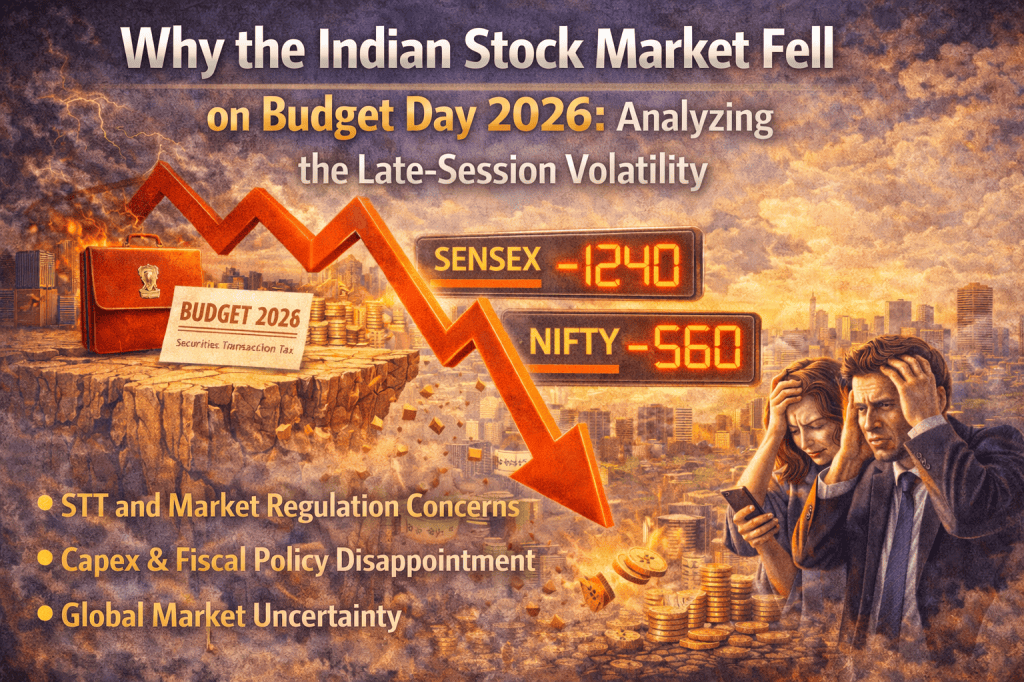
On February 1, 2026, a unique Sunday trading session was held in India to coincide with the presentation of Union Budget 2026 by Finance Minister Nirmala Sitharaman. What started as a day of anticipation quickly turned into one of disappointment for investors, with benchmark indices experiencing significant volatility. The BSE Sensex closed down 1,546.84 points (1.88%) at 80,722.94, while the NSE Nifty 50 ended 495.20 points (1.96%) lower at 24,825.45. This marked the worst Budget Day performance for the indices in six years, wiping out approximately ₹11 lakh crore in market capitalization.
The session began on a positive note, with markets rallying in pre-Budget optimism. The Sensex climbed to an intraday high of 82,726.65 (up about 457 points), and the Nifty reached 25,440.90 (up around 120 points). However, the tide turned sharply following key announcements in the Budget speech, leading to a steep intraday plunge. At its lowest, the Sensex dropped to 79,899.42 (a fall of over 2,370 points from the day’s high), and the Nifty hit 24,571.75 (down more than 748 points). The market then staged a partial recovery, pulling back from these lows as some investors saw buying opportunities amid the dip.
Yet, in the final minutes of trading, the indices faced renewed selling pressure, preventing a fuller rebound and cementing the day’s losses. This late-session fade after the initial recovery highlights the “rollercoaster” nature of the day, driven by immediate reactions to the Budget’s fiscal measures and unmet expectations.
Key Reasons Behind the Fall
The primary catalyst for the market’s downturn was the Budget’s focus on fiscal prudence, which included several investor-unfriendly surprises. Here’s a breakdown of the main factors:
- Hike in Securities Transaction Tax (STT) on Derivatives:
The government announced a significant increase in STT for futures and options (F&O) trading – futures tax rose from 0.02% to 0.05%, and options from 0.1% to 0.15%. This move, aimed at curbing speculative trading, was seen as a direct hit to market volumes and liquidity. Traders feared reduced activity in the F&O segment, which has been a major driver of exchange and brokerage revenues. The announcement triggered the sharp post-speech sell-off, with broking and capital market stocks bearing the brunt. Expert Samir Arora of Helios Capital called it “unexpected and negative for no reason,” warning that it could lead to further declines as foreign investors lose confidence. - Higher-Than-Expected Government Borrowing:
The Budget outlined gross market borrowings of ₹17.2 lakh crore for FY27, exceeding market estimates. This raised concerns about upward pressure on bond yields, potentially causing mark-to-market losses for banks’ bond portfolios. Public sector bank stocks fell 2-6% as a result, contributing to the broader market drag. Prashant Khemka of WhiteOak Capital noted this as a “partly negative” development for investors. - Unmet Expectations on Tax Reforms:
Investors had hoped for relief on long-term capital gains (LTCG) tax or other incentives to boost sentiment, but these were absent. Additionally, changes like taxing buybacks as capital gains and bringing secondary market purchases of Sovereign Gold Bonds (SGBs) under capital gains tax added to the negativity. As one X post highlighted, these moves signaled policy unpredictability, eroding trust among foreign institutional investors (FIIs). - Broader Sentiment and Global Cues:
The Budget’s emphasis on fiscal deficit reduction (targeted at 4.3% of GDP for FY27) came at the expense of aggressive growth stimuli, disappointing those expecting boosts for sectors like railways or consumer goods. Lingering global uncertainties, including U.S. trade policies and Federal Reserve shifts, amplified the sell-off. Volatility surged, with the India VIX rising 14%.
The Late-Minute Dip: Profit Booking and Panic Selling
The recovery from the intraday lows was short-lived, with the final trading minutes seeing intensified profit booking. By around 12:30 PM IST, the indices had already started slipping from their highs due to initial reactions, but the close reflected ongoing pessimism as traders unwound positions ahead of the weekend. Experts like Madhu Kela of MK Ventures suggested the event’s impact might fade in a couple of days, but immediate sentiment was soured by foreign outflows and a lack of “big bang” reforms. Since it was a Sunday session, limited participation from global players may have exaggerated the volatility, with potential for more pressure when markets reopen.
Looking Ahead
While the Budget included positives like allocations for defense (₹7.85 lakh crore), railways (high-speed corridors), and semiconductors (ISM 2.0), these were overshadowed by the tax hikes and borrowing plans. Historical data shows markets often recover post-Budget volatility, with average gains of 2% in the following week and 6-7% over three months. However, with FIIs potentially selling off further, Monday could bring more downside.
In summary, the stock market’s fall on February 1, 2026, was a direct response to Budget measures that prioritized fiscal discipline over market-friendly incentives. The late-session weakness after a brief recovery underscores the fragility of investor confidence in uncertain times. Stay tuned for how the markets digest this in the coming days.
Disclaimer: This blog post is intended for informational and educational purposes only. It does not constitute financial advice, investment recommendations, or an endorsement of any specific strategy. Stock market investments involve risks, including the potential loss of principal. Past performance is not indicative of future results. Readers should conduct their own research and consult with a qualified financial advisor before making any investment decisions. The author and publisher are not responsible for any losses incurred based on the information provided here.


Leave a Reply