Gold Mutual Funds (also called Gold Funds or Gold Fund of Funds/FoF) are mutual fund schemes in India that primarily invest in Gold ETFs (or sometimes gold-related assets) to provide exposure to gold prices without holding physical gold. They act as a “fund of funds” layer on top of Gold ETFs, making them convenient for investors who prefer the mutual fund route.
These are different from pure Gold ETFs (which directly hold physical gold and trade like stocks) and Sovereign Gold Bonds (SGBs) (government-issued bonds with interest).
Key Features of Gold Mutual Funds
- How they work — Pool money from investors → Invest mostly (often 95%+) in underlying Gold ETFs → Track domestic gold prices (99.5% purity or higher).
- No physical gold — Eliminates storage, theft, making charges, and purity issues.
- Investment modes — Lump sum or SIP (starting as low as ₹500–₹1,000), making it easy for regular investing.
- No Demat account needed — Buy/redeem directly via mutual fund platforms/apps (Groww, Zerodha Coin, ET Money, etc.) or AMCs.
- Liquidity — Redeemable at end-of-day NAV (usually T+1 or T+2 settlement); less real-time than ETFs but sufficient for most.
- Costs — Expense ratio typically 0.5%–1% p.a. (higher than pure Gold ETFs due to the extra FoF layer); possible exit load if redeemed early (e.g., within 1 year).
- Returns — Closely mirror gold price movements, minus expenses (tracking error minimal in good funds).
- Taxation (as of 2026 rules, post-Budget 2026) — Treated as non-equity funds:
- Holding ≤24 months: Short-term capital gains (STCG) taxed at your income tax slab rate.
- Holding >24 months: Long-term capital gains (LTCG) at 12.5% without indexation.
- No special exemptions like SGB maturity (for original allottees).
Top Gold Mutual Funds (based on recent performance data as of early 2026)
These are popular ones with strong AUM and consistent tracking of gold prices (performance varies; past returns ~20–25% CAGR over 5 years in many, driven by gold rally):
- SBI Gold Fund — Large AUM, low expense ratio (~0.24% in direct), strong tracking.
- HDFC Gold ETF FoF — Reliable, good liquidity.
- ICICI Prudential Gold ETF FoF — Consistent performer.
- Kotak Gold Fund — Popular for SIPs.
- Nippon India Gold Savings Fund — Often among top returns.
- Some newer ones like Edelweiss Gold and Silver ETF FoF or Motilal Oswal Gold and Silver Passive FoF include silver exposure too (higher volatility but diversification).
Always check latest NAV, returns, and expense ratios on platforms like Groww, ET Money, or Value Research before investing.
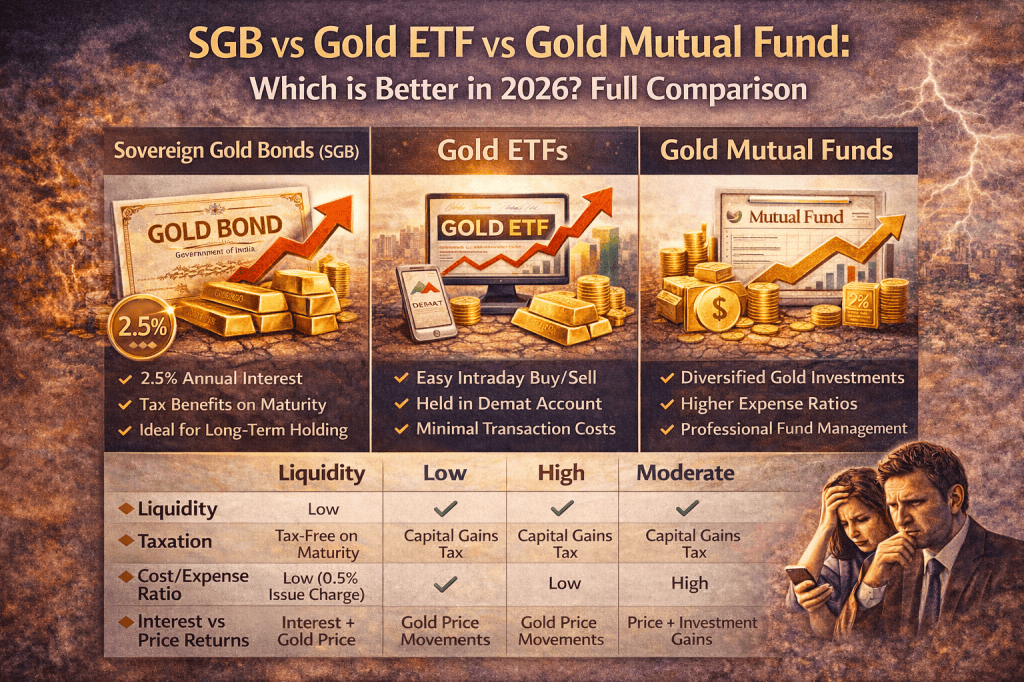
Comparison: Gold Mutual Funds vs Gold ETFs vs SGBs (Updated for 2026)
| Feature | Gold Mutual Funds (FoF) | Gold ETFs | Sovereign Gold Bonds (SGBs) |
|---|---|---|---|
| Structure | Fund of Funds investing in Gold ETFs | Direct investment in physical gold (traded on exchange) | Government bond linked to gold price |
| Extra Return | None (only gold price appreciation) | None | 2.5% p.a. fixed interest (semi-annual) |
| Liquidity | Good (redeem at NAV, T+1/2) | High (real-time trading during market hours) | Moderate (exchange-traded, low volume; exit after 5 yrs) |
| Demat Required? | No | Yes | No (but for secondary market, yes) |
| SIP Facility | Yes (easy, low minimum) | No (lump sum via broker) | No (only during issuance windows) |
| Expense Ratio/Costs | 0.5%–1% p.a. (higher due to double layer) | Lower (~0.3%–0.6% p.a.) + brokerage | None (no expense ratio) |
| Minimum Investment | ₹500–₹5,000 (SIP/lump) | 1 unit (~1 gram gold price) | 1 gram (issuance-specific) |
| Tax on Capital Gains | STCG (≤24m): slab; LTCG (>24m): 12.5% no indexation | STCG (≤12m): slab; LTCG (>12m): 12.5% no indexation | Interest: slab; CG: Exempt at maturity only for original allottees (post-2026 change); otherwise 12.5% LTCG |
| Best For | SIP investors, no Demat, convenience | Active traders, high liquidity, low costs | Long-term (5–8 yrs), extra interest + potential tax benefit |
Advantages of Gold Mutual Funds
- Easiest for beginners/SIP discipline — No need for trading account or timing the market.
- Professional management and automatic rebalancing.
- Good for diversification in a mutual fund portfolio.
Disadvantages
- Slightly higher costs than direct Gold ETFs → Slightly lower net returns over long term.
- No real-time intraday trading.
- Same taxation as physical/digital gold (no SGB-like perks).
Which to Choose in 2026?
- Gold Mutual Funds if: You want simple SIPs, no Demat hassle, and are okay with slightly higher fees for convenience (great for long-term accumulation).
- Gold ETFs if: You already have a Demat/trading account, want lowest costs, real-time liquidity, and tactical/short-term plays.
- SGBs if: Holding 5–8+ years, value the 2.5% interest, and qualify for maturity tax exemption (original issue only now).
Many Hyderabad-based investors (via apps like Groww/Zerodha) mix them: Gold Mutual Funds for SIP core holding + Gold ETFs for flexibility. Gold remains a strong diversifier (5–15% portfolio allocation) amid inflation/uncertainty, but returns depend on global gold prices.
Check latest details on SEBI/AMFI sites or your broker, as markets evolve!


Leave a Reply