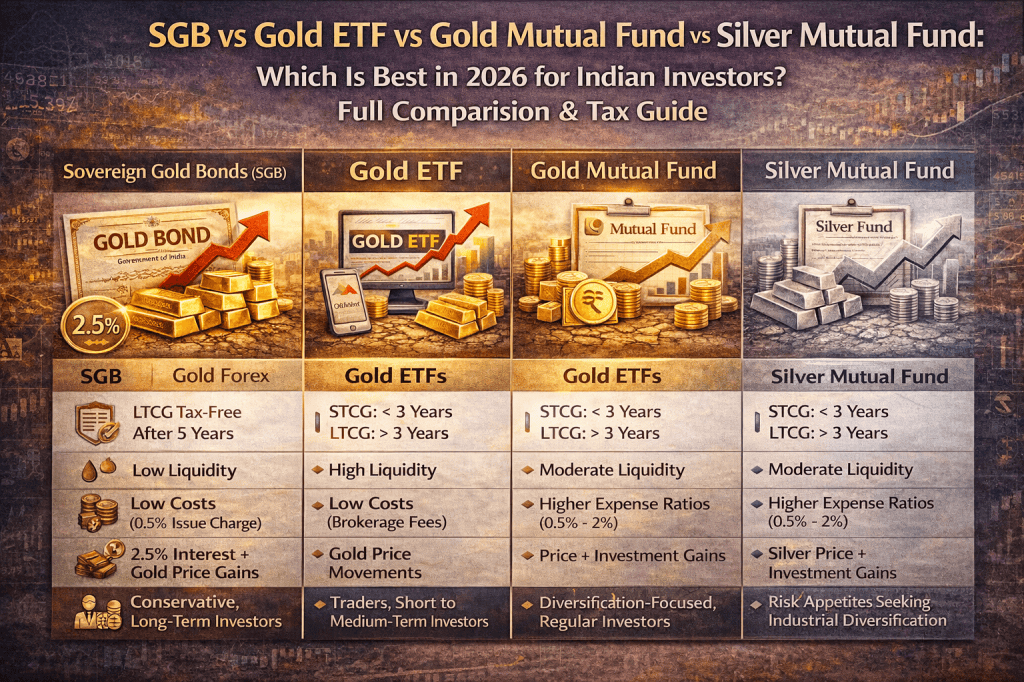
Gold and silver have long been favored by Indian investors as hedges against inflation, currency fluctuations, and economic uncertainty. With gold prices hovering around ₹80,000 per 10 grams and silver near ₹100,000 per kg in early 2026, these assets remain attractive. However, choosing the right investment vehicle is crucial. This post compares Sovereign Gold Bonds (SGBs), Gold ETFs, Gold Mutual Funds, and Silver Mutual Funds across key parameters: returns, taxation (including post-Budget 2026 rules), liquidity, costs, pros and cons, and recommendations tailored for Indian investors.
To provide a structured overview, here’s a comparison table:
| Feature | Sovereign Gold Bonds (SGBs) | Gold ETFs | Gold Mutual Funds | Silver Mutual Funds |
|---|---|---|---|---|
| Issuer/Structure | Issued by RBI on behalf of Government of India; government-backed bonds representing gold. | Exchange-traded funds tracking physical gold prices, listed on NSE/BSE. | Fund of Funds (FoFs) investing primarily in Gold ETFs or gold-related assets. | FoFs investing in silver ETFs or silver-related assets. |
| Minimum Investment | ₹5,000 (1 gram equivalent); max 4 kg per individual per year. | As low as 1 unit (₹50-100). | ₹500-1,000 (often via SIP). | Similar to Gold MFs, ₹500-1,000. |
| Lock-in Period | 8-year maturity; exit after 5 years via RBI redemption or secondary market. | None. | None. | None. |
| Interest/Dividends | Fixed 2.5% p.a., paid semi-annually. | None. | None (possible minor dividends from underlying). | None. |
Returns
Returns from these instruments are primarily driven by the underlying metal prices, with variations based on structure.
- SGBs: Offer dual returns—capital appreciation tied to gold prices plus a fixed 2.5% annual interest. Over the last 5 years (2021-2026), gold has delivered approximately 15% CAGR in INR terms, making SGBs’ effective returns around 17.5% before taxes. Long-term (10-40 years), gold averages 9-12% CAGR, boosted by interest in SGBs.
- Gold ETFs: Pure play on gold prices, minus minor costs. Historical returns mirror gold: ~15% CAGR over 5 years, 9-12% over longer periods. No additional interest.
- Gold Mutual Funds: Similar to ETFs but may lag slightly due to higher fees. Average 5-year returns around 13-15% (absolute returns often reported as 25-36% over 3-5 years, equating to 8-12% annualized after adjustments).
- Silver Mutual Funds: Track silver prices, which are more volatile due to industrial demand (e.g., electronics, renewables). Over the last 10 years, silver has outperformed gold with ~26% returns (likely absolute, implying ~12-15% CAGR adjusted for volatility), compared to gold’s ~19.5%. 5-year CAGR ~15-20%, but with higher swings.
Silver funds can deliver higher returns in bull markets but underperform during downturns.
Taxation (Post-2026 Rules)
Taxation for gold and silver investments was unified under Budget 2024, with further SGB-specific changes in Budget 2026 effective from April 1, 2026. All gains are now without indexation benefits.
- SGBs: Interest (2.5%) taxed at income slab rates. Capital gains: Exempt if bought in primary market (directly from RBI) and held to 8-year maturity. If bought in secondary market or sold early: STCG (<12 months) at slab rates; LTCG (>12 months) at 12.5%. Budget 2026 restricts exemption to original subscribers only.
- Gold ETFs: Treated as listed securities. STCG (<12 months) at slab rates; LTCG (>12 months) at 12.5%.
- Gold Mutual Funds: Treated as unlisted (MF units). STCG (<=24 months) at slab rates; LTCG (>24 months) at 12.5%.
- Silver Mutual Funds: Identical to Gold MFs: STCG (<=24 months) at slab rates; LTCG (>24 months) at 12.5%.
No GST on purchase for any (except physical metal equivalents).
Liquidity
- SGBs: Moderate. Tradable on exchanges but lower volumes lead to premiums/discounts. RBI redemption available after 5 years (semi-annual windows).
- Gold ETFs: High. Traded real-time on stock exchanges during market hours.
- Gold Mutual Funds: Good. Redeemable at end-of-day NAV; SIP-friendly but not intra-day.
- Silver Mutual Funds: Similar to Gold MFs; good but less liquid than ETFs due to NAV-based trading.
Costs
- SGBs: No expense ratio, no storage costs. Online purchase discount (₹50/gram). Secondary market may involve brokerage.
- Gold ETFs: Expense ratio 0.2-0.5%; brokerage for trading; demat account required.
- Gold Mutual Funds: Higher expense ratio (0.5-1.5%, including underlying ETF fees); no demat needed.
- Silver Mutual Funds: Similar to Gold MFs, 0.5-1.5% expense ratio; potentially higher due to silver’s volatility.
Pros and Cons
- SGBs:
- Pros: Government backing, fixed interest, tax exemption at maturity (for primary buyers), no physical storage risks.
- Cons: Long lock-in, lower liquidity, interest taxable, new tax rules reduce appeal for secondary buyers.
- Gold ETFs:
- Pros: High liquidity, low costs, easy diversification, tracks gold precisely.
- Cons: No interest, market volatility, requires demat/brokerage.
- Gold Mutual Funds:
- Pros: SIP option, no demat needed, professional management, suitable for beginners.
- Cons: Higher fees than ETFs, potential tracking error, taxed as unlisted.
- Silver Mutual Funds:
- Pros: Higher growth potential from industrial demand, diversification beyond gold, SIP-friendly.
- Cons: Greater volatility, higher fees, similar tax drawbacks as Gold MFs.
Recommendations for Indian Investors in 2026
- Long-term investors (5+ years): Opt for SGBs if buying in primary issuances for the interest and tax benefits. Allocate 5-10% of portfolio to gold/silver for hedging.
- Short-term/traders: Gold or Silver ETFs for liquidity and low costs. Silver for those bullish on industrial recovery (e.g., EVs, solar).
- Beginners/SIP-focused: Gold or Silver Mutual Funds for ease and rupee-cost averaging.
- Diversification tip: Combine gold (stable) and silver (growth-oriented) in a 70:30 ratio. Avoid over-allocation (>15% portfolio) as metals don’t generate income like equities.
- Current context: With reduced customs duty on gold/silver (6% post-Budget 2026), prices may stabilize, but global factors like US rates and geopolitics could drive volatility. Monitor RBI SGB tranches for primary buys to maximize tax efficiency.
Disclaimer: This post is for informational purposes only and does not constitute financial advice. Investment decisions should be based on your risk tolerance, financial goals, and consultation with a certified financial advisor. Past performance is not indicative of future results. Tax rules are subject to change; verify with a tax professional. The author and blog are not liable for any losses incurred.


Leave a Reply