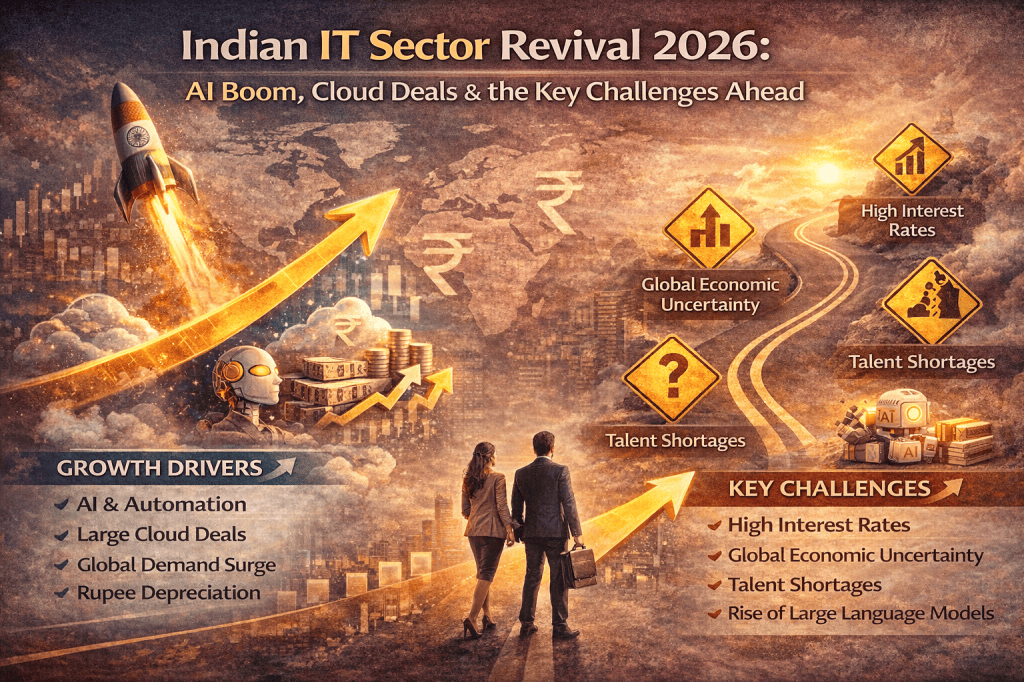
After a volatile 2024–2025 period marked by global macro uncertainty, delayed tech budgets, and margin pressure, the IT sector is staging a notable revival in 2026. The turnaround isn’t accidental—it’s structural. Three powerful forces are reshaping the industry:
- The acceleration of enterprise AI adoption
- A fresh cycle of cloud transformation deals
- Relative insulation from global tariff and trade disruptions
The emergence and rapid scaling of Anthropic—alongside heavyweights like OpenAI, Google, and Microsoft—is redefining how enterprises think about AI infrastructure, safety, and deployment. This shift is creating a new demand cycle that benefits IT services firms globally, including Indian IT majors.
Let’s break down what’s driving the revival.
1. AI Is No Longer Experimental — It’s Mission-Critical
The AI wave of 2023–2024 was largely exploratory. Enterprises tested generative AI for chatbots, internal productivity tools, and pilots. In 2026, the focus has shifted to:
- Enterprise-grade AI integration
- Secure model deployment
- Industry-specific AI applications
- AI governance and compliance frameworks
The rise of Anthropic has accelerated this transition. Its emphasis on AI safety, constitutional AI frameworks, and enterprise-grade models has made regulated industries—banking, healthcare, insurance—more comfortable adopting large language models at scale.
This matters for IT services firms because enterprises now need:
- AI integration partners
- Data modernization experts
- Model fine-tuning services
- Cloud infrastructure migration support
- Cybersecurity and compliance integration
Indian IT companies—such as Tata Consultancy Services, Infosys, and Wipro—are positioning themselves not just as coders, but as AI transformation partners.
2. The Cloud Deal Cycle Is Back
During the global slowdown, enterprises deferred large discretionary IT spending. But 2026 has seen a rebound in:
- Multi-year cloud migration contracts
- Vendor consolidation deals
- AI + cloud bundled transformation contracts
Why? Because AI workloads demand scalable cloud infrastructure. Models built by players like Anthropic and OpenAI are compute-intensive. Enterprises can’t run these systems on legacy on-premise setups.
Cloud hyperscalers such as Amazon Web Services, Microsoft Azure, and Google Cloud are investing aggressively in AI infrastructure. That spending trickles down to IT services vendors via:
- Implementation contracts
- Managed services
- Optimization projects
- Cost rationalization consulting
For Indian IT firms, this marks a return of large-ticket deals that improve revenue visibility and margin stability.
3. Tariff Insulation: Why IT Is Less Vulnerable
While manufacturing and export-heavy sectors face renewed global trade tensions and tariff uncertainties in 2026, IT services remain relatively insulated.
Here’s why:
✔ Services > Physical Goods
IT exports are largely digital. There are no shipping bottlenecks, customs duties, or raw material tariffs affecting software delivery.
✔ Global Delivery Models
Indian IT companies operate distributed delivery centers across geographies, reducing geopolitical concentration risk.
✔ Recurring Revenue Contracts
Long-term managed services contracts offer predictable cash flows, cushioning volatility.
In contrast to hardware-dependent tech companies, software services firms are less exposed to direct tariff shocks.
4. AI Safety & Governance: A New Revenue Stream
The emergence of Anthropic has brought AI alignment and safety into mainstream boardroom discussions.
Enterprises are now asking:
- How do we audit AI models?
- How do we prevent hallucinations?
- How do we ensure regulatory compliance?
- How do we mitigate bias risks?
This has created demand for:
- AI risk assessment frameworks
- Responsible AI consulting
- Model validation services
- Governance architecture
IT services firms are monetizing these needs through advisory and high-margin consulting services—boosting profitability beyond traditional application maintenance work.
5. Margin Expansion Through AI-Led Productivity
AI isn’t just a revenue driver—it’s also a margin enhancer.
IT companies are using generative AI tools internally to:
- Accelerate code generation
- Improve testing efficiency
- Reduce turnaround time
- Optimize support functions
This leads to:
- Better operating leverage
- Lower employee cost intensity
- Higher EBIT margins
Thus, AI acts as both a top-line and bottom-line catalyst.
6. Valuation Re-Rating in 2026
Markets are beginning to price in:
- AI-enabled revenue growth
- Improved deal pipelines
- Stronger order books
- Margin stabilization
If earnings upgrades sustain over the next few quarters, IT stocks could see further valuation re-rating—especially those with strong AI partnerships and cloud capabilities.
However, risks remain:
- Delays in enterprise spending
- AI monetization slower than expected
- Regulatory overhang
- Wage inflation
Investors should differentiate between companies with genuine AI execution capabilities and those merely using AI as a narrative.
Final Thoughts: Structural Shift, Not Just a Cyclical Bounce
The 2026 IT revival is not merely a rebound from a slowdown—it represents a structural transformation.
The emergence of AI leaders like Anthropic has accelerated enterprise AI adoption, while hyperscaler investments are reigniting cloud deal momentum. Combined with relative tariff insulation and AI-driven productivity gains, the sector appears positioned for a new growth cycle.
For long-term investors, the focus should be on:
- AI revenue visibility
- Deal wins in cloud + AI transformation
- Margin trajectory
- Client diversification
However, despite strong growth drivers like AI adoption, cloud deal renewals, and tariff insulation, the Indian IT sector still faces several meaningful challenges in 2026. These challenges stem from technological shift pressures, market dependencies, workforce dynamics, and regulatory headwinds. Recent industry discussions and data help paint a comprehensive picture:
📉 1. AI-Driven Structural Disruption
- Automation scares and market reactions: Recent developments in generative AI — including innovations from companies like Anthropic — have triggered sell-offs in IT stocks and investor anxiety over traditional service models. Indian IT share indices have experienced sharp draws due to fears that AI tools could replace human-intensive work historically outsourced to Indian firms. (Reuters)
- Pressure on revenue models: Critics argue that AI could automate tasks such as debugging, testing, documentation, and back-office processes — the core of labour-arbitrage-based service revenues — undermining traditional billing models. (Reddit)
👩💼 2. Talent and Skills Gap
- Mismatch between supply and demand: While India produces millions of engineers yearly, there’s a significant skills gap in emerging areas like AI, ML, data science, cybersecurity, and cloud-native development. (https://www.bajajfinserv.in)
- Reskilling pressure: Indian IT firms must invest heavily in upskilling existing professionals, which is costly and time-consuming. Limited skilled specialists can slow AI and next-gen project execution. (SRCRC)
📊 3. Moderating Growth & Slow Hiring
- Growth forecasts for FY26 remain moderate or muted, typically in the mid-single-digit range, reflecting cautious IT spending by global clients and macroeconomic uncertainty. (Outlook Business)
- Hiring and net workforce additions have slowed significantly, with top firms reporting very low net hiring — a shift from historical expansion. (Reddit)
🌍 4. Dependence on Global Markets
- Indian IT revenue heavily depends on the U.S. and European markets. Policy shifts — such as visa fee hikes, tighter immigration rules, or slower tech budgets — directly affect Indian service exports. (The Economic Times)
- Slower IT spending in key markets or geopolitical tensions could lead to deal postponements or cancellations, hurting growth visibility. (Outlook Business)
🧠 5. Increased Competition from GCCs & Insourcing
- Global Capability Centres (in-house tech hubs operated by multinational clients) are growing. These can reduce reliance on external IT vendors, especially for standardized services. (NDTV Profit)
🛡️ 6. Regulatory, Compliance & Security Costs
- Rapid digital adoption increases cybersecurity and data-privacy risks. Compliance with evolving regulations (like India’s DPDP Act and international data protection rules) puts pressure on operating costs. (BS Media)
📈 7. Innovation Shortfalls in Global Tech Leadership
- Indian firms historically excel in services delivery but have limited presence in product innovation and R&D compared to global tech giants. This may constrain long-term competitiveness, especially in AI product ecosystems. (ForumIAS)
🔎 Summary — A Balanced View
| Opportunity | Corresponding Challenge |
|---|---|
| AI & Cloud demand | AI automating core service jobs |
| Tariff insulation | Dependence on global tech budgets |
| Digital transformation | Skills gap & slow hiring |
Despite these constraints, many Indian IT firms are actively pivoting toward AI-centric services and higher-value digital transformation work to mitigate risks and harness future growth opportunities.
The IT sector in 2026 is no longer just about outsourcing—it’s about orchestrating intelligent digital ecosystems.
Disclaimer
This article is for informational and educational purposes only and should not be construed as investment advice, financial advice, or a recommendation to buy or sell any securities. The views expressed are based on publicly available information and general industry trends as of 2026. Market conditions are subject to change, and investors should conduct their own research or consult a qualified financial advisor before making investment decisions.


Leave a Reply