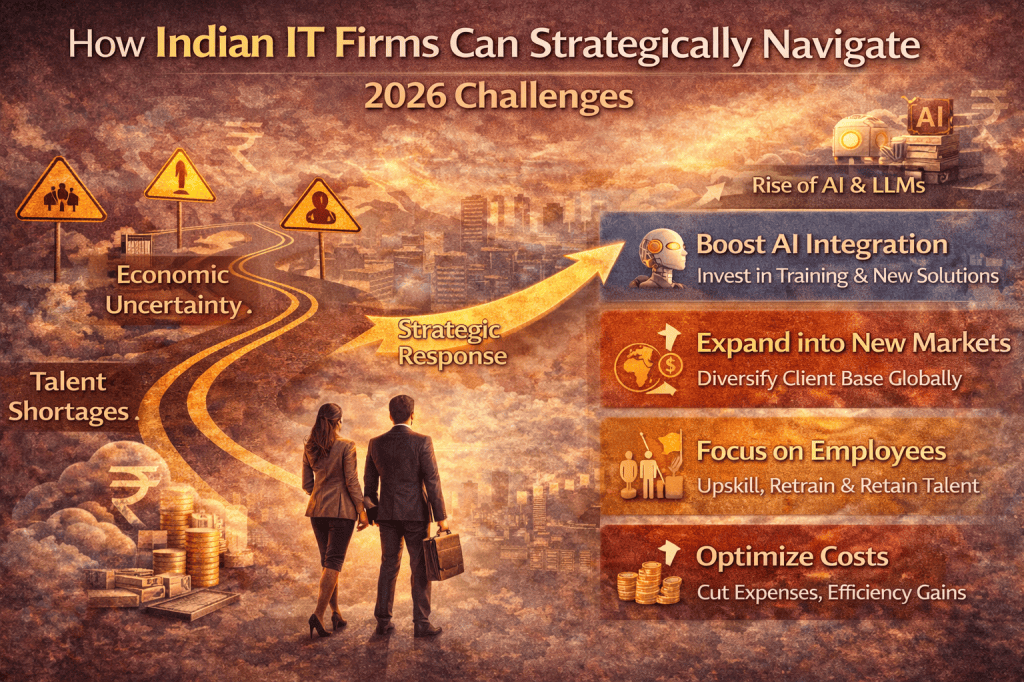
As we saw in the previous post on Indian IT Sector, the revival is real — but so are the structural headwinds. In this post, we see how Indian IT companies can navigate through these turbulences.
For Indian IT companies such as Tata Consultancy Services, Infosys, Wipro, and HCLTech, the next phase of growth will depend less on cost arbitrage and more on strategic repositioning.
Here are the key strategic levers:
1️⃣ Move Up the AI Value Chain
Instead of competing in commoditized coding or testing services that generative AI can automate, firms must:
- Focus on AI consulting and architecture design
- Offer industry-specific AI solutions (BFSI, healthcare, manufacturing)
- Build proprietary AI accelerators and frameworks
- Provide AI governance, audit, and compliance services
The emergence of AI leaders like Anthropic has pushed enterprises to prioritize safe and explainable AI. Indian IT firms can monetize this shift by positioning themselves as AI risk management partners, not just implementation vendors.
2️⃣ Strengthen Hyperscaler Partnerships
Deep alliances with cloud providers such as:
- Amazon Web Services
- Microsoft Azure
- Google Cloud
can unlock co-selling opportunities and large transformation contracts.
Strategic priorities should include:
- Joint solution development
- AI + Cloud bundled offerings
- Migration-to-modernization roadmaps
- Consumption-based pricing models
The firms that integrate seamlessly into hyperscaler ecosystems will capture disproportionate deal flow.
3️⃣ Invest Aggressively in Workforce Reskilling
The AI era demands a shift from headcount growth to skill intensity growth.
Key actions:
- Large-scale AI, ML, cybersecurity, and cloud certifications
- Internal AI tool adoption to improve productivity
- Creation of AI Centers of Excellence
- Outcome-based compensation structures
Rather than fearing AI-driven automation, companies must use AI to enhance delivery efficiency and protect margins.
4️⃣ Transition to Outcome-Based Pricing Models
The traditional billing model — hourly rates tied to headcount — is vulnerable in an AI world.
To protect revenue, firms should:
- Shift toward value-based or outcome-based contracts
- Bundle AI efficiency gains into pricing strategy
- Offer shared savings models
- Expand managed services annuity contracts
This reduces vulnerability to automation-led pricing pressure.
5️⃣ Expand Geographic and Sector Diversification
Heavy dependence on the U.S. market remains a structural risk. Diversification into:
- Europe (digital public infrastructure projects)
- Middle East (sovereign AI investments)
- Asia-Pacific (cloud adoption cycle)
can smooth revenue volatility.
Similarly, expanding into high-growth verticals like:
- Energy transition tech
- Defense digitalization
- AI-driven manufacturing
can create new growth engines.
6️⃣ Build Intellectual Property (IP) & Platforms
Indian IT firms historically excelled in services delivery. The next leap requires:
- Proprietary platforms
- Industry SaaS solutions
- AI frameworks and reusable toolkits
- Vertical-specific automation engines
Owning IP improves margins and reduces commoditization risk.
7️⃣ Strengthen Cybersecurity & Regulatory Capabilities
As AI adoption scales, regulatory scrutiny will intensify globally. Firms that build expertise in:
- Responsible AI frameworks
- Data protection compliance
- Cybersecurity automation
- AI audit trails
will gain trust in regulated industries.
This could become a high-margin consulting segment over the next five years.
The Strategic Shift: From Outsourcing Vendor to Digital Orchestrator
The Indian IT sector’s 2026 challenge is not survival — it’s reinvention.
The winning firms will:
✔ Integrate AI deeply into delivery
✔ Monetize AI governance & compliance
✔ Reduce dependence on labor arbitrage
✔ Build platform-led differentiation
✔ Focus on margin quality, not just revenue growth
If executed well, the AI era could mark not the disruption of Indian IT — but its evolution into a higher-value, globally strategic technology partner.
Disclaimer
This article is for informational and educational purposes only and should not be construed as investment advice, financial advice, or a recommendation to buy or sell any securities. The views expressed are based on publicly available information and general industry trends as of 2026. Market conditions are subject to change, and investors should conduct their own research or consult a qualified financial advisor before making investment decisions.


Leave a Reply