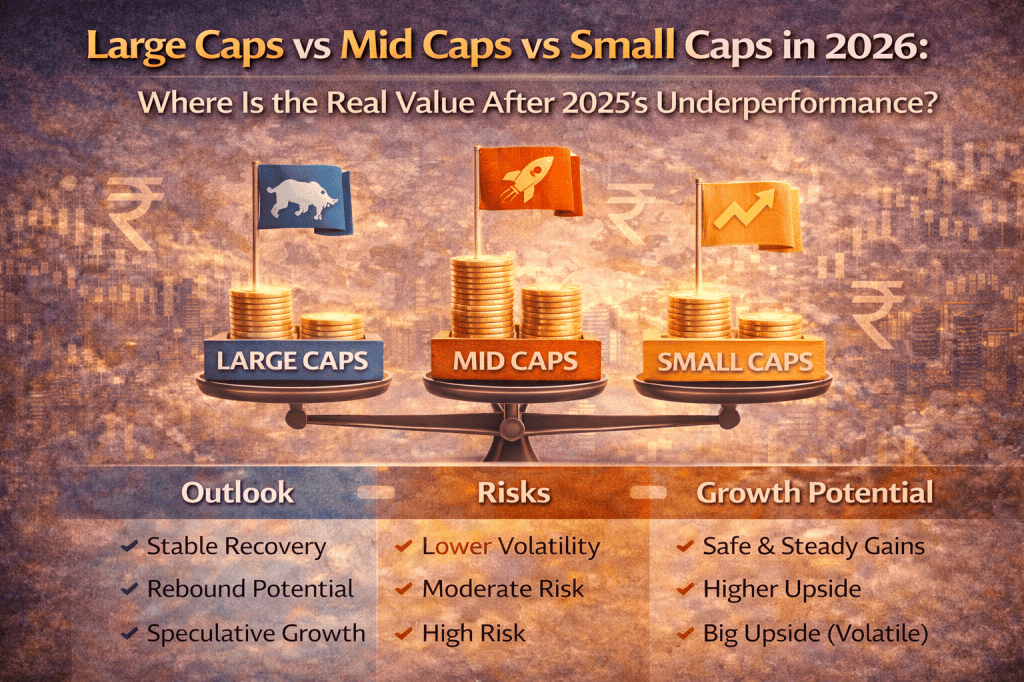
After a turbulent 2025 where mid-cap and small-cap stocks underperformed meaningfully, investors are entering 2026 with a key question:
Is it time for rotation back into broader markets — or do large caps now offer superior risk-reward?
Let’s break this down by valuation, earnings visibility, liquidity dynamics, and sector rotation trends.
What Happened in 2025?
In 2025, Indian equity markets saw:
- Mid-cap and small-cap correction after years of strong outperformance
- Stretched valuations normalizing
- Liquidity tightening due to global risk-off sentiment
- FII flows concentrating into quality large caps
Broader markets, especially speculative and momentum-driven counters, faced sharper drawdowns. Meanwhile, large caps — particularly in banking, energy, and select IT — held up relatively better.
1. Large Caps in 2026: Stability with Improving Valuations?
Large caps (Nifty 50–type names) now present an interesting setup:
Why They Look Attractive
- Reasonable valuations vs historical averages
- Strong balance sheets
- Higher institutional ownership
- Better earnings visibility
- Beneficiaries of global capital inflows
Large companies like those in the Nifty 50 and BSE Sensex are trading closer to long-term average P/E multiples compared to the premium valuations seen in mid/small caps during 2023–2024.
If global volatility persists, FIIs typically prefer liquid large-cap names.
Risk-reward profile:
Lower downside risk, moderate upside potential.
2. Mid Caps: Consolidation Phase or Accumulation Opportunity?
Mid caps suffered valuation compression in 2025. Many quality companies saw price corrections without proportionate earnings deterioration.
The Nifty Midcap 100 experienced sharper drawdowns compared to large caps, narrowing valuation gaps.
What Could Trigger Rotation?
- Earnings upgrades
- Domestic liquidity from SIP flows
- Capex revival
- Rate cuts (if inflation stabilizes)
However, mid caps are still sensitive to:
- Slower demand growth
- Margin pressures
- Liquidity cycles
Risk-reward profile:
Balanced — but selective stock picking is critical.
3. Small Caps: High Risk, High Reward?
The Nifty Smallcap 100 was hit hardest in 2025. Many speculative counters corrected 30–50%.
Are Valuations Attractive Now?
In pockets — yes.
But:
- Earnings visibility remains weak for many small companies
- Liquidity can evaporate quickly in downturns
- Promoter quality and governance risks are higher
Historically, small caps outperform after economic clarity returns — not during uncertainty.
Risk-reward profile:
High volatility, potential outsized returns — but only for high-risk investors.
Valuation Gap: Where Is It Now?
In 2023–2024:
- Mid and small caps traded at a massive premium to large caps.
In early 2026:
- That premium has compressed.
- Large caps now offer earnings stability at comparable valuations.
- Select mid caps are trading at reasonable PEG ratios.
- Small caps still show wide dispersion — some cheap, some still expensive.
This narrowing valuation gap is crucial.
When valuation premiums shrink, risk-adjusted returns often favor large caps first.
| Metric | Large Caps (Nifty 50) | Mid Caps (Nifty Midcap 100) | Small Caps (Nifty Smallcap 100) |
|---|---|---|---|
| Index Reference | Nifty 50 | Nifty Midcap 100 | Nifty Smallcap 100 |
| Relative Valuation vs 5Y Avg | Near historical average | Slight premium / normalizing | Mixed — wide dispersion |
| Earnings Visibility | High | Moderate | Low to Moderate |
| Balance Sheet Strength | Strong | Selective | Highly variable |
| Institutional Ownership | Very High (FII + DII heavy) | Moderate | Limited |
| Liquidity | Very High | Moderate | Low in downturns |
| Volatility | Lower | Medium | High |
| Downside Protection | Better | Moderate | Weak |
| Upside Potential (2–3 yrs) | Moderate | High (selective) | Very High (high risk) |
| Ideal Investor Profile | Conservative / Core Portfolio | Growth-focused | Aggressive / Tactical |
Interpretation: The valuation gap between large and mid caps has narrowed significantly after 2025’s correction, improving the risk-adjusted appeal of large caps while creating selective opportunities in mid caps.
Rotation Possibilities in 2026
Market rotations generally follow this pattern:
- Large caps lead during uncertainty
- Mid caps follow once confidence improves
- Small caps outperform in full risk-on cycles
If 2026 sees:
- Stable macro conditions
- Rate cuts
- Strong earnings growth
Then rotation into mid and small caps could accelerate in the second half of the year.
But if global volatility persists:
- Large caps may continue to dominate.
So, Where’s the Value in 2026?
Conservative Investors:
Large caps currently offer better downside protection and steady compounding potential.
Moderate Risk Investors:
Selective mid caps with strong cash flows and low debt could provide superior returns over 2–3 years.
Aggressive Investors:
Small caps may offer multibagger potential — but require deep research and patience.
Key Takeaway: Risk-Reward Has Shifted
After 2025’s correction:
- Large caps: Attractive for stability + valuation comfort
- Mid caps: Selective opportunities emerging
- Small caps: Tactical allocation only
This cycle may reward discipline more than momentum.
Instead of chasing broad themes, 2026 could be a year of quality over quantity.
Suggested Allocation Strategy (Illustrative Only)
- 50–60% Large Caps
- 25–35% Mid Caps
- 10–15% Small Caps
(Adjust based on risk appetite and investment horizon.)
Final Thoughts
The underperformance of mid and small caps in 2025 has reset expectations.
In 2026, the question isn’t “Which segment will double?”
It’s “Where is the best risk-adjusted return?”
At this stage, large caps appear better positioned for capital protection — while selective mid caps may offer the next leg of alpha.
Rotation will happen. The key is timing it wisely — and not confusing correction with structural decline.
Disclaimer
This article is for informational and educational purposes only and should not be construed as investment advice. Markets are subject to risks including volatility, liquidity constraints, and macroeconomic factors. Past performance does not guarantee future returns. Investors should conduct their own research or consult a qualified financial advisor before making investment decisions. The author is not responsible for any financial losses arising from actions taken based on this article.


Leave a Reply