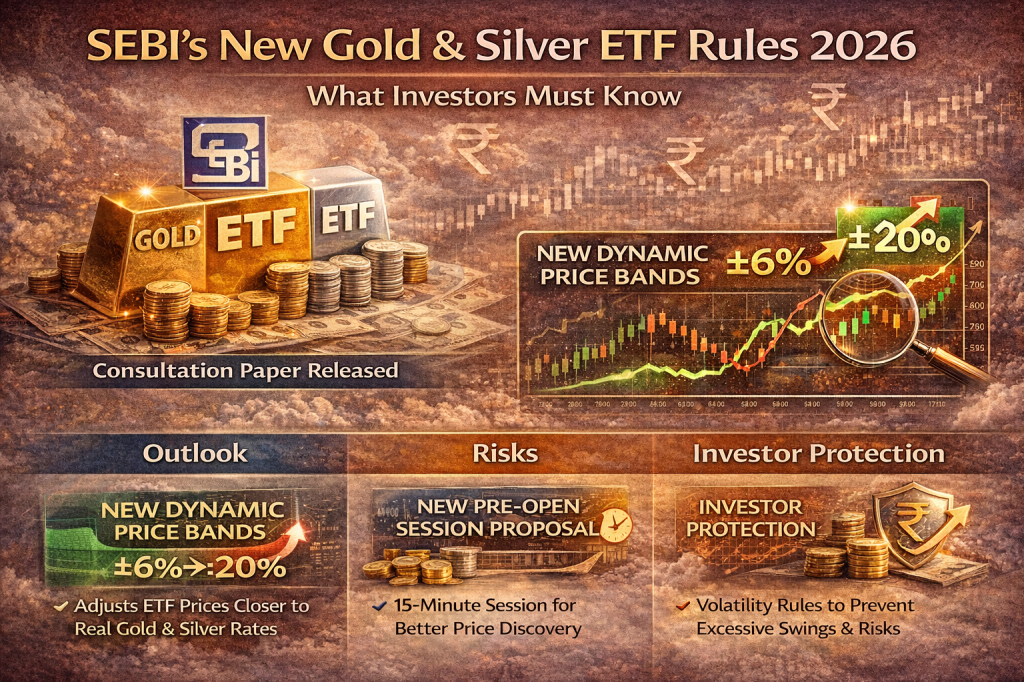
The Securities and Exchange Board of India (SEBI) has unveiled significant updates for gold and silver exchange-traded funds (ETFs) to improve market efficiency and protect investors amid rising volatility and pricing misalignments. The move comes as precious metal ETF trading sees record assets under management crossing ₹2 lakh crore recently, reflecting strong retail and institutional interest.(बिज़नेस स्टैंडर्ड)
🔍 What Are the New SEBI Rules?
SEBI has proposed changes to how gold and silver ETFs are priced and traded to ensure that their market prices stay closer to the true value of their underlying assets:(The Economic Times)
📌 1. Dynamic Price Bands instead of Fixed Limits
- Previously, ETFs traded within broad fixed bands, which could be up to ±20% of Net Asset Value (NAV).
- Under the new proposal, gold and silver ETFs will start with a ±6% price band, adjustable in stages (±3%) with market movement, up to a maximum of ±20%.
- This gradual expansion prevents sharp mispricing and reduces extreme volatility.
- Exchanges may even allow further relaxations if global precious metal markets move beyond existing limits.(The Economic Times)
📌 2. Pre-Open Session Consideration
- SEBI is evaluating whether to introduce a pre-open trading session for commodity ETFs so that opening prices better reflect international gold and silver market levels.
- Because global bullion markets trade almost 24×7, while domestic ETF sessions are limited, this could help narrow discrepancies.(The Economic Times)
📌 3. Real-Time Price Alignment
- The regulator aims to rectify long-standing mismatches where ETFs priced on older NAVs diverged from spot prices in underlying commodity markets.
- By revising price band logic and considering dynamic mechanisms, SEBI hopes to enhance price discovery.(The Economic Times)
📈 Why This Matters for Investors
✔️ Reduced Mispricing and Better Price Discovery
Gold & silver ETFs will be less prone to exaggerated premiums or discounts relative to the actual metal price — especially during volatile sessions. This benefits both long-term investors and traders.(The Economic Times)
✔️ Lower Risk of Sudden Sharp Moves
Dynamic price bands help guard against abrupt price swings that can erode investor returns or trigger unintended stop-loss trades.(The Economic Times)
✔️ Closer Alignment with Global Markets
Investors could see pricing more in sync with international spot markets (e.g., London/MCX rates), reducing arbitrage inefficiencies.(The Economic Times)
✔️ Transparency and Market Confidence
By inviting public comments and consulting stakeholders before finalising the new regime, SEBI aims to build a stronger, more transparent environment for commodity-linked ETFs.(The Economic Times)
📉 Short-Term Market Reaction
Following the announcement, gold and silver ETF prices saw some profit booking and corrections, with several ETFs trading lower as markets adjusted to the proposed norms.(Moneycontrol Hindi)
🧠 What Investors Should Do Next
- Review Your ETF Holdings: Check current gold/silver ETF positions and how price fluctuations affect cost basis.
- Understand Trading Mechanisms: Familiarise yourself with how dynamic bands work, especially if you trade frequently.
- Beware of Unregulated Alternatives: SEBI has previously warned about unregulated “digital gold” products offered by fintech apps — these are not ETFs and carry significant risks outside SEBI’s investor protections.(Business Today)
- Diversify Smartly: Gold and silver ETFs are often held for diversification and inflation hedging — align allocations with your risk profile.
Disclaimer:
This blog post is for informational purposes only and does not constitute investment advice. The views and opinions expressed here are based on current publicly available information and may change over time. Always consult with a qualified financial advisor or professional before making investment decisions.


Leave a Reply