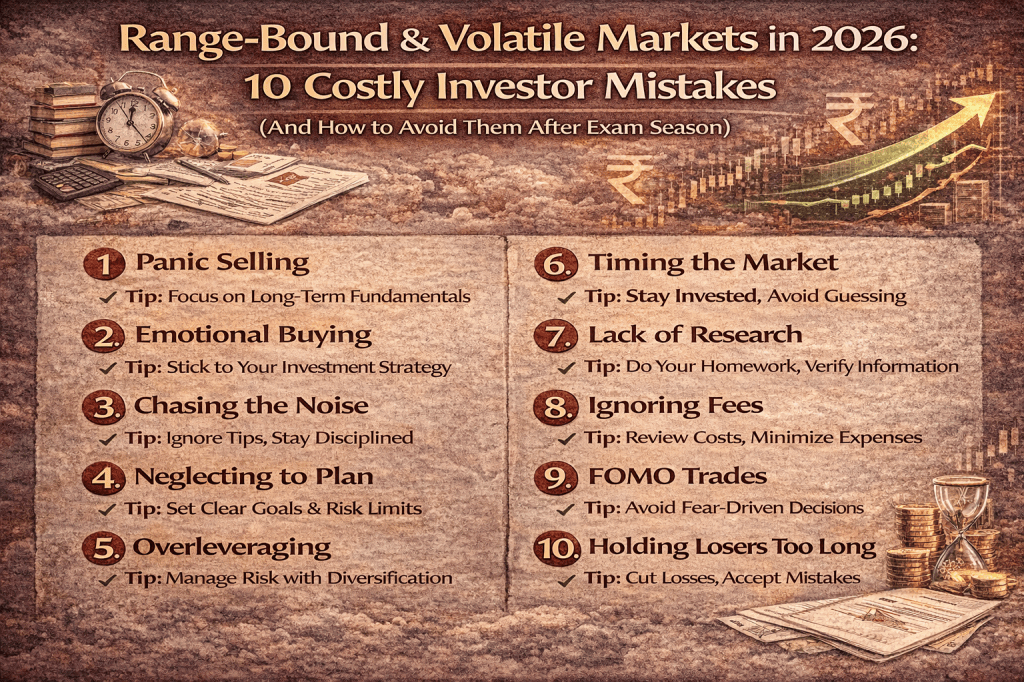
The first few months of 2026 have reminded investors of one hard truth — markets don’t always trend smoothly upward.
After a strong rally in select pockets during 2024–2025, indices like the Nifty 50 and Sensex have largely moved in phases of consolidation, sharp pullbacks, and sudden rallies. Add global uncertainty, policy tweaks, sector rotations, and liquidity shifts — and you get a classic range-bound, volatile market.
Interestingly, this period coincides with post-exam season — when many young earners and fresh graduates decide to “restart” or begin investing seriously.
If that’s you, this post could save you from expensive mistakes.
🚨 Common Investor Mistakes in a Volatile 2026 Market
1️⃣ Over-Chasing Momentum Stocks
In volatile markets, sharp rallies in certain stocks attract attention quickly.
Many investors:
- Enter after a 20–30% rally
- Buy purely based on recent performance
- Ignore whether earnings justify the move
By the time retail participation peaks, early investors may already be booking profits.
Lesson:
Momentum is a strategy — but blind chasing is speculation. Always ask: Has the earnings outlook improved, or only the price?
2️⃣ Ignoring Valuations During Sector Euphoria
In 2026, we’ve seen phases where:
- PSU stocks ran hard
- Select defence and railway stocks saw euphoric buying
- Midcaps moved faster than fundamentals
In a range-bound index environment, money rotates aggressively between sectors. Investors who ignore valuation metrics like:
- P/E ratio
- Price-to-book
- Earnings growth consistency
often end up stuck at the top.
Lesson:
Even great companies become bad investments at extreme valuations.
3️⃣ FOMO Buying After Every Breakout
Range-bound markets create fake breakouts.
Index breaks resistance → excitement builds → retail jumps in → sudden reversal.
This cycle has repeated multiple times in recent months.
Lesson:
Not every breakout sustains. Confirmation and volume matter. Patience is underrated.
4️⃣ Selling Quality Stocks in Panic
Volatility creates fear.
A 5–8% correction in a fundamentally strong company often triggers:
- Panic selling
- WhatsApp rumours
- Social media negativity
But in most cases, business fundamentals remain intact.
Lesson:
Separate price volatility from business deterioration.
5️⃣ Going All-In Instead of Staggered Investing
Many investors restart investing with lump-sum deployment — especially after:
- Bonuses
- First salary
- Tax refunds
- Post-exam job offers
In volatile markets, staggered SIP-style allocation reduces regret and emotional stress.
6️⃣ Ignoring Asset Allocation
After strong equity returns in previous years, many portfolios became:
- 80–90% equity
- Highly mid/small-cap heavy
In 2026’s consolidation phase, such portfolios felt extreme swings.
Consider balancing with:
- Large caps
- Gold ETFs
- Debt instruments
- International exposure
7️⃣ Overtrading in a Sideways Market
Range-bound markets tempt traders to:
- Buy near support
- Sell near resistance
- Repeat frequently
But:
- Brokerage
- Slippage
- Taxes
- Emotional fatigue
often eat into returns.
Sometimes, doing nothing is the smartest move.
8️⃣ Confusing Noise with Structural Change
Short-term events like:
- RBI commentary
- Global rate speculation
- US election uncertainty
- Geopolitical tensions
cause sharp reactions. But not all news changes long-term growth trajectories.
Long-term investors must filter noise.
9️⃣ Blindly Following Social Media “Experts”
In volatile times, everyone claims to have predicted:
- The top
- The crash
- The next multibagger
Avoid strategy hopping every 2 weeks.
Consistency beats prediction.
🔟 Restarting Investing Without a Clear Plan
Post-exam season is symbolic:
- New beginnings
- Fresh income
- Renewed financial goals
But investing without:
- Defined risk appetite
- Time horizon
- Allocation plan
- Exit rules
leads to emotional decision-making.
Here’s a clean, beginner-friendly comparison table you can directly insert after the “Common Investor Mistakes” section in your blog post.
📊 Investor Mistake vs Smart Action (2026 Volatile Market Guide)
“Here’s a quick reality check for 2026 — if you find yourself in the left column, it’s time to shift to the right.”
| ❌ Investor Mistake | ✅ Smart Action in a Range-Bound Market |
|---|---|
| Over-chasing momentum after a 20–30% rally | Check earnings growth and valuation before buying |
| Buying purely due to FOMO on breakouts | Wait for confirmation and accumulate in phases |
| Ignoring high P/E or stretched valuations | Compare valuation with historical averages and sector peers |
| Panic selling quality stocks during corrections | Re-evaluate fundamentals before reacting to price moves |
| Deploying full capital in one go | Use staggered investing (SIP or phased allocation) |
| Overexposure to mid/small caps | Maintain balanced asset allocation (large caps, gold, debt) |
| Overtrading in sideways markets | Reduce churn and focus on long-term conviction bets |
| Following social media stock tips blindly | Build your own investment framework and thesis |
| Reacting to every RBI/global news headline | Differentiate between short-term noise and structural change |
| Restarting investing without a plan | Define risk appetite, goals, time horizon, and exit strategy |
💡 Smart Approach for 2026’s Market Conditions
If markets remain range-bound:
✔ Focus on earnings growth over price momentum
✔ Prefer staggered investing
✔ Review valuations before adding
✔ Maintain asset allocation discipline
✔ Keep cash ready for meaningful corrections
✔ Think 3–5 years, not 3–5 weeks
🎓 Special Note for Young Investors Restarting in 2026
If you’re just starting after exams or entering the workforce:
- Don’t try to recover “missed opportunities”
- Avoid comparing your portfolio with influencers
- Build a process before chasing returns
The biggest edge young investors have is time, not timing.
🏁 Final Thought
Volatile markets don’t destroy wealth — emotional decisions do.
2026 is not a bad year to invest.
It’s a year that rewards discipline, patience, and valuation awareness.
If you can learn to survive range-bound markets, you’ll thrive in trending ones.
⚠ Disclaimer
This article is for educational and informational purposes only and should not be considered as financial or investment advice. Stock market investments are subject to market risks. Please conduct your own research or consult a SEBI-registered financial advisor before making investment decisions. The views expressed are personal and meant for general awareness in the current market context of 2026.


Leave a Reply