Introduction
In a landmark 6–3 decision, the United States Supreme Court ruled that former President Donald Trump overstepped his legal authority by imposing sweeping tariffs under emergency powers — effectively striking down the tariff regime he implemented on a wide range of imported goods. (Reuters)
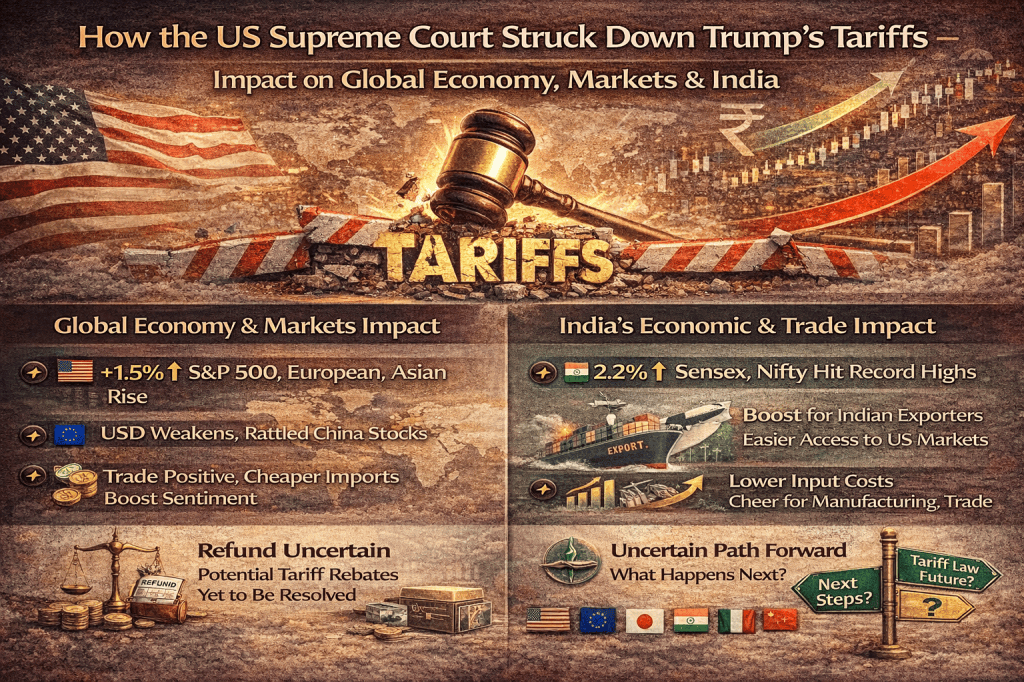
This ruling has sent ripples through global trade, financial markets, and ongoing diplomatic negotiations — especially the controversial tariff provisions in the US-India trade deal that had proposed an 18% tariff on Indian exports. In this blog post, we’ll unpack the economic and strategic implications for the world, global markets, India’s economy and stock markets, and whether this development is ultimately beneficial or detrimental for India.
What the Supreme Court Decided
The court found that Trump exceeded his authority under statutes like the International Emergency Economic Powers Act (IEEPA) by imposing broad tariffs without explicit Congressional approval. (Reuters)
While the decision invalidated the core of the tariff regime, the administration quickly responded by introducing a temporary 10% global tariff under a different legal authority (Section 122 of the 1974 Trade Act) — creating continued uncertainty. (AP News)
Global Economic Implications
**1. Trade Policy and Rule of Law
- The ruling reinforces limits on the executive’s unilateral power to impose tariffs, emphasizing that trade restrictions should be rooted in clear legislative authority.
- It signals that future tariffs may require more transparent legal bases and potentially Congressional approval.
**2. Impact on Global Trade
- Tariffs have been a key weapon in trade conflicts that slow global commerce, increasing costs, discouraging investment, and disrupting supply chains.
- With the court’s decision, some tariffs may be rolled back or restructured, potentially lowering trade tensions temporarily.
**3. Uncertainty Remains
- Although this is a judicial check on executive authority, the ruling doesn’t eliminate all tariff risk — the government is already seeking alternate legal routes to maintain levies. (The Guardian)
- This means global businesses and governments still face unpredictability in U.S. trade policy.
Impact on Global Financial Markets
**1. Equity Markets Reacted Favorably
- Major U.S. indices — including the S&P 500, Nasdaq, and Dow Jones — rose after the ruling, as investors welcomed reduced trade headwinds. (AP News)
- Stocks of companies reliant on global supply chains or imports also rallied.
**2. Bond Market Jitters
- A legal requirement to refund up to $150–$200 billion of previously collected tariffs sparked concerns over higher fiscal deficits and bond yields. (Reuters)
**3. Global Markets
- European and Asian markets showed mixed responses, reflecting relief from lower tariffs but caution due to lingering policy uncertainty.
Implications for the Indian Economy
**1. Tariff Relief for Indian Exports
As a result of the Supreme Court decision:
- Around 55–60% of India’s exports to the U.S. — previously subject to an **18% tariff under the proposed trade framework — will now revert to standard Most Favored Nation (MFN) duty rates. (The Times of India)
- This is significant for sectors like textiles, gems and jewellery, engineering goods, and chemicals, which faced punitive tariff rates. (mint)
This relief could make Indian goods significantly more competitive in the U.S. market relative to tariff-inflated competitors.
**2. **Mixed Impact Across Sectors
Not all tariffs are gone:
- Tariffs imposed under other trade laws — including Section 232 levies on steel, aluminium, and some automotive components — remain in force. (The New Indian Express)
- Thus, India’s exports of metals and some industrial goods will still face elevated duties.
**3. Stock Market Reaction
The Indian stock market (e.g., Nifty50, BSE Sensex) opened strongly as traders priced in the tariff relief:
- Export-oriented sectors such as pharma, textiles, gems and jewellery, and engineering saw positive sentiment, reflecting potential margin expansion and revived demand. (Bramesh’s Technical Analysis)
- However, broader market strength will also depend on global macro conditions, inflation, and domestic policy responses.
Is This Development Good or Bad for India?
**1. **Near-Term Benefits
Good news for India:
✔ Improved export competitiveness
✔ Stronger market access in the U.S.
✔ Opportunity to negotiate better terms in the broader trade deal
By reducing tariff barriers effectively for a large chunk of exports, Indian exporters may gain pricing power and market share in the U.S.
**2. **Challenges and Strategic Risks
However, there are caveats:
✖ Remaining tariffs on key sectors
✖ Unclear refund mechanisms for past tariffs
✖ Continued trade policy unpredictability from Washington
Moreover, India now has an opportunity — but also a challenge — to reassess and renegotiate its trade agreement with the U.S. from a stronger position, ensuring fairer terms rather than being cornered by unilateral tariff threats. (Business Today)
What About the US-India Trade Deal and the 18% Tariffs?
Earlier frameworks between the U.S. and India proposed a tariff rate of 18% on Indian goods as part of interim arrangements. (Onmanorama)
Following the Court’s decision:
- That 18% tariff framework is effectively nullified for most exports. (The Times of India)
- The U.S. may attempt to reinstate tariffs via alternate legal routes or renegotiate the trade deal. (The Indian Express)
This gives India leverage to push for a trade deal that better aligns with its interests, including tariff reductions and stronger market access.
Conclusion
The U.S. Supreme Court’s ruling on Trump-era tariffs is a significant legal and economic watershed with far-reaching implications:
- Global trade has regained some predictability, at least temporarily.
- Global markets reacted favorably, though uncertainties remain.
- India could benefit greatly — especially its export industries and stock markets — by regaining tariff competitiveness and strengthening its negotiating position.
However, the landscape remains uncertain, and India must smartly navigate future trade discussions to lock in long-term gains.
Disclaimer
This blog post is for informational purposes only and does not constitute financial, legal, or trade advice. The interpretations are based on publicly available information and evolving developments; readers should consult qualified professionals before making investment or business decisions.


Leave a Reply