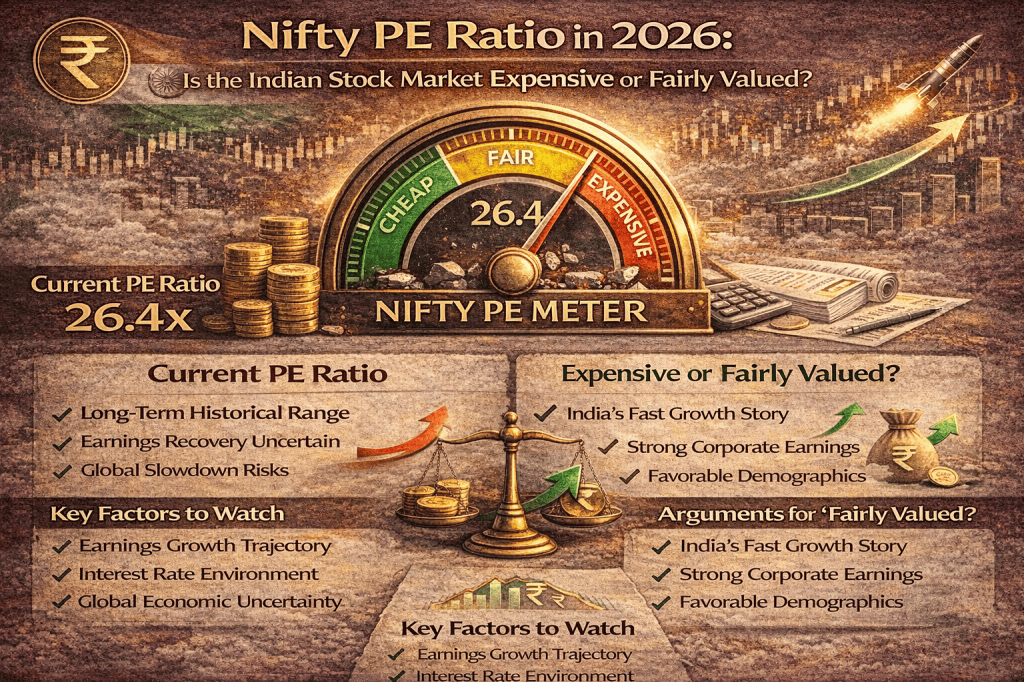
The Nifty PE ratio is one of the most widely tracked valuation indicators in the Indian stock market. In 2026, with global uncertainties, AI-led sector shifts, geopolitical tensions, and evolving interest rate cycles, investors are once again asking:
Is the Nifty expensive right now, or fairly valued?
Let’s break it down in simple terms.
What is Nifty PE Ratio?
The PE (Price-to-Earnings) ratio measures how much investors are willing to pay for ₹1 of earnings.
For the NIFTY 50, the PE ratio represents:
Current Index Price ÷ Combined Earnings of 50 Companies
If Nifty PE is:
- Below 18 → Historically cheap zone
- 18–22 → Fair valuation range
- 22–25 → Slightly expensive
- Above 25 → Expensive / High optimism
(These ranges are broad historical observations, not fixed rules.)
Where Does Nifty Stand in 2026?
In early 2026, Nifty’s PE has been hovering in the upper fair to slightly expensive range, depending on earnings revisions and sectoral movement.
Why?
- Strong domestic liquidity (SIPs continue to flow)
- Banking sector stability
- Capex cycle revival
- AI & digital optimism
- But… global growth concerns and export slowdown risks
This makes the market not cheap, but also not in bubble territory (yet).
Comparing 2026 with Previous High PE Phases
Let’s compare:
| Period | Nifty PE | What Happened After? |
|---|---|---|
| 2007 Bull Run | ~28+ | Sharp correction in 2008 |
| 2020 Post-COVID Rally | 35+ | Earnings catch-up over 2 years |
| 2023–24 Rally | 24–26 | Time correction + sector rotation |
| 2026 | Upper fair zone | ? |
The key insight:
High PE does not always mean immediate crash. Sometimes, the market corrects through time, not price.
At What PE Should You Worry?
Here’s a simple valuation heatmap table you can directly paste into your blog for visual clarity.
📊 NIFTY 50 Valuation Heatmap (Based on PE Ratio)
| PE Range | Valuation Zone | Market Mood | Investor Strategy |
|---|---|---|---|
| Below 15 | 🟢 Deep Value | Panic / Crisis | Aggressive long-term accumulation |
| 15 – 18 | 🟢 Cheap | Fear / Early Recovery | Increase allocation gradually |
| 18 – 22 | 🟡 Fair | Balanced | Continue SIP / Selective buying |
| 22 – 25 | 🟠 Slightly Expensive | Optimistic | Stock-specific approach, avoid overpaying |
| 25 – 30 | 🔴 Expensive | Euphoria building | Reduce lump-sum exposure, rebalance |
| Above 30 | 🔴 Extreme Overvaluation | Bubble Risk | Defensive positioning, raise cash |
📌 Where 2026 Currently Stands
Based on recent readings of the NIFTY 50, the PE is hovering in the 22–23 range, which places the market in the:
🟠 Upper Fair to Slightly Expensive Zone
This suggests:
- Not a bargain zone
- Not bubble territory
- Stock selection matters more than index timing
It simplifies valuation thinking for beginner-to-intermediate investors and makes your article more actionable.
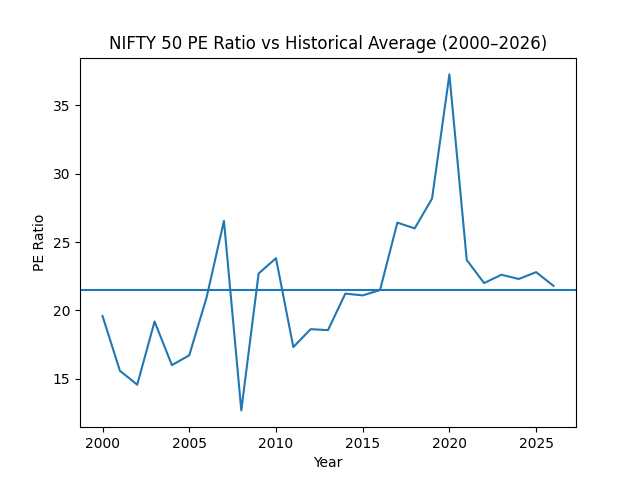
NIFTY 50 PE Ratio vs Long-Term Historical Average (2000–2026)
What Is Driving PE in 2026?
1️⃣ Earnings Growth Expectations
If earnings grow 15–18% annually, current valuations may justify themselves.
2️⃣ Interest Rate Outlook
If RBI eventually cuts rates, higher PE multiples can sustain.
3️⃣ Retail Participation
SIP flows are creating valuation support during dips.
4️⃣ Global Liquidity
US Fed stance impacts foreign inflows.
Is Nifty Expensive in 2026?
Short Answer:
It’s not cheap. It’s selectively fair.
Long Answer:
- Largecaps → Fairly valued
- Quality compounders → Slightly expensive
- Some PSU / defense / thematic stocks → Overheated
- Certain IT & export plays → Reasonable after correction
The index PE alone doesn’t tell the full story. Sector-level analysis is crucial.
What Smart Investors Should Do in 2026
Instead of worrying about whether PE is 22 or 24, focus on:
✔️ Gradual investing (SIP or staggered buying)
✔️ Avoiding FOMO in momentum stocks
✔️ Watching earnings growth, not just price
✔️ Keeping cash for corrections
✔️ Diversifying across sectors
Remember:
Markets correct excess optimism, not reasonable growth expectations.
A Better Way to Look at Valuations
Instead of asking:
“Is Nifty expensive?”
Ask:
- Are earnings accelerating?
- Is liquidity strong?
- Are rates supportive?
- Are we in a euphoric phase?
Right now in 2026:
We are in optimistic but not euphoric territory.
That means:
- Sharp corrections are possible
- But long-term structural story of India remains intact
Final Verdict: Expensive or Fair?
Nifty in 2026 looks fairly valued to slightly expensive — but not dangerously overvalued.
The real risk is not valuation.
The real risk is overconfidence.
Invest with discipline, not emotion.
Disclaimer
This article is for educational and informational purposes only and does not constitute investment advice, financial recommendation, or solicitation to buy or sell any securities. Stock market investments are subject to market risks. Please consult your financial advisor before making any investment decisions. The author is not responsible for any financial losses arising from the use of this information.


Leave a Reply