
As we progress through 2026, the Indian equities landscape is shaping up with a blend of optimism and caution. Domestic macro fundamentals, continued policy support from the Reserve Bank of India (RBI), and evolving global headwinds are setting the stage for how the National Stock Exchange (NSE) and Bombay Stock Exchange (BSE) benchmarks could perform this year.
📊 Nifty 50 & NSE Outlook
- After underperforming in 2025, the Nifty 50 has shown signs of renewed resilience, trading around the mid-25,000s and regaining market confidence. Experts project targets ranging from ~28,000 to 30,000+ by the end of 2026 in base and bull-case scenarios. (The Times of India)
- Broader domestic inputs — including earnings growth, corporate capex, and improving consumption data — are expected to support upward momentum. (The Times of India)
- Valuations have moderated compared with peaks seen in 2024, providing a relatively softer entry point for long-term investors. (The Times of India)
Technical traders also point to key support levels between 25,000–26,000, with upside zones near psychological markers like 29,000–30,000 based on historical patterns and seasonal trends.
🏦 Bank Nifty & Financial Sector View
- The Nifty Bank index is expected to outperform the broader Nifty in many scenarios, driven by higher credit growth, margin expansion, and liquidity support from RBI policy easing. (Business Standard)
- Continued deregulation, improved asset quality, and stronger earnings momentum among private and public sector lenders provide a favourable backdrop for bank stocks. (Business Standard)
- However, emerging regulatory curbs on proprietary trading and increased capital requirements may modulate derivatives volumes and trading firm profitability. (Reuters)
📌 BSE Sensex & Broader Market
- The BSE Sensex is tracking similar patterns to the NSE, with analysts forecasting mid-90,000s to potentially 1,00,000+ levels by year-end 2026 in the bull case. (Moneycontrol)
- Sector rotation and inclusion of new listings on both the NSE and BSE are improving index breadth. Recent IPOs and dual listings (e.g., CS Tech AI) are helping deepen market participation. (The Times of India)
🏛️ Reserve Bank of India (RBI) Policy Impact
- The RBI’s monetary stance will be a key market driver in 2026. Continued rate cuts or liquidity injections aim to foster credit growth and provide support to risk assets. (The Economic Times)
- Liquidity operations planned for FY27 are likely to improve transmission of monetary support and dampen excessive volatility. (The Economic Times)
- Inflation stability, forex management and calibrated policy guidance will continue to play a central role in shaping investor confidence.
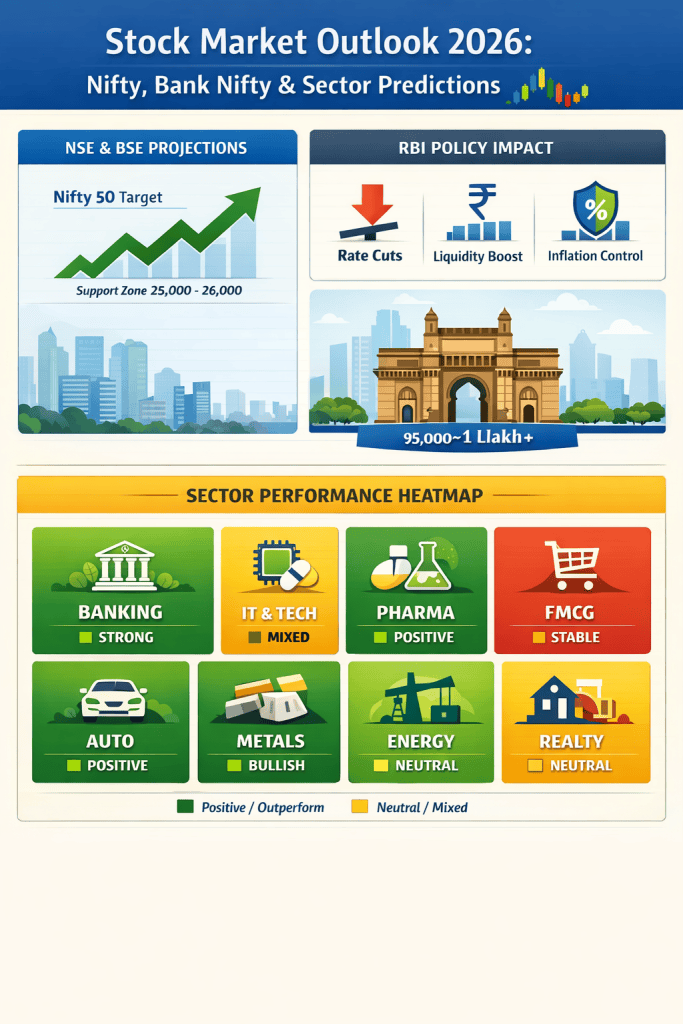
🔥 Sector Heatmap — 2026 Themes
(Indicative expectations based on current performance and earnings trends)
| Sector | Outlook | Key Drivers |
|---|---|---|
| Banking & Financials | 🟩 Strong | Credit growth, margin expansion |
| IT & Technology | 🟨 Mixed | Recovery post-global tech weakness |
| Pharma & Healthcare | 🟩 Positive | Export growth, biosimilars demand |
| Consumer Goods (FMCG) | 🟨 Stable | Premiumisation, rural demand |
| Auto & Auto Ancillaries | 🟩 Positive | EV & CV demand uptick |
| Metals & Materials | 🟩 Bullish | Commodity demand, infra push |
| Energy & Utilities | 🟨 Neutral | Capex vs oil price volatility |
| Realty & Construction | 🟨 Neutral | Housing demand, policy support |
Heatmap legend:
🟩 Positive / Outperform | 🟨 Neutral / Mixed
📉 Valuation Snapshot (Indicative)
| Metric | Approx Value | Notes |
|---|---|---|
| Nifty 50 P/E | ~22–24x | Near long-term average valuations (The Times of India) |
| Bank Nifty P/E | ~15–16x | Relatively attractive bank valuations (dailyfinancial.in) |
| IT Sector P/E | ~25–28x | Discounted vs historical peaks (dailyfinancial.in) |
| Pharma Sector P/E | ~27–30x | Strong growth but valuation premium (dailyfinancial.in) |
| Consumer Goods P/E | ~16–18x | Defensive and stable growth (dailyfinancial.in) |
📌 Final Thoughts
Indian equity markets in 2026 are poised at a transitional pivot — supported by domestic growth fundamentals, monetary easing, and valuation comfort, yet subject to global headwinds and sector-specific challenges. A diversified, bottom-up investment approach remains key, with a tilt towards financially resilient sectors and earnings growth leaders.
⚠️ Disclaimer
This blog post is for informational and educational purposes only. It does not constitute financial, investment, tax, or legal advice. Please consult with a licensed financial advisor before making any investment decisions. Market conditions can change rapidly, and past performance is not indicative of future results.


Leave a Reply