
Introduction
After delivering spectacular returns in 2023 and 2024, midcap stocks entered 2025 with sky-high expectations. However, instead of continuing their rally, many midcap indices significantly underperformed large-cap benchmarks.
Investors who aggressively bought midcaps during the euphoric phase are now wondering:
- Why did midcaps fall so sharply?
- Is this a temporary correction or a structural slowdown?
- Should investors exit or accumulate?
Let’s break it down clearly.
1. Excessive Valuations Became Unsustainable
One of the biggest reasons midcaps underperformed in 2025 was stretched valuations.
By late 2024:
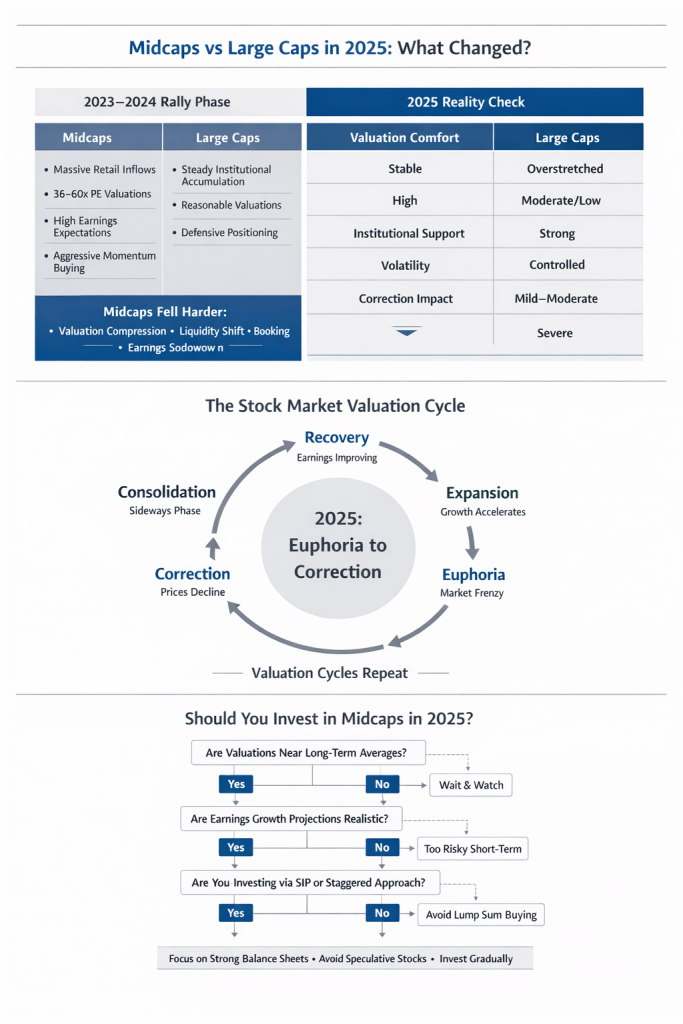
- Many midcap stocks were trading at 35–60x earnings.
- Price-to-book ratios were at multi-year highs.
- Earnings growth expectations were extremely aggressive.
When growth failed to justify those valuations, de-rating became inevitable.
In contrast, large caps under indices like NIFTY 50 were relatively better valued and therefore more resilient.
👉 Lesson: In the stock market, price matters as much as growth.
2. Shift of Liquidity Back to Large Caps
Another major factor was liquidity rotation.
In 2023–2024, massive retail inflows via SIPs and smallcase-style thematic investing pushed money into midcaps and smallcaps.
But in 2025:
- FIIs turned cautious amid global uncertainties.
- Domestic institutions rebalanced portfolios.
- Investors moved funds into safer large-cap names.
As a result, midcaps—being less liquid—fell faster when selling pressure emerged.
The broader NIFTY Midcap 150 corrected more sharply compared to frontline indices.
3. Global Macro Headwinds
Midcaps are generally more sensitive to:
- Interest rate expectations
- Currency volatility
- Global demand slowdown
With uncertainty around US Federal Reserve rate trajectory and global growth concerns, risk appetite reduced.
Emerging markets, including India, saw selective flows rather than broad-based buying.
Export-oriented midcaps and cyclical sectors like chemicals, capital goods, and niche manufacturing faced margin pressure.
4. Regulatory Warnings on Froth
In late 2024 and early 2025, market regulators and mutual fund houses warned about excessive speculation in mid and smallcap segments.
The regulator, Securities and Exchange Board of India, flagged valuation concerns and liquidity risks.
Some fund houses:
- Slowed fresh inflows into midcap schemes
- Asked investors to stagger investments
- Increased cash allocations
This triggered sentiment cooling in the segment.
5. Profit Booking After a Massive Rally
Let’s not forget:
Midcaps delivered extraordinary returns from 2022 to 2024.
When an asset class doubles or triples in a short period, profit booking is natural.
Smart money exited first.
Late entrants felt the correction the most.
This is classic market cycle behaviour:
Euphoria → Overvaluation → Correction → Consolidation
6. Earnings Growth Moderation
Another under-discussed reason:
- Input costs stabilized but revenue growth slowed.
- Government capex momentum moderated in certain quarters.
- Credit growth normalized.
Midcaps require high earnings growth to justify premium valuations. When growth normalized, multiples compressed.
Midcaps vs Large Caps in 2025 (Summary)
| Factor | Large Caps | Midcaps |
|---|---|---|
| Valuation Comfort | Relatively Better | Overstretched |
| Liquidity | High | Lower |
| Institutional Support | Strong | Selective |
| Volatility | Moderate | High |
| Correction Severity | Controlled | Sharp |
Is This the End of the Midcap Story?
Not necessarily.
Corrections are healthy.
Historically:
- Midcaps outperform during economic expansion.
- They underperform when liquidity tightens.
- They recover strongly after consolidation.
The key question is valuation and earnings sustainability — not price decline alone.
What Should Investors Do Now?
✔ Avoid panic selling
✔ Focus on quality midcaps with strong balance sheets
✔ Accumulate gradually (SIP or staggered buying)
✔ Compare valuations with long-term averages
✔ Maintain asset allocation discipline
If you’re a long-term investor, corrections create opportunities — but only in fundamentally strong businesses.
Final Thoughts
Midcaps underperformed in 2025 primarily due to:
- Valuation excess
- Liquidity shift
- Regulatory caution
- Profit booking
- Earnings normalization
This is not unusual — it’s part of the market cycle.
Smart investors don’t chase momentum.
They respect valuation and risk.
Disclaimer
This article is for educational and informational purposes only and should not be considered as investment advice. Stock market investments are subject to market risks. Please consult your financial advisor before making any investment decisions. The views expressed are personal and based on market observations and publicly available information.


Leave a Reply