
Introduction
Gold has always held a special place in Indian investors’ portfolios. Beyond cultural significance, gold serves as a powerful financial asset that provides stability, diversification, and protection during uncertain times.
In 2026, with global inflation risks, geopolitical tensions, and volatile equity markets, investors are once again asking an important question:
How much gold should you allocate in your portfolio?
This guide explains the ideal gold allocation percentage, when to increase or reduce exposure, and the best ways to invest in gold.
Why Gold Deserves a Place in Your Portfolio
Gold is not just another asset—it plays a unique strategic role.
1. Portfolio Diversification
Gold often moves differently from stocks and bonds. When equities fall, gold frequently performs well, helping reduce overall portfolio risk.
Example:
During market crashes, gold has historically acted as a shock absorber.
2. Hedge Against Inflation
Gold tends to maintain purchasing power over long periods.
When inflation rises and currency value declines, gold prices often increase.
This makes gold particularly useful in environments with:
- High inflation
- Currency depreciation
- Rising global uncertainty
3. Safe Haven During Crises
Gold typically performs well during:
- Economic recessions
- Geopolitical tensions
- Stock market crashes
Investors shift to gold because it is considered a reliable store of value.
Ideal Gold Allocation: How Much is Enough?
Financial experts generally recommend allocating:
Recommended Gold Allocation Range
| Investor Type | Gold Allocation |
|---|---|
| Conservative | 10% – 15% |
| Moderate | 5% – 10% |
| Aggressive | 5% |
| Retirees | 10% – 20% |
Why Not Allocate Too Much?
Gold provides stability but does not generate income like stocks or bonds.
Excessive allocation can:
- Reduce overall portfolio returns
- Limit wealth creation potential
Gold should be used as a risk management tool—not the primary growth asset.
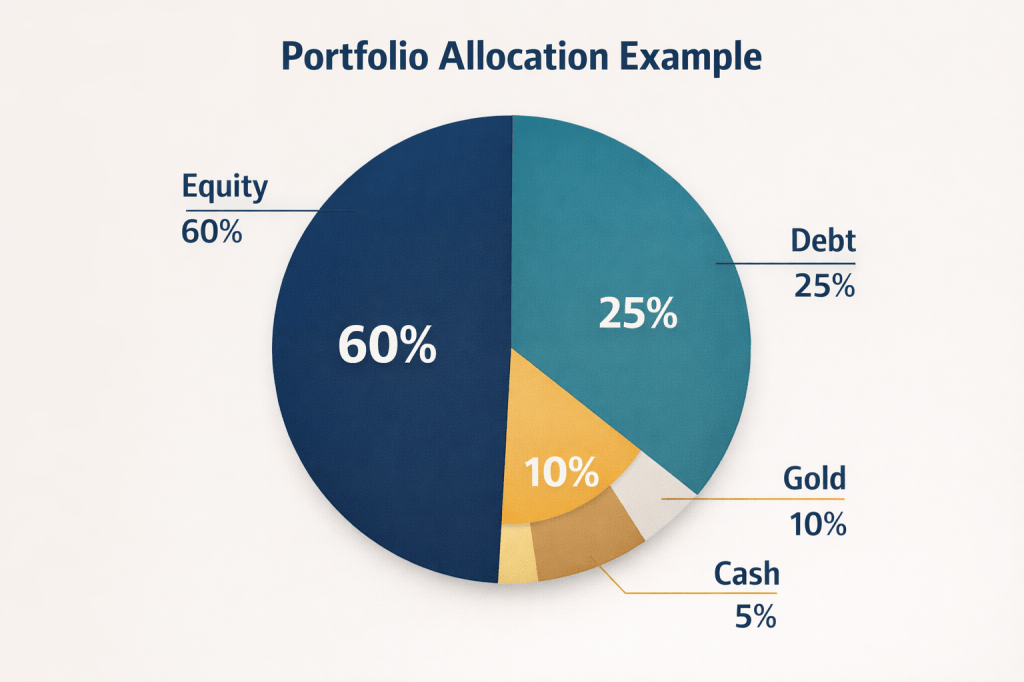
Model Portfolio Example
Here is an example of a balanced portfolio allocation:
| Asset Class | Allocation |
|---|---|
| Equity | 60% |
| Debt | 25% |
| Gold | 10% |
| Cash | 5% |
This structure balances growth, income, and protection.
When Should You Increase Gold Allocation?
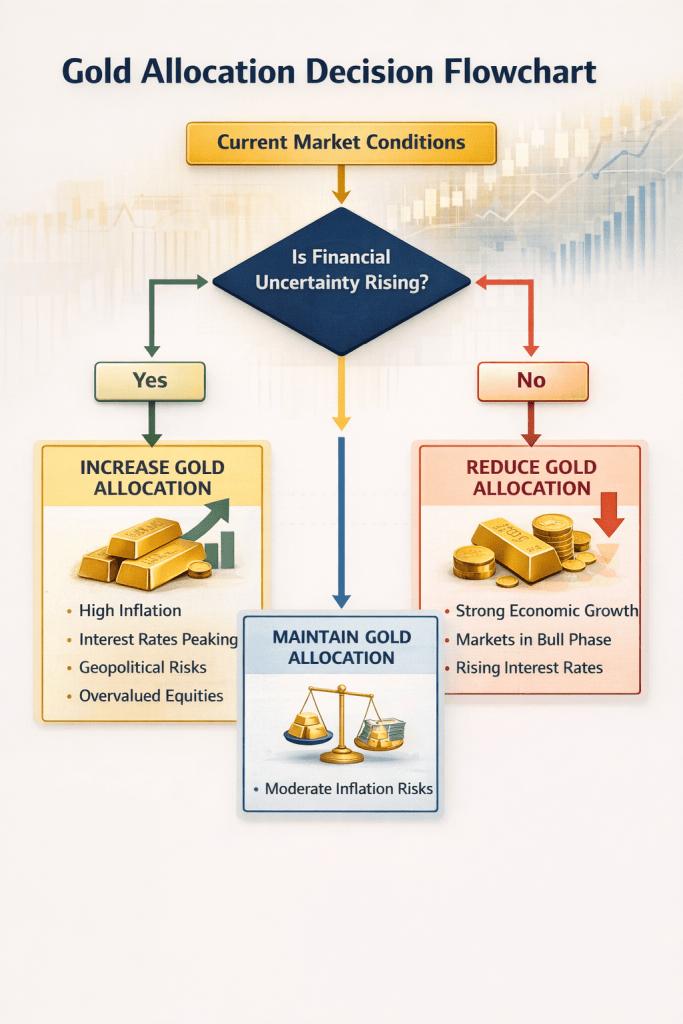
Consider increasing gold allocation when:
- Inflation is rising sharply
- Interest rates peak or begin falling
- Global uncertainty increases
- Equity valuations are very high
Gold performs best when financial uncertainty rises.
When Should You Reduce Gold Allocation?
Consider reducing gold allocation when:
- Economic growth is strong
- Equity markets are in early bull phase
- Interest rates are rising significantly
During strong bull markets, equities usually outperform gold.
Best Ways to Invest in Gold (Ranked)
1. Sovereign Gold Bonds (Best Option)
Advantages:
- No storage risk
- 2.5% annual interest income
- No capital gains tax if held till maturity
- Backed by Government of India
Best for long-term investors.
2. Gold ETFs
Advantages:
- Easy to buy and sell
- No storage risk
- Highly liquid
Best for portfolio diversification.
3. Digital Gold
Advantages:
- Convenient
- Small investment amounts possible
Disadvantage: Regulatory risks compared to ETFs and SGBs.
4. Physical Gold (Least Preferred for Investment)
Disadvantages:
- Storage cost
- Making charges
- No passive income
Best suited for jewellery, not investments.
Gold Allocation Strategy by Age
Age 20–35 (Growth Focus)
Gold Allocation: 5–10%
Focus more on equities for long-term growth.
Age 35–50 (Balanced Phase)
Gold Allocation: 8–12%
Balance between growth and safety.
Age 50+ (Capital Protection)
Gold Allocation: 10–15%
Higher gold allocation helps protect wealth.
Key Benefits Summary
Gold helps your portfolio by providing:
- Stability during volatility
- Inflation protection
- Diversification
- Crisis protection
But remember: gold is a defensive asset, not a high-growth asset.
Ideal Gold Allocation Rule (Simple Thumb Rule)
Keep 5–10% of your portfolio in gold.
Increase to 15% during uncertain times.
Avoid exceeding 20% allocation.
Conclusion
Gold is an essential component of a well-diversified portfolio, especially in uncertain economic environments like 2026. However, moderation is key.
The optimal gold allocation for most investors lies between 5% and 10%, increasing slightly during periods of high uncertainty.
Gold should act as a portfolio stabilizer—not the main growth driver.
A disciplined allocation strategy can help you achieve both stability and long-term wealth creation.

Disclaimer
This article is for educational and informational purposes only and should not be considered financial or investment advice. Investments in gold and other financial assets are subject to market risks. Investors should assess their financial situation, risk tolerance, and investment objectives before making any investment decisions. Past performance is not indicative of future results. Please consult a qualified financial advisor before investing.


Leave a Reply