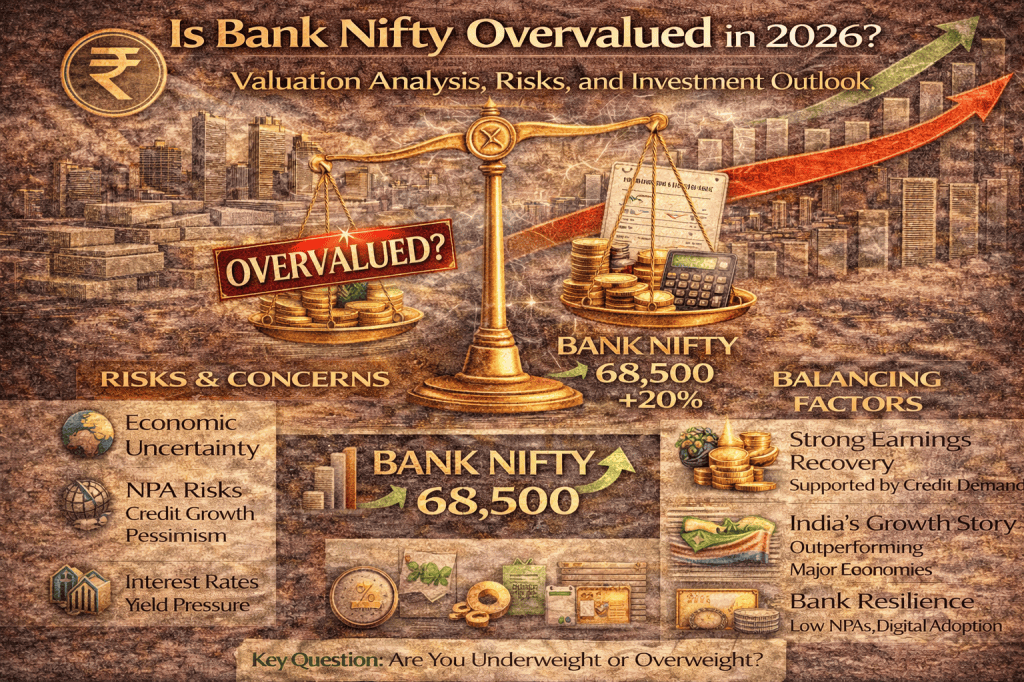
The Bank Nifty index, which represents India’s largest and most liquid banking stocks, has been one of the key drivers of the broader market rally in recent years. With strong credit growth, improving asset quality, and consistent earnings performance, banking stocks have attracted significant investor interest.
However, after a strong run, investors are now asking an important question: Is Bank Nifty overvalued, fairly valued, or still attractive for investment?
Let’s break this down using valuations, earnings trends, macroeconomic factors, and future outlook.
What is Bank Nifty and Why It Matters
Bank Nifty tracks the performance of the most liquid and large banking stocks listed on NSE, including:
- HDFC Bank
- ICICI Bank
- State Bank of India
- Kotak Mahindra Bank
- Axis Bank
- IndusInd Bank
Since banking contributes nearly 30–40% weightage in Nifty 50, Bank Nifty’s performance is crucial for the overall market direction.
Banking stocks tend to perform well when:
- Credit growth is strong
- Interest rates stabilize
- NPAs decline
- Economic growth accelerates
Current Valuation Snapshot of Bank Nifty (2026)
Valuations of banking indices are typically measured using:
- Price to Earnings (P/E) ratio
- Price to Book (P/B) ratio
- Return on Equity (ROE)
- Earnings growth outlook
Historical vs Current Valuation Comparison
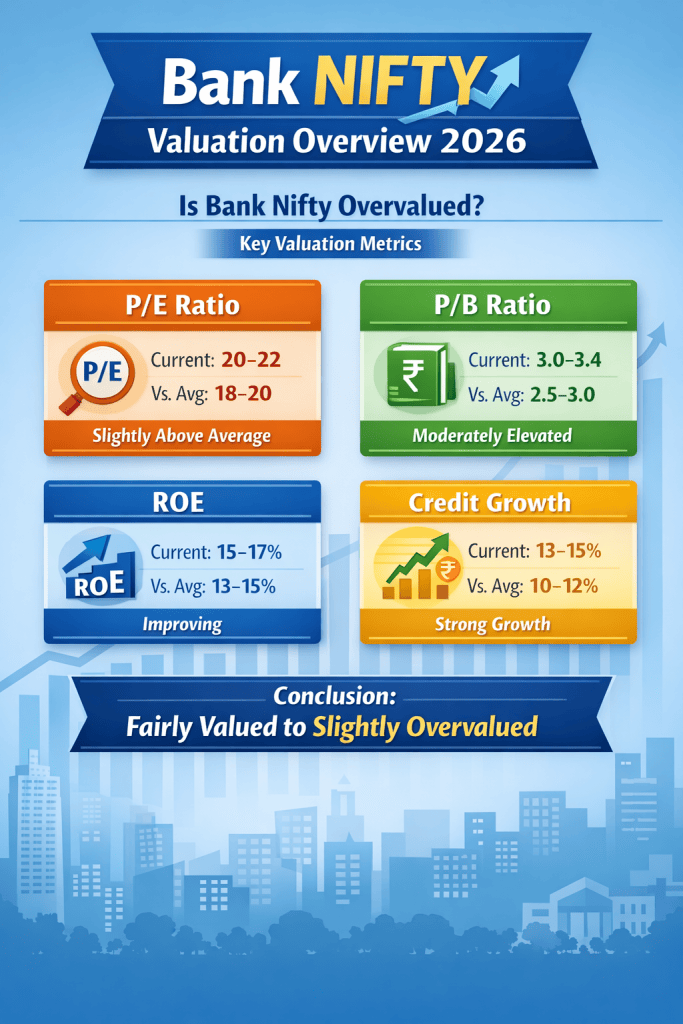
| Metric | Long-term Average | Current Estimate | Interpretation |
|---|---|---|---|
| P/E Ratio | 18–20 | 20–22 | Slightly above average |
| P/B Ratio | 2.5–3.0 | 3.0–3.4 | Moderately elevated |
| ROE | 13–15% | 15–17% | Improving |
| Credit Growth | 10–12% | 13–15% | Strong |
This suggests that Bank Nifty is not extremely overvalued, but it is trading above its historical average.
Why Bank Nifty Valuations Have Increased
1. Strong Earnings Growth
Indian banks have delivered strong earnings growth due to:
- Higher loan growth
- Improved net interest margins (NIM)
- Lower NPAs
- Better operating efficiency
Large private banks, in particular, have shown consistent profitability.
2. Improved Asset Quality
One of the biggest positives for banks has been the sharp decline in NPAs.
- Gross NPAs are near multi-year lows
- Credit costs have declined
- Balance sheets are significantly stronger
This has improved investor confidence and justified higher valuations.
3. Strong Credit Demand Cycle
India is currently in a healthy credit growth phase driven by:
- Retail loan demand
- Corporate capex cycle revival
- Infrastructure spending
- Economic growth momentum
Higher credit growth directly supports bank earnings.
4. Dominance of Private Sector Banks
Private banks like HDFC Bank and ICICI Bank now dominate the index weightage.
These banks typically command premium valuations due to:
- Better asset quality
- Higher growth visibility
- Superior management quality
Reasons for Caution: Why Bank Nifty May Be Near Fair Value
While fundamentals remain strong, some valuation risks exist.
1. Valuations Above Historical Average
Bank Nifty is trading slightly above its long-term average P/E and P/B.
This means:
- Much of the good news is already priced in
- Future returns may depend more on earnings growth than valuation expansion
2. Interest Rate Risks
If interest rates rise further:
- Loan growth may slow
- Borrowing costs may increase
- Margins could compress
Banks perform best when rates stabilize or decline.
3. Slower Earnings Growth Ahead
After a strong earnings cycle, growth may normalize.
Markets typically re-rate banks only when:
- Earnings surprise positively, or
- Credit growth accelerates further
4. Global and Macro Risks
Factors such as:
- Global recession risks
- Inflation uncertainty
- Liquidity tightening
can impact banking stocks.
Is Bank Nifty Overvalued, Fairly Valued, or Undervalued?
Based on current data and trends:
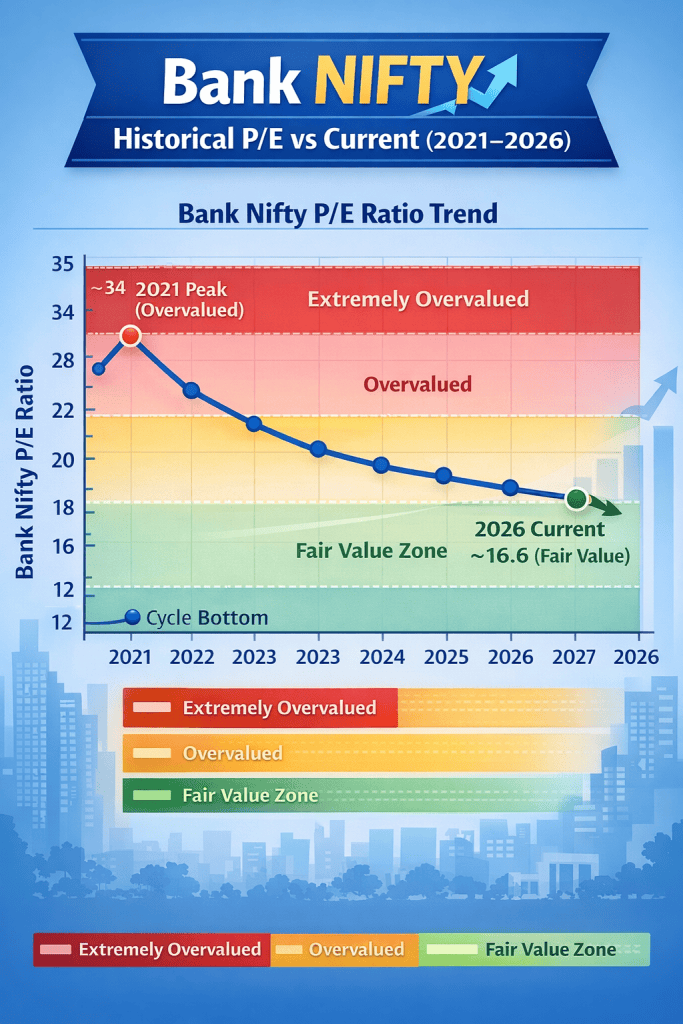
Conclusion: Bank Nifty appears fairly valued to slightly overvalued, but not in bubble territory.
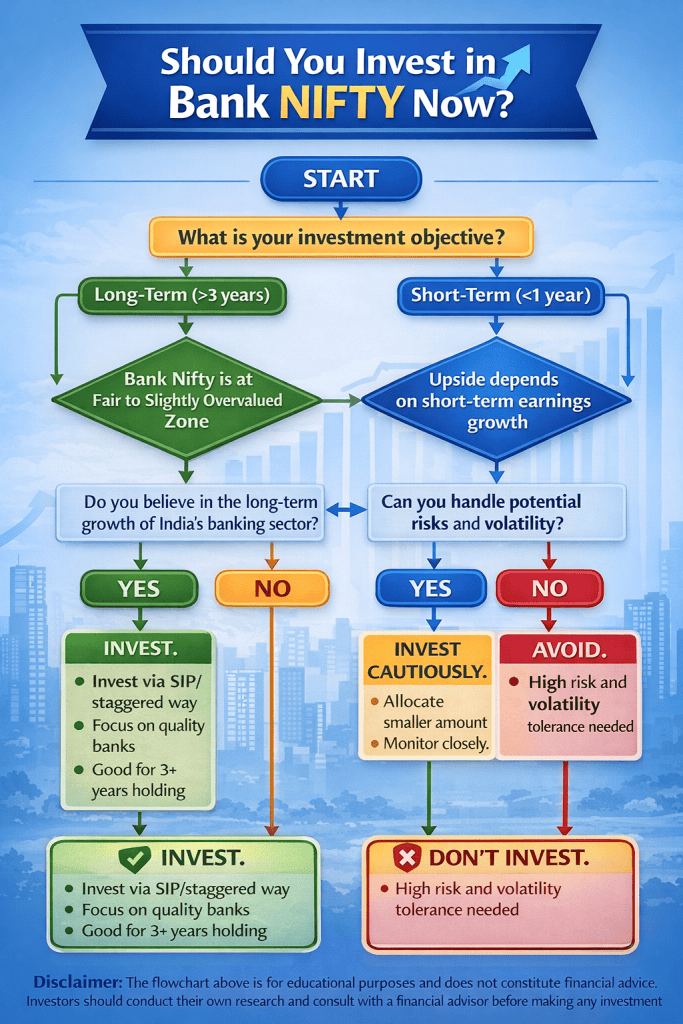
Interpretation by investor type:
Long-term investors:
Still attractive due to strong structural banking growth in India.
Short-term investors:
Upside may be limited unless earnings surprise positively.
New investors:
Consider staggered investing instead of lump sum at current levels.
Long-Term Structural Bullish Factors for Bank Nifty
India’s banking sector still has strong long-term growth drivers:
- Financialization of savings
- Rising credit penetration
- Digital banking expansion
- Strong economic growth outlook
- Increasing retail participation
These factors support long-term earnings growth.
Key Levels and Outlook for 2026
Bullish Scenario
If credit growth remains strong and rates stabilize:
- Bank Nifty can deliver steady returns
- Earnings growth will support valuations
Neutral Scenario
If earnings grow in line with expectations:
- Bank Nifty may consolidate
- Returns may be moderate
Bearish Scenario
If macro conditions worsen:
- Valuation correction is possible
- Short-term volatility may increase
Investment Strategy: What Should Investors Do Now?
Best approach:
- Avoid aggressive lump sum buying
- Prefer SIP or staggered investing
- Focus on fundamentally strong banks
- Stay invested for long term
Avoid making decisions purely based on short-term valuation concerns.
Final Verdict
Bank Nifty is not significantly overvalued, but it is no longer deeply undervalued either.
It is currently in a fair valuation zone with strong long-term growth potential, but short-term upside may be limited unless earnings exceed expectations.
Long-term investors can remain invested, while new investors should consider gradual allocation.
Disclaimer
This article is for educational and informational purposes only and should not be considered financial or investment advice. Stock market investments are subject to market risks. Valuations and outlook may change based on economic conditions, interest rates, and company performance. Investors should conduct their own research or consult a qualified financial advisor before making investment decisions.


Leave a Reply