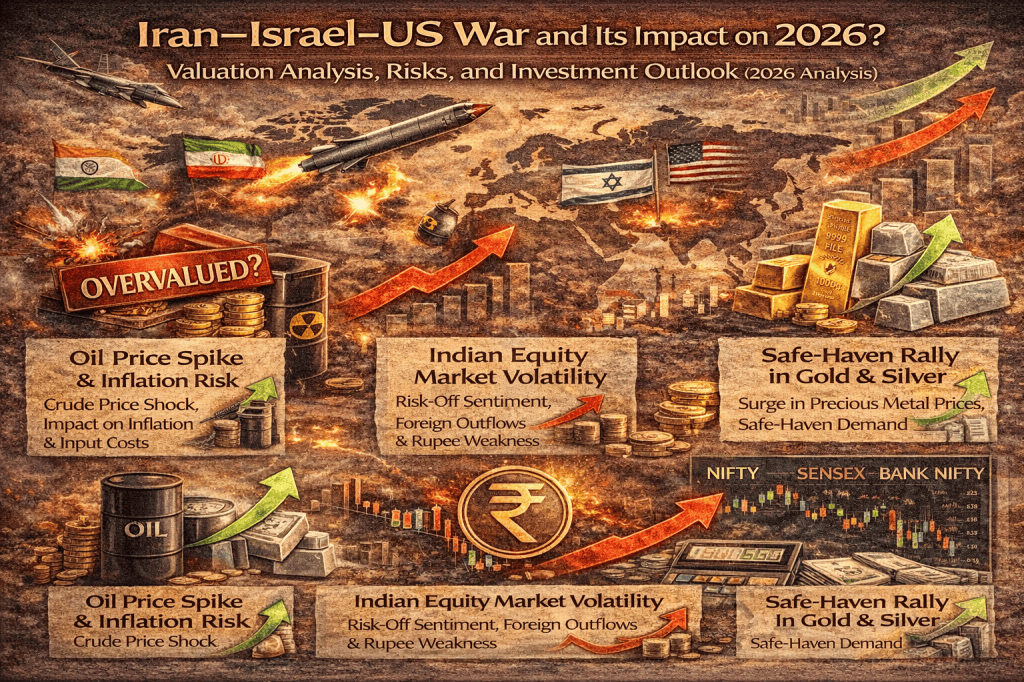
The escalation of military conflict between Iran, Israel, and the United States marks one of the most significant geopolitical developments in recent years. Joint US-Israeli strikes on Iran and subsequent retaliation have raised fears of a prolonged regional war, creating shock waves across global financial markets. (Reuters)
For investors—especially in India—this conflict has major implications for equities, commodities, currencies, and portfolio strategy. Let’s examine the situation and its investment impact in detail.
What Triggered the Current Crisis?
The conflict intensified after coordinated US and Israeli military strikes on Iran, followed by missile retaliation and heightened tensions across the Gulf region. (Reuters)
The biggest global economic risk comes from potential disruption of oil supply routes, particularly the Strait of Hormuz—through which around 20% of global oil flows. (Reuters)
This matters enormously for India because:
- Around 50% of India’s crude oil imports pass through the Strait of Hormuz (Moneycontrol)
- Oil prices could rise significantly if supply disruptions worsen (mint)
- Higher oil prices increase India’s import bill, inflation, and economic risks (Moneycontrol)
This is the key transmission channel from war → oil prices → inflation → stock markets.
Impact on Indian Stock Markets
1. Short-Term Impact: Volatility and Risk-Off Sentiment
Geopolitical conflicts create uncertainty, and uncertainty creates volatility.
Key short-term effects:
- Foreign investors often reduce exposure to emerging markets
- India VIX (volatility index) tends to rise significantly during geopolitical crises (Moneycontrol)
- Markets may correct or remain volatile in the near term
Why?
Because rising oil prices increase inflation and reduce corporate profitability.
2. Sector-Wise Impact on Indian Equities
Negative Impact Sectors
These sectors suffer when oil prices rise:
Aviation
- Fuel is 30–40% of operating costs
- Profit margins shrink
Paints, Chemicals, Plastics
- Use crude-derived raw materials
- Higher input costs reduce margins
Auto Sector
- Higher fuel prices reduce vehicle demand
Oil Marketing Companies (IOC, BPCL, HPCL)
- Face margin pressure due to delayed price pass-throughs (Moneycontrol)
Logistics and Transport
- Fuel cost increases impact profitability
Positive Impact Sectors
Some sectors benefit from rising oil prices:
Oil Producers (ONGC, Oil India)
- Higher oil prices increase realizations and profits (mint)
Defence Sector
- Increased global defence spending benefits defence companies
Commodity companies
- Higher global commodity prices support profits
3. Macro Impact on Indian Economy
If oil prices remain elevated:
- Inflation rises
- RBI may delay rate cuts
- Rupee may weaken
- Economic growth may slow slightly
For example:
- A 25% oil price rise could increase India’s import bill by $15 billion and raise inflation by 0.7%. (Moneycontrol)
This is bearish for equity markets in the medium term.
Impact on Gold: Strong Positive
Gold is the biggest beneficiary of geopolitical conflicts.
Why?
Gold is a safe-haven asset.
During war or uncertainty:
- Investors shift from stocks to gold
- Central banks increase gold buying
- Gold prices rise significantly
Experts expect gold prices to surge sharply due to the war, with potential targets as high as ₹2 lakh per 10 grams in extreme scenarios. (mint)
This makes gold one of the best hedges during geopolitical crises.
Impact on Silver: Positive but Volatile
Silver benefits from:
- Safe-haven demand (like gold)
- Industrial demand recovery
Silver prices have already surged sharply due to geopolitical uncertainty. (mint)
Some experts even see potential for silver to rise dramatically if tensions persist. (mint)
However, silver is more volatile than gold.
Impact on Debt Investments (Bonds and Fixed Income)
Debt assets benefit in geopolitical crises due to:
- Flight to safety
- Lower equity allocations
- Increased bond demand
Impact breakdown:
Government bonds: Positive
High-quality debt funds: Positive
Corporate bonds: Neutral to mildly positive
However, if inflation rises significantly, bond yields may increase over time, limiting returns.
Impact on Other Assets
Crude Oil: Biggest Winner
Oil prices may spike sharply if supply disruptions worsen.
This impacts:
- Oil companies positively
- Oil-consuming countries negatively (like India)
Currency Impact (Rupee)
Higher oil prices weaken the rupee because India imports oil.
This can create:
- FII outflows
- Market volatility
- Imported inflation
Bitcoin and Risk Assets
Unlike gold, risk assets like crypto often fall during geopolitical stress.
Investors prefer safer assets during war.
Historical Market Pattern During Wars
Typical sequence during geopolitical conflicts:
Phase 1: Shock → Market fall
Phase 2: Volatility → Sideways movement
Phase 3: Stabilisation → Market recovery
Markets eventually recover once uncertainty reduces.
What Should Indian Investors Do Now?
Recommended Strategy
Equity allocation:
Continue investing but expect volatility
Gold allocation:
Increase to 10–15% of portfolio
Debt allocation:
Maintain stable allocation
Avoid panic selling
Focus on long-term investing
Long-Term Outlook: Temporary Shock, Not Structural Damage
India’s long-term equity outlook remains intact because:
- Strong domestic growth
- Strong domestic investor flows
- Structural economic growth
Geopolitical shocks typically cause temporary volatility—not permanent damage.
Final Investment Summary Table
| Asset Class | Impact | Outlook |
|---|---|---|
| Equities | Negative short-term | Positive long-term |
| Gold | Strong positive | Bullish |
| Silver | Positive but volatile | Bullish |
| Debt | Stable to positive | Defensive |
| Oil | Strong positive | Bullish |
| Rupee | Negative | Weak bias |
Conclusion
The Iran–Israel–US conflict is a major geopolitical risk that primarily impacts markets through oil prices and investor sentiment. Indian stock markets may see short-term volatility, but the long-term structural growth story remains intact.
Gold and silver are likely to benefit the most, while equity markets may face temporary pressure. Investors should remain calm, diversified, and focused on long-term goals rather than reacting emotionally to short-term geopolitical events.
Disclaimer
This article is for educational and informational purposes only and should not be considered financial or investment advice. Market investments are subject to risks, including geopolitical, economic, and market risks. Investors should consult a qualified financial advisor before making investment decisions. Past performance is not indicative of future results.


Leave a Reply