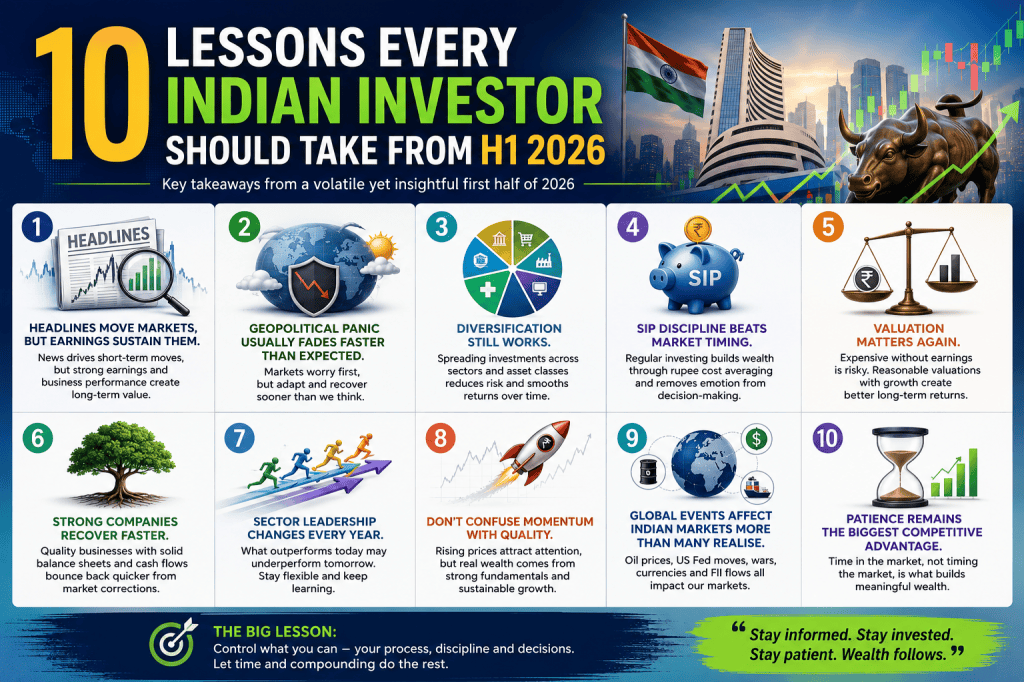
The first half of 2026 was anything but ordinary for Indian investors.
Markets navigated a complex mix of geopolitical tensions, volatile crude oil prices, changing expectations around global interest rates, corporate earnings, foreign institutional investor (FII) flows, and shifting sector leadership. There were days when optimism drove benchmark indices to new highs, and days when uncertainty erased weeks of gains in a single session.
Yet, beneath all the headlines, one truth remained unchanged: successful investing is built on discipline rather than prediction.
The first six months of 2026 offered several valuable lessons that every investor—whether a beginner or an experienced market participant—should carry forward. Here are ten of the most important ones.
1. Headlines Move Markets, But Earnings Sustain Them
One of the biggest takeaways from H1 2026 was the difference between short-term excitement and long-term value.
Markets reacted instantly to every major headline—whether it was geopolitical developments, crude oil movements, inflation data or central bank commentary. Stock prices often moved sharply within hours of breaking news.
However, these reactions rarely lasted unless they were supported by improving business performance.
Companies that consistently delivered strong quarterly results, maintained healthy margins and provided optimistic business guidance generally recovered from corrections much faster than those with weak fundamentals.
For long-term investors, this reinforces an important principle: while headlines influence sentiment, earnings determine value.
2. Geopolitical Panic Usually Fades Faster Than Expected
The first half of 2026 once again demonstrated how quickly markets respond to geopolitical uncertainty.
Conflicts in West Asia, concerns over global energy supplies and fears surrounding international trade routes triggered bouts of volatility. Investors worried about higher inflation, rising crude oil prices and slowing global growth.
History, however, shows that markets often adapt more quickly than expected.
While geopolitical events should never be ignored, investors should avoid making emotional decisions solely because of alarming headlines. In many cases, markets recover well before the uncertainty completely disappears.
The key is to distinguish between temporary disruptions and long-term structural changes.
3. Diversification Still Works
Every sector did not perform equally during H1 2026.
While some industries benefited from strong earnings and favourable market conditions, others faced pressure from slowing demand, global uncertainties or stretched valuations.
Investors who spread their investments across multiple sectors and asset classes generally experienced smoother portfolio performance than those heavily concentrated in one theme.
Diversification does not eliminate risk.
Instead, it reduces the impact of unexpected events affecting any single sector or company.
It remains one of the simplest and most effective risk management strategies available to retail investors.
4. SIP Discipline Beats Market Timing
One of the biggest mistakes investors continue to make is trying to predict every market top and bottom.
H1 2026 reminded us how difficult that is.
Markets experienced sharp rallies, sudden corrections and equally rapid recoveries. Investors waiting for the “perfect” entry often found themselves buying at higher prices later—or not investing at all.
Systematic Investment Plans (SIPs) remove much of this emotional decision-making.
By investing regularly regardless of market conditions, investors benefit from rupee-cost averaging and reduce the stress of timing the market.
Consistency often proves more rewarding than perfect timing.
5. Valuation Matters Again
Not every company deserves an expensive valuation.
One encouraging trend during H1 2026 was that investors became more selective. Stocks trading at stretched valuations without corresponding earnings growth often corrected sharply, while fundamentally strong businesses attracted fresh buying after reasonable declines.
This shift indicates a healthier market environment.
Paying attention to valuation metrics alongside business quality can help investors avoid overpaying for future growth.
A great company purchased at an unreasonable price may still produce disappointing returns.
6. Strong Companies Recover Faster
Market corrections affect almost every stock in the short term.
However, the speed of recovery often depends on the quality of the underlying business.
Companies with strong balance sheets, reliable cash flows, capable management teams and consistent earnings generally regained investor confidence more quickly than weaker peers.
Temporary price declines do not necessarily indicate permanent business problems.
Long-term investors should focus on whether the company’s competitive position remains intact rather than reacting to short-term price movements.
7. Sector Leadership Changes Every Year
Many investors assume that yesterday’s winning sector will continue outperforming indefinitely.
H1 2026 challenged that belief.
Leadership shifted across different parts of the market as economic conditions evolved. Banking, defence, pharmaceuticals, metals, information technology and consumer-related sectors all experienced varying phases of strength and weakness.
Successful investing requires flexibility.
Rather than chasing sectors after they have already delivered exceptional returns, investors should understand the underlying business cycle and valuation environment.
Markets reward adaptability.
8. Don’t Confuse Momentum with Quality
A rapidly rising stock is not always a fundamentally strong business.
During periods of optimism, momentum often attracts more buyers simply because prices are already increasing. However, momentum without earnings growth or improving business fundamentals can reverse quickly.
Quality companies create value through consistent execution, prudent capital allocation and sustainable profitability—not merely through short-term price appreciation.
Before investing, ask an important question:
Is the business improving, or is only the share price rising?
That distinction can make a significant difference over the long term.
9. Global Events Affect Indian Markets More Than Many Investors Realise
Although India remains one of the world’s fastest-growing major economies, it does not operate in isolation.
Events taking place thousands of kilometres away can influence domestic markets through multiple channels.
Changes in crude oil prices, US Federal Reserve policy, global inflation trends, international conflicts, currency movements and foreign investment flows all shape investor sentiment in India.
Understanding these connections helps investors interpret market movements more objectively.
At the same time, it is equally important not to overreact to every global headline. Long-term investing requires balancing awareness with perspective.
10. Patience Remains the Biggest Competitive Advantage
Perhaps the greatest lesson from H1 2026 has nothing to do with economics or finance.
It is about behaviour.
Markets will always experience uncertainty.
There will always be reasons to worry—whether inflation, elections, wars, interest rates or global recessions.
Investors who remain patient, continue investing systematically, and focus on business quality rather than daily price fluctuations are often rewarded over time.
Patience is difficult because it rarely feels productive.
Yet history repeatedly shows that disciplined investors who stay invested through volatility generally outperform those constantly reacting to short-term market movements.
Final Thoughts
The first half of 2026 reminded us that investing is not about predicting every market movement.
It is about making sound decisions despite uncertainty.
Markets will continue reacting to headlines, earnings seasons, geopolitical developments and economic data. Those factors are unavoidable.
What investors can control is their own approach.
By focusing on business fundamentals, maintaining diversification, investing consistently, paying attention to valuations and exercising patience, investors can navigate both rising and falling markets with greater confidence.
Ultimately, the biggest lesson from H1 2026 is simple:
Successful investing is less about forecasting the future and more about following a disciplined process, regardless of what the headlines say.
Disclaimer: This article is for educational and informational purposes only and should not be considered investment advice. Investors should conduct their own research and consult a qualified financial advisor before making investment decisions.
Please read the previous articles related to the above topic: Indian Stock Market in H1 2026: What the First Six Months Taught Every Investor and Winners & Laggards of H1 2026.


Leave a Reply