The first half of 2026 reminded investors that markets rarely move in a straight line.
Indian equities navigated geopolitical conflicts, fluctuating crude oil prices, shifting foreign investment flows, quarterly earnings surprises and changing expectations around global interest rates. Despite these challenges, the broader market remained resilient, supported by strong domestic participation and the long-term growth story of the Indian economy.
As we enter the second half of 2026, investors face an important question:
What could shape the Indian stock market over the next six months?
While nobody can predict market movements with certainty, several key factors deserve close attention. Understanding these drivers can help investors make informed decisions instead of reacting emotionally to daily headlines.
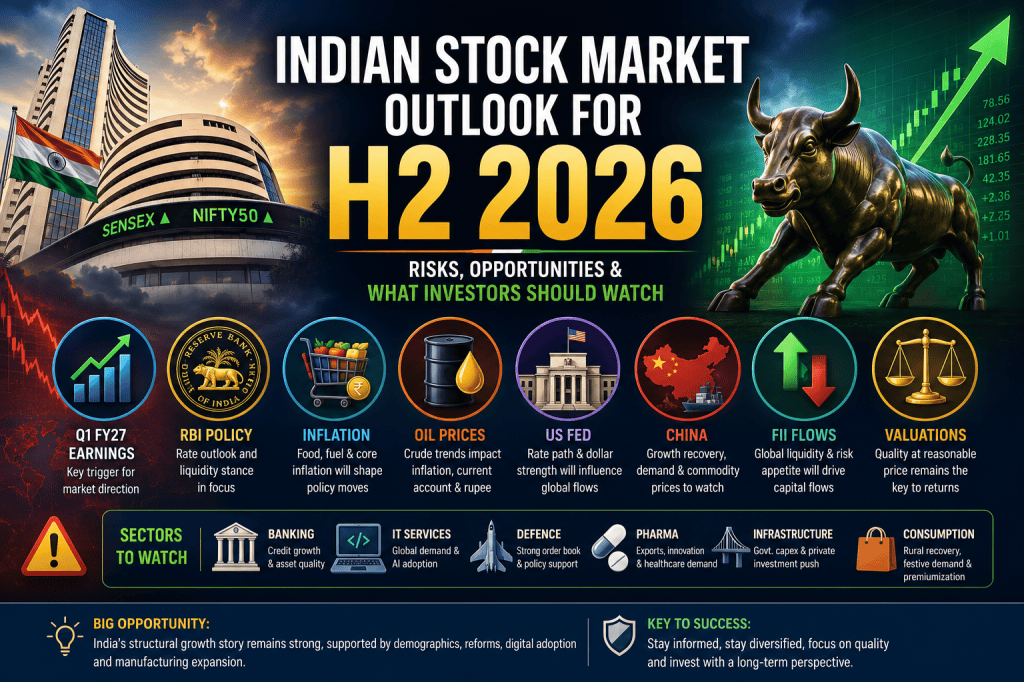
1. Q1 FY27 Earnings: The Most Important Short-Term Trigger
If there is one factor likely to influence the market immediately, it is the Q1 FY27 earnings season.
Markets have already priced in expectations for many companies. The question now is whether businesses can justify those expectations through stronger revenue growth, expanding profit margins and positive management guidance.
Investors should pay attention not only to headline profit numbers but also to:
- Revenue growth
- Operating margins
- Order book strength
- Future guidance
- Capital expenditure plans
- Management commentary
A company delivering good results but cautious guidance may still disappoint investors, while optimistic commentary can sometimes outweigh a small earnings miss.
Ultimately, earnings remain the strongest long-term driver of stock prices.
2. RBI Policy: The Interest Rate Balancing Act
The Reserve Bank of India (RBI) will continue balancing two important objectives:
- Supporting economic growth.
- Keeping inflation under control.
If inflation remains comfortable, the RBI may have greater flexibility to maintain an accommodative stance or consider further policy support.
However, any resurgence in inflation could force policymakers to remain cautious.
Interest rate decisions directly affect:
- Banking profitability
- Housing demand
- Automobile sales
- Corporate borrowing costs
- Consumer spending
Markets generally prefer policy stability over unexpected surprises.
3. Inflation: The Silent Market Driver
Inflation rarely dominates headlines for long, but it quietly influences almost every part of the economy.
Higher inflation can:
- Reduce household purchasing power.
- Increase corporate costs.
- Delay interest rate cuts.
- Weaken consumer demand.
On the other hand, stable inflation creates a healthier environment for businesses, consumers and financial markets.
Investors should monitor food inflation, fuel prices and core inflation trends rather than focusing on a single monthly data point.
4. Crude Oil Prices: India’s Biggest External Risk
India imports a significant portion of its crude oil requirements.
Because of this, oil prices remain one of the most important external variables for Indian markets.
A sustained increase in crude oil prices can lead to:
- Higher inflation
- Increased import bills
- Pressure on the rupee
- Lower corporate margins
- Reduced consumer spending
Conversely, stable or declining oil prices provide relief to businesses, consumers and policymakers.
While short-term fluctuations are common, investors should focus on whether oil prices remain elevated over an extended period.
5. US Federal Reserve: Why It Still Matters
Although the US Federal Reserve sets monetary policy for the United States, its decisions often influence financial markets around the world.
Changes in US interest rates affect:
- Global liquidity
- Dollar strength
- Emerging market capital flows
- Investor risk appetite
If the Fed maintains a stable policy environment, emerging markets such as India could continue attracting foreign investment.
Unexpected policy tightening, however, could increase market volatility worldwide.
Indian investors should therefore follow not only RBI announcements but also developments from the US Federal Reserve.
6. China: A Global Factor Investors Cannot Ignore
China remains one of the world’s largest economies and a major consumer of industrial commodities.
Any significant improvement or slowdown in Chinese economic activity can influence:
- Metal prices
- Global manufacturing
- Supply chains
- Export-oriented industries
For Indian investors, China’s performance is particularly relevant for sectors such as:
- Metals
- Chemicals
- Engineering
- Capital goods
Rather than viewing China only as a competitor, investors should recognise its broader influence on global economic activity.
7. FII Flows: Watching Global Capital
Foreign Institutional Investors (FIIs) continued playing an important role during H1 2026, although domestic investors increasingly helped stabilise the market.
Strong FII inflows generally improve market sentiment.
Persistent selling, on the other hand, can create short-term volatility even when domestic fundamentals remain healthy.
However, one structural change has become increasingly evident:
Domestic Institutional Investors (DIIs) and Systematic Investment Plans (SIPs) now provide meaningful support during periods of foreign selling.
This growing domestic participation has made Indian markets more resilient than in previous decades.
8. Valuations: Quality Still Comes at a Price
One encouraging trend during H1 2026 was that valuation discipline returned to the market.
Investors became less willing to pay premium prices for companies without corresponding earnings growth.
As H2 begins, investors should continue asking two important questions:
- Is earnings growth supporting the valuation?
- Are future expectations already reflected in the share price?
Buying excellent businesses remains important.
Buying them at reasonable valuations is equally important.
9. Sectors to Watch in H2 2026
Rather than focusing only on individual stocks, investors should observe broader sector trends.
Banking
Healthy credit growth and stable asset quality continue supporting the sector.
Information Technology
The pace of global technology spending and AI adoption will remain key drivers.
Defence
Government spending, order inflows and export opportunities continue attracting investor interest.
Pharmaceuticals
Healthcare demand and export markets could support long-term growth.
Infrastructure & Capital Goods
Government capital expenditure and private investment remain important catalysts.
Consumption
Festive demand, rural recovery and inflation trends will determine performance across consumer-focused businesses.
Instead of chasing whichever sector performed best in H1, investors should monitor where earnings and valuations are improving.
10. The Biggest Opportunity: India’s Structural Growth Story
Despite global uncertainties, India’s long-term investment story remains supported by several structural strengths:
- Expanding infrastructure
- Rising digital adoption
- Manufacturing growth
- Increasing financial inclusion
- Strong domestic consumption
- Growing retail investor participation
These factors do not eliminate short-term volatility.
However, they provide a strong foundation that continues attracting long-term capital.
Investors should remember that structural trends often matter more than temporary market noise.
Risks That Investors Should Not Ignore
While the long-term outlook remains constructive, several risks deserve monitoring:
- Escalation of geopolitical conflicts.
- A sharp rise in crude oil prices.
- Higher-than-expected inflation.
- Slower global economic growth.
- Weak corporate earnings.
- Unexpected central bank policy changes.
- Rich valuations in certain sectors.
None of these risks necessarily signals a market downturn.
However, being aware of them helps investors prepare rather than panic.
Final Thoughts
The second half of 2026 is unlikely to be driven by a single event.
Instead, markets will respond to a combination of earnings, economic data, central bank decisions, global developments and investor sentiment.
For long-term investors, the objective should not be predicting every market movement.
It should be understanding the forces that influence those movements while staying focused on quality businesses, sensible valuations and disciplined investing.
If H1 2026 taught investors the importance of resilience, H2 2026 may well test their ability to remain patient, selective and informed.
Regardless of short-term volatility, those qualities are often the strongest foundation for long-term wealth creation.
Disclaimer: This article is for educational and informational purposes only and should not be considered investment advice. Investors should conduct their own research and consult a qualified financial advisor before making investment decisions.
Please also read the previous articles related to this topic: Indian Stock Market in H1 2026: What the First Six Months Taught Every Investor, Winners & Laggards of H1 2026, and 10 Lessons Every Indian Investor Should Take from H1 2026.


Leave a Reply