The Indian IT sector entered FY27 amid significant uncertainty. Clients across the globe remained cautious about discretionary technology spending, geopolitical tensions continued to cloud business confidence, and concerns over artificial intelligence disrupting traditional IT services persisted.
Against this backdrop, Tata Consultancy Services (TCS), India’s largest IT services company, delivered a surprisingly encouraging set of Q1 FY27 results. While the quarter was not perfect, it contained several positive signals that suggest the worst may be behind the sector.
From stronger-than-expected revenue growth and steady profitability to robust hiring, stable attrition, growing AI business, and optimistic management commentary, TCS has given investors plenty to analyse.
Let’s understand everything in detail.
Financial Performance: A Strong Start to FY27
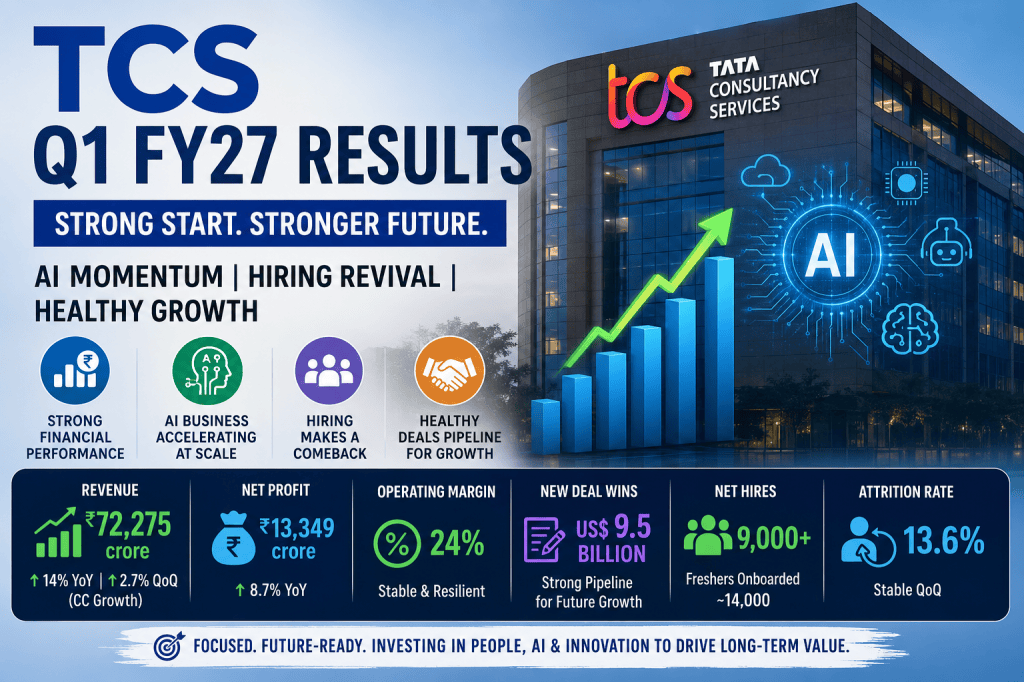
TCS reported revenue of ₹72,275 crore, registering nearly 14% year-on-year growth, while revenue in dollar terms grew about 2.7% YoY despite global headwinds.
Net profit increased to ₹13,349 crore, reflecting healthy earnings growth despite certain exceptional costs during the quarter.
Operating margin remained around 24%, demonstrating that TCS continues to manage costs effectively even after implementing annual salary hikes.
Another encouraging sign was cash generation.
The company converted almost 93% of its net profit into operating cash flow, highlighting the quality of earnings and strong financial discipline.
Banking and Financial Services Continue to Lead Growth
One of the biggest positives was the continued strength of the Banking, Financial Services and Insurance (BFSI) segment.
Large global banks continued investing in:
- Core banking modernization
- Digital transformation
- Cloud migration
- Cybersecurity
- AI-driven automation
Since BFSI contributes the largest share of TCS revenue, sustained spending from this vertical provides stability even when other industries remain cautious.
AI Is Becoming a Real Revenue Driver
Artificial Intelligence was one of the biggest highlights of the quarter.
Rather than treating AI merely as a future opportunity, TCS reported that its annualised AI business has grown further, with enterprises increasingly adopting:
- Generative AI
- AI-powered customer support
- Intelligent automation
- AI coding assistants
- Data modernization
- Enterprise AI platforms
Management stated that AI is now becoming embedded into larger transformation deals instead of remaining isolated pilot projects.
This is particularly encouraging because investors have been worried that AI could reduce IT outsourcing demand.
Instead, TCS is demonstrating that AI is creating new consulting and implementation opportunities.
Large Deal Wins Remain Healthy
TCS reported new deal wins worth approximately US$9.5 billion during Q1 FY27.
Although this was lower than the exceptionally strong previous quarter, it still represents a healthy order pipeline.
Importantly, the quality of deals appears encouraging.
Many new contracts involve:
- AI transformation
- Cloud migration
- Digital engineering
- Enterprise modernization
- Banking transformation
- Data platforms
Large multi-year contracts improve future revenue visibility and strengthen earnings predictability.
Hiring Makes a Strong Comeback
Perhaps the biggest surprise came from hiring.
TCS added over 9,000 employees during the quarter—the strongest quarterly net addition in several years—and onboarded around 14,000 freshers.
This is significant because hiring is often viewed as a leading indicator of management confidence.
Companies generally increase recruitment only when they expect future demand to remain healthy.
The hiring revival suggests TCS believes client spending may gradually improve over the coming quarters.
Attrition Remains Under Control
Employee attrition remained around 13.6%, broadly stable compared to recent quarters.
This is good news for multiple reasons:
- Lower replacement costs
- Better project continuity
- Higher productivity
- Improved customer satisfaction
- Reduced recruitment pressure
During the post-pandemic hiring boom, attrition had crossed 20% across much of the industry.
Today’s levels indicate the labour market has largely normalised.
Salary Hikes Continue
Despite global uncertainty, TCS implemented annual salary hikes effective from April.
While wage revisions temporarily impacted margins, management remains confident about protecting profitability through:
- Better utilisation
- Operational efficiency
- Automation
- AI productivity improvements
- Higher-value services
This reflects management’s long-term confidence rather than focusing only on short-term cost reduction.
Management Guidance Remains Optimistic
Perhaps the most encouraging aspect of the results was management commentary.
According to the leadership:
- BFSI demand remains healthy.
- Manufacturing is showing signs of recovery.
- Life Sciences spending is gradually improving.
- AI demand continues to accelerate.
- Enterprises are moving from AI experimentation to large-scale implementation.
- The deal pipeline remains healthy.
Although macroeconomic uncertainty still exists, management sounded considerably more optimistic than many market participants had expected.
Challenges Still Remain
Despite the positive quarter, investors should not ignore the risks.
1. Global Economic Uncertainty
Interest rates remain elevated in several developed economies.
Many companies are still cautious about discretionary IT spending.
2. Geopolitical Risks
Trade tensions and geopolitical conflicts could delay technology investments by global clients.
3. AI Disruption
While AI creates opportunities, it may also reduce demand for certain traditional outsourcing services over the long term.
TCS must continue evolving its service portfolio to stay ahead.
4. Margin Pressure
Salary hikes, pricing competition, and investments in AI capabilities could continue putting pressure on operating margins.
What Does This Mean for Investors?
The biggest takeaway from Q1 FY27 is that TCS appears to be entering FY27 from a position of strength.
Positive indicators include:
- Strong revenue growth
- Stable profitability
- Healthy cash generation
- Strong BFSI demand
- AI-led transformation opportunities
- Large deal wins
- Robust hiring
- Stable attrition
- Positive management commentary
These signals suggest that the Indian IT sector may gradually recover if global economic conditions improve during the second half of FY27.
While investors should remain cautious about macroeconomic risks, TCS continues to demonstrate why it remains one of India’s highest-quality businesses with strong execution capabilities and long-term growth potential.
Final Thoughts
TCS has once again shown why it is often regarded as the bellwether of India’s IT industry.
The company’s Q1 FY27 results were not just about higher profits—they reflected resilience, operational discipline, continued client confidence, growing AI adoption, and management’s willingness to invest in future growth through hiring and innovation.
Although challenges remain, the quarter provides encouraging evidence that India’s largest IT company is adapting successfully to a rapidly changing technology landscape.
For long-term investors, the focus should remain on execution, deal conversions, AI monetisation, margin sustainability, and global demand trends over the coming quarters.
Disclaimer: This article is for educational and informational purposes only and should not be construed as investment advice. Investors should conduct their own research or consult a qualified financial advisor before making any investment decisions.


Leave a Reply