Introduction
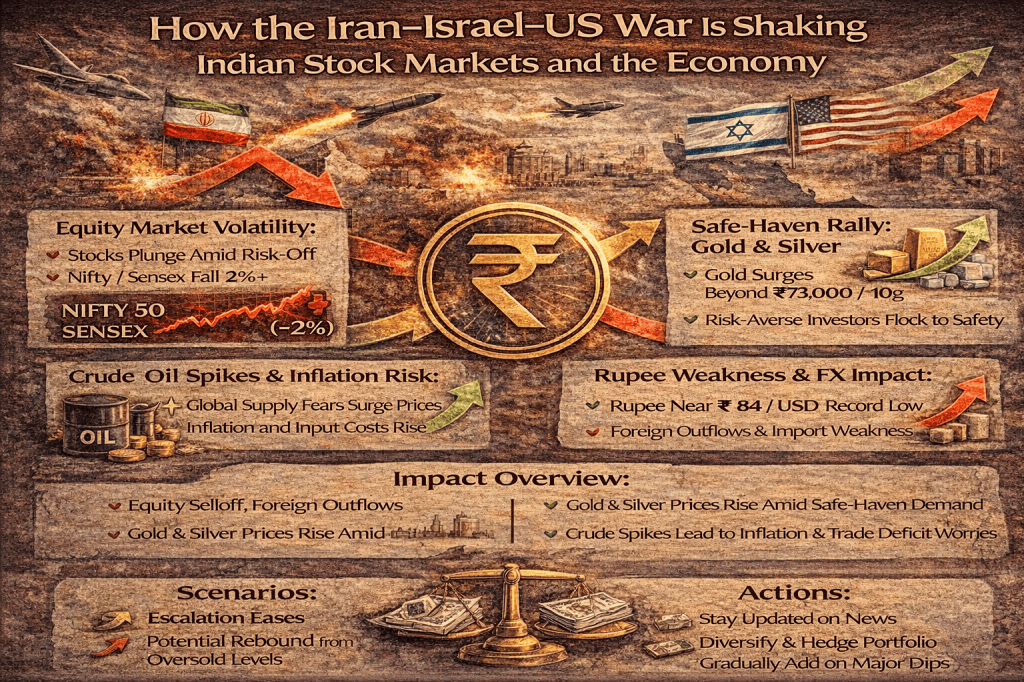
The escalating war involving Iran, Israel, and the United States has created profound ripples in global financial markets — and India is no exception. What might seem like a distant geopolitical conflict has quickly turned into a key driver of volatility for Indian equities, currency markets, inflation expectations and economic growth prospects. (The Economic Times)
1. Indian Stock Markets Under Intense Pressure
Indian markets have reacted sharply to rising geopolitical tensions:
- Major indices plunged: The BSE Sensex and Nifty 50 both fell over 2%, wiping out significant market capitalization in a very short period as risk-off sentiment intensified. (Outlook Business)
- Capital markets & sector stocks under pressure: Shares linked to capital market infrastructure and financial services saw declines of up to 4%. (Moneycontrol)
- Safe-haven flows increased: Investors flocked to gold and other defensive assets amid heightened uncertainty. (mint)
Overall, equity markets have entered a volatile phase, reacting not just to headlines but to concerns of broader economic stress. (The Times of India)
2. Crude Oil Prices: The Main Transmission Channel
One of the key transmission mechanisms from the Middle East conflict to the Indian economy and markets is crude oil prices:
- The ongoing conflict has pushed oil to multi-month highs, driven by fears of supply disruptions via the Strait of Hormuz, a strategic transit route for much of the world’s crude. (Moneycontrol)
- Higher crude prices inflate India’s import bill and place upward pressure on inflation. (The Economic Times)
- As India imports more than 85% of its fuel needs, rising oil costs have direct implications for corporate earnings, consumer prices, and fiscal balances. (Moneycontrol)
This surge in energy costs is one of the primary reasons equity volatility has accelerated and economic headwinds have emerged.
3. Rupee Weakness and Capital Flows
The Indian rupee has weakened significantly against the US dollar, reaching fresh lows amid the conflict:
- A weaker rupee increases the cost of imports, especially crude oil, and can feed into inflation. (The Economic Times)
- Foreign institutional investor (FII) flows have cooled as global investors move into safer assets, contributing to selling pressure in Indian equities. (Business Standard)
These capital flow dynamics reduce liquidity in Indian markets and amplify equity sell-offs.
4. Broader Economic Impacts
The war’s influence extends beyond markets to the wider Indian economy:
- Inflation and current account strain: Higher fuel costs can widen the current account deficit and stoke inflation, complicating the Reserve Bank of India’s policy task. (Fortune India)
- Investment sentiment: Ratings and research agencies have warned that geopolitical uncertainty could discourage investment into India, offsetting gains from trade deals and slowing growth momentum. (The Economic Times)
- Sectoral Growth Challenges: Indian IT services and export sectors that depend on Middle Eastern clients face slower spending growth, while logistics and energy costs continue to rise. (The Economic Times)
The conflict’s multidimensional impacts mean risks are not limited to the financial markets alone — underlying economic indicators are also under pressure.
5. What Investors and Policymakers Are Watching
Key variables to watch moving forward include:
- Oil price trajectories — A sustained breakout could trigger deeper inflation and balance-of-payments stress. (The Economic Times)
- Global risk sentiment — Rallying safe-haven flows and volatility can extend equity market weakness. (mint)
- Capital inflows/outflows — Continued foreign selling could amplify market volatility. (Business Standard)
Market participants should prepare for ongoing uncertainty until geopolitical tensions ease or clear risk-mitigating developments occur.
Conclusion
The Iran–Israel–US war has demonstrated how interconnected global geopolitics and domestic financial systems have become. While India is not directly involved in the conflict, its dependence on energy imports, integration with global capital markets, and macroeconomic structure make it susceptible to spillover effects. From stock market sell-offs to inflationary pressures and investment sentiment shifts, the fallout is shaping up to be broad and multifaceted.
For both investors and policymakers, monitoring geopolitical risk alongside traditional economic indicators will be crucial in navigating this turbulent period.
Disclaimer
The content above is for informational and educational purposes only. It does not constitute financial, investment, or economic advice. Readers should conduct their own research or consult with a qualified financial advisor before making any investment or economic decisions.


Leave a Reply