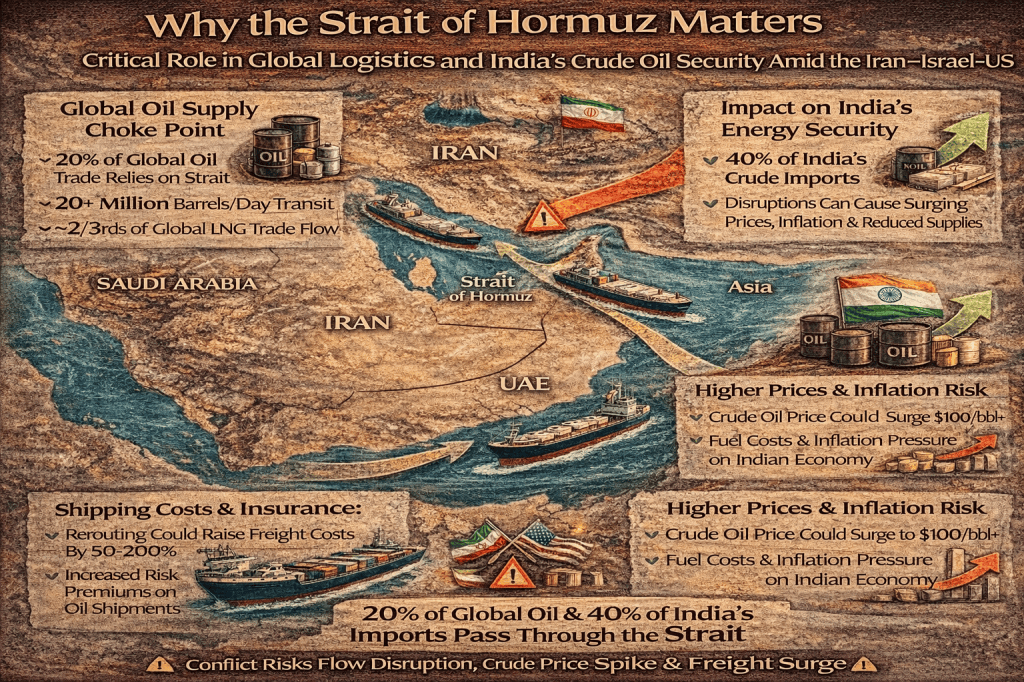
The Strait of Hormuz — a narrow waterway between Iran and Oman — is one of the most strategically significant maritime chokepoints in the world. Despite spanning only about 33 km at its narrowest, this passage is a lifeline for global energy trade and international logistics, making its stability essential for global markets. Any escalation in regional conflicts, especially the ongoing Iran–Israel–US war, underscores its importance and the potential risks to economies heavily dependent on these routes like India. (The Economic Times)
🌍 Strategic Importance of the Strait of Hormuz in Global Logistics
🚢 Oil and Energy Flow:
Around 20 % of the world’s total petroleum liquids and about one-fifth of global LNG trade passes through the Strait of Hormuz every day. This includes crude oil, condensates, LPG and LNG heading from the Persian Gulf to markets in Asia, Europe and beyond. (The Economic Times)
⛴️ Global Supply Chain Artery:
The strait connects the Persian Gulf to the Arabian Sea and the Indian Ocean, making it the shortest sea route for major oil-exporting nations such as Saudi Arabia, Iraq, Kuwait, the UAE and Qatar. Its closure or disruption instantly reverberates across global energy markets because there is no viable direct maritime alternative. (Business Standard)
📦 Beyond Energy:
While oil is dominant, the strait’s disruptions also affect container shipping, bulk commodities and even air freight flows when regional airspace closes, as seen in recent conflict escalations. This can delay deliveries, increase freight costs and strain international supply chains. (AP News)
🇮🇳 Significance for Indian Crude Oil Imports
🛢️ Heavy Dependence on Middle East Oil:
India imports over 80 % of its crude oil requirements, making energy security a core economic concern. A substantial portion — estimates range from 35 % to nearly 50 % of India’s crude oil imports — transit through the Strait of Hormuz. These are mainly shipments from West Asian producers such as Iraq, Saudi Arabia, Kuwait and the UAE. (The Economic Times)
📈 Impact on Import Costs:
Any threat to the uninterrupted flow — even the perception of risk — can cause a “geopolitical risk premium” to be priced into crude markets. This leads to higher Brent crude prices, increased freight and insurance costs, and eventually a higher import bill for India’s refiners and consumers alike. (Business Today)
💼 Downstream Effects:
Increased crude oil costs influence the broader Indian economy by driving up fuel prices, transportation costs, inflation, and pressure on the current account balance. Significant disruptions can also affect non-oil exports, especially to markets dependent on Gulf shipping routes. (The Financial Express)
📦 Trade and Logistics:
Shipping delays due to heightened risks or closure of Gulf ports can also impact Indian exports of goods such as engineering products, chemicals, pharmaceuticals and agricultural items, increasing delivery times and logistics costs. (India Business Trade)
🔥 Impact of the Iran–Israel–US Conflict on Indian Economy and Energy Security
📊 Escalating Geopolitical Risks:
The current conflict involving Iran, Israel and the United States has brought renewed fears of disruption in the Strait of Hormuz. Iran has at times threatened closure or hostile action against vessels in the strait, which has already raised premiums on crude prices and global energy risk metrics. (The Guardian)
💹 Energy Price Volatility:
Heightened conflict has already led to swings in global oil markets, with prices jumping as supply risks intensify. Analysts warn that a prolonged or widening conflict could push global crude prices significantly higher, which directly increases India’s import bill and indirectly influences inflation and currency value. (Business Standard)
📉 Market and Economic Reaction:
Recent market responses include stock market declines, weakening currency (rupee), and investor flight toward safe-haven assets, reflecting broader economic uncertainty linked to regional instability. (Reuters)
🧠 Strategic Mitigations:
To ease dependence, India has sought alternative options such as routing some oil through pipelines that bypass Hormuz (e.g., Saudi and UAE pipeline exits), diversifying suppliers, and maintaining strategic petroleum reserves to buffer short-term disruptions. However, these measures may add costs and require time to fully operationalize. (NDTV India)
📌 Key Takeaways
- The Strait of Hormuz is a critical global logistics and energy artery, central to global economic stability and energy security. (The Economic Times)
- India’s energy security is deeply linked to this chokepoint, with up to half of its crude imports transiting through it. (Business Today)
- Regional conflicts, especially the current Iran–Israel–US confrontation, threaten to disrupt this passage, raising energy costs, freight/insurance premiums, and broader economic risks for India. (The Guardian)
- India must continue diversification of energy imports, investment in strategic reserves, and diplomatic engagement to mitigate such risks.
⚠️ Disclaimer:
This post is for informational and educational purposes only. It does not constitute financial, legal or professional advice. The geopolitical landscape and international markets are subject to rapid change. Always verify current data and consult experts before making decisions based on geopolitical or economic developments.


Leave a Reply