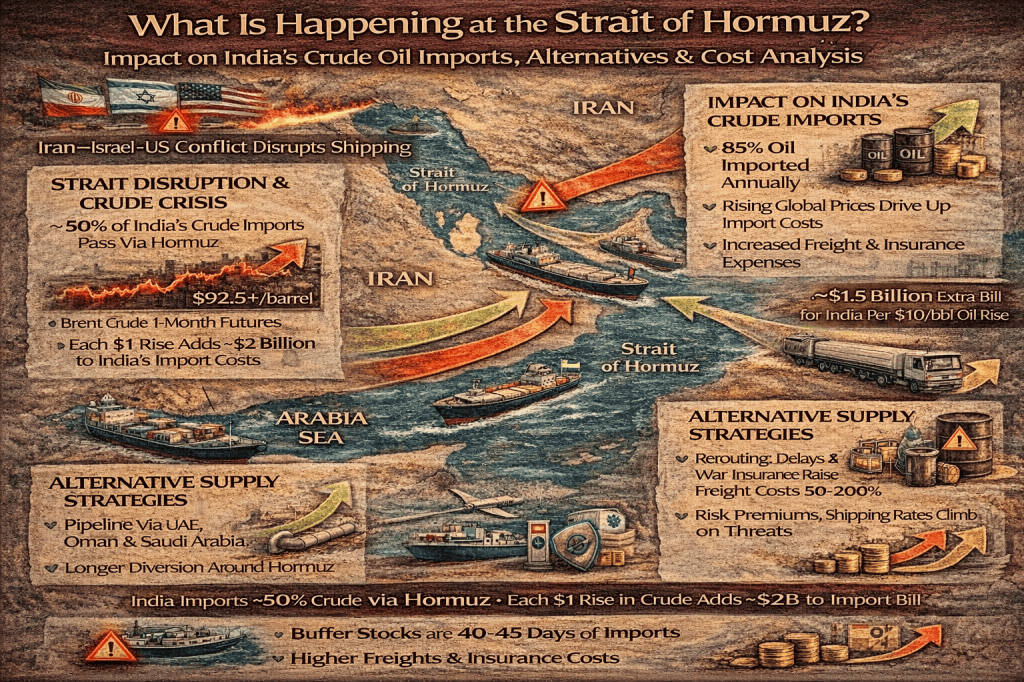
What Exactly Is Happening at the Strait of Hormuz?
The Strait of Hormuz is one of the world’s most critical oil transit routes. Nearly 20% of global oil consumption passes through this narrow maritime corridor connecting the Persian Gulf to the Arabian Sea.
Amid escalating tensions involving Iran, Israel, and the United States, the Strait has once again become a geopolitical flashpoint. Recent developments include:
- Threats of partial or full closure by Iran
- Seizure or harassment of commercial vessels
- Heightened US naval presence
- Surge in marine insurance premiums
- Sharp volatility in Brent crude prices
Even if the Strait is not formally closed, risk perception alone pushes oil prices higher, as traders price in potential supply disruption.
Why the Strait of Hormuz Matters So Much to India
India imports nearly 85% of its crude oil needs, and a large portion comes from Gulf nations like Iraq, Saudi Arabia, UAE, and Kuwait — all of which ship oil through Hormuz.
If disruptions occur:
- Crude prices spike globally
- Freight and insurance costs rise
- Rupee may weaken due to higher import bills
- Inflation risk increases
- Fiscal deficit pressure mounts
In short, Hormuz instability directly impacts:
- Indian stock markets
- Oil marketing companies (OMCs)
- Aviation and paint sectors
- FMCG margins
- Current account deficit
What Should Be India’s Strategy?
1️⃣ Diversify Import Sources
India has already reduced dependence on traditional Gulf suppliers and increased imports from:
- Russia
- United States
- West Africa
- Latin America
This strategy reduces geopolitical concentration risk.
2️⃣ Build Strategic Petroleum Reserves (SPR)
India maintains emergency crude reserves in underground facilities. These reserves can cover several days of consumption if supply is disrupted.
Expanding SPR capacity would provide stronger buffer protection.
3️⃣ Negotiate Long-Term Contracts
Instead of relying heavily on spot markets, India can:
- Lock in long-term supply contracts
- Use currency settlement mechanisms
- Explore rupee-based trade arrangements
This reduces volatility exposure.
4️⃣ Accelerate Energy Transition
Long-term solution:
- Expand renewables
- Push EV adoption
- Increase ethanol blending
- Invest in domestic exploration
Reduced oil intensity = reduced Hormuz risk.
Are There Alternatives to Hormuz-Based Oil?
Yes — but they come at a cost.
🚢 1. Russian Oil (via alternate shipping routes)
- Shipped through longer maritime paths
- May face sanctions risk
- Sometimes discounted, but logistics cost higher
Net impact: Often still cheaper than Middle East crude during crisis periods.
🚢 2. US Shale Oil
- Longer shipping time (Atlantic route)
- Higher freight cost
- Usually priced closer to Brent benchmark
Net impact: 2–5% costlier landed price compared to Gulf supplies during stable periods.
🚢 3. West African Crude
- Nigeria, Angola sources
- Compatible with Indian refineries
- Higher freight but politically diversified
Net impact: Slightly more expensive but safer geographically.
🚢 4. Overland Pipelines (Limited Option)
Pipelines bypass Hormuz but India has no direct pipeline access from major oil exporters. So this option is limited unless regional geopolitics changes.
How Expensive Are Alternatives?
If Hormuz risk premium rises sharply:
- Oil may spike $5–15 per barrel
- Insurance premiums increase 30–50%
- Freight rates surge significantly
For India:
Every $10 rise in crude increases annual import bill by billions of dollars and pressures inflation.
Alternative sourcing could increase landed cost by:
- ₹2–5 per litre (depending on severity and duration)
But this is still better than a supply shock.
What Happens If the Strait Actually Closes?
A complete closure would be extreme and unlikely for long duration because:
- Global powers would intervene
- Oil-exporting Gulf nations would suffer revenue collapse
- Iran itself depends on oil exports
Markets would likely:
- See Brent spike above $100–120
- Gold surge
- Indian markets correct sharply
- Rupee weaken
However, historically, such chokepoint crises are short-lived.
Investment Implications for Indian Markets
If tensions escalate:
✔ Oil & Gas upstream companies may benefit
✔ Defence stocks could gain
✔ Gold may outperform
✔ Aviation & paint stocks may face margin pressure
✔ FMCG may pass on costs gradually
Long-term investors should focus on:
- Asset allocation discipline
- Avoid panic decisions
- Use corrections for staggered buying
Final Thoughts
The Strait of Hormuz is not just a geopolitical headline — it is an economic nerve center for India.
Short-term volatility is inevitable during Middle East tensions. But India today is better prepared than a decade ago due to:
- Diversified sourcing
- Discounted Russian oil
- Strategic reserves
- Stronger forex reserves
The real risk lies not in temporary disruption, but in prolonged geopolitical escalation.
Disclaimer
This article is for informational and educational purposes only. It does not constitute investment advice, trading recommendation, or policy endorsement. Oil prices, geopolitical situations, and market conditions are highly dynamic and subject to rapid change. Investors should consult a qualified financial advisor before making any investment decisions.


Leave a Reply